There was a time when HR services meant one thing: getting the administrative work off your desk.
Payroll had to run. Contracts had to be prepared. Employee records had to be maintained. Vacancies had to be filled. Outsourcing was largely about finding someone who could execute these tasks faster, cheaper, or with fewer headaches.
That model has not disappeared. But it is no longer the whole story.
Today, companies are asking external HR partners to contribute to recruitment strategy, workforce planning, analytics, compliance, talent mapping, and even broader HR transformation.
In other words, HR is being asked to do much more than administer the workforce. It must help the business anticipate which skills it will need, where to find them, and how to develop them.

And that raises a more interesting question than simply “What can we outsource?”
What should your internal HR team actually be spending its time on?
Article at a glance
| Key takeaway | |
|---|---|
| Challenge | HR teams are expected to contribute strategically while still carrying substantial administrative and operational workloads. |
| Modern HR services | They now extend beyond payroll and administration to recruitment, analytics, compliance expertise and workforce planning. |
| Key shift | Outsourcing is evolving from task delegation into access to capacity, specialist expertise and strategic capabilities. |
| Main benefit | External support can free internal HR teams to spend more time on workforce strategy, people and business priorities. |
| Best approach | Decide function by function what HR should own, co-manage or outsource rather than choosing an all-in-house or all-outsourced model. |
| Critical safeguard | Execution can be externalized; accountability for culture, people strategy and sensitive workforce decisions should remain internal. |
WHAT DO HR SERVICES INCLUDE TODAY?
The definition of HR services has expanded considerably.
The shift reflects a much broader transformation in what businesses need from their people functions. According to the World Economic Forum’s Future of Jobs Report 2025, employers expect 39% of workers’ core skills to change by 2030. Talent management, leadership, technological literacy, and analytical thinking are all among the capabilities gaining importance.
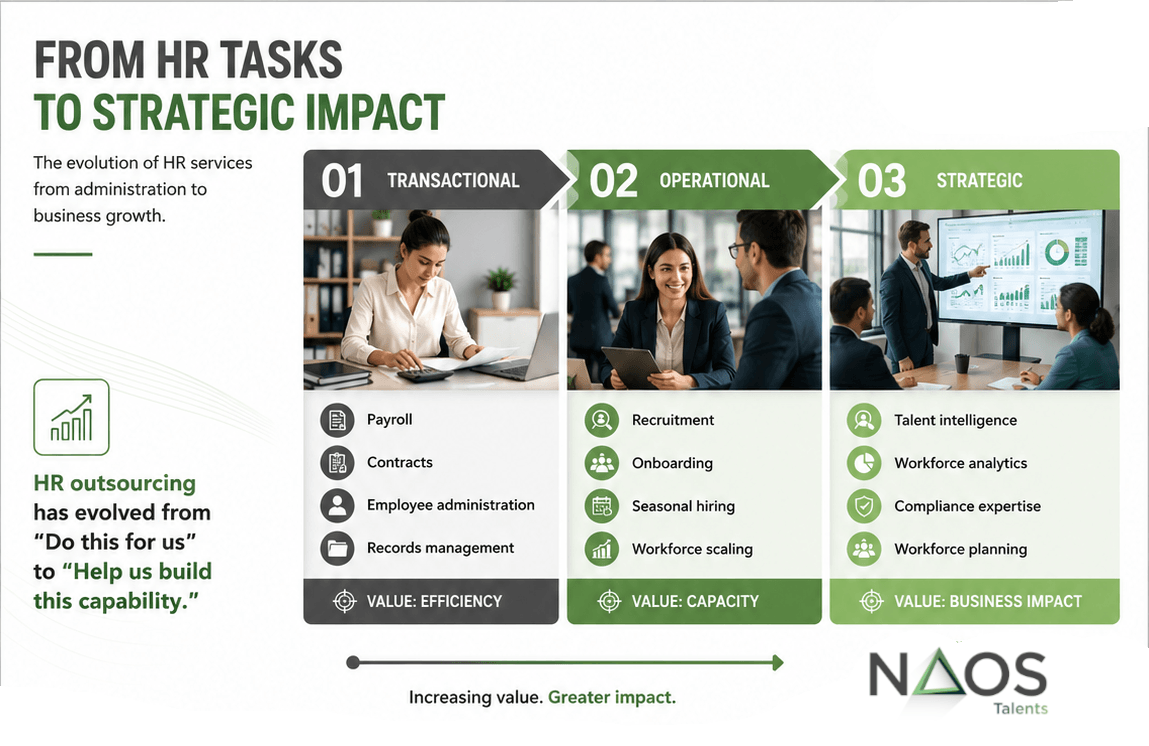
At one end of the spectrum are transactional activities: payroll, employee administration, documentation and routine HR operations. At the other end are services requiring specialist expertise, data, and business insight.
A useful way to see the change is through three levels:
| HR service level | Examples | Main objective |
| Transactional | Payroll, contracts, employee administration | Efficiency |
| Operational | Recruitment, onboarding, workforce scaling | Capacity |
| Strategic | Talent strategy, analytics, workforce planning | Business impact |
This evolution also changes how companies think about outsourcing.
The choice is no longer simply between an in-house HR department and an outsourced HR department.
A growing company might keep employee relations and people strategy firmly in-house, use an external recruitment team during periods of rapid expansion, outsource payroll permanently, and call on specialist expertise when regulations or workforce requirements change. The right model may even combine several approaches: as we explain in our guide to insourcing vs. outsourcing HR in Egypt, control and externalization need not be mutually exclusive.
Think less either/or.
Think HR ecosystem.
This blended model is already well established in modern HR operating structures. The CIPD describes HR shared services as typically centralizing administrative activities, while strategic business partners and specialist centers of expertise focus on higher-value needs.
In other words, separating HR service delivery from strategic HR ownership is not about diminishing HR’s role. Done well, it creates more room for HR professionals to concentrate on the work where their expertise matters most.
PHASE 1: OUTSOURCING THE WORK NOBODY MISSES
The first wave of outsourcing was hardly glamorous.
Nobody woke up on Monday morning excited about transferring employee information between systems or checking whether another payroll file had been processed correctly.
Yet these activities are indispensable.
Payroll must be accurate. Employee records must be maintained. Contracts and administrative processes must comply with applicable legislation. Mistakes can quickly create unhappy employees, management headaches, or legal exposure.
That is exactly why they became natural candidates for outsourcing.
Payroll and HR Administration
Transactional HR services tend to have three important characteristics: they are repetitive, process-heavy, and dependent on accuracy.
That makes specialization valuable.
An external provider that handles payroll or HR administration across multiple organizations can combine standardized processes, dedicated expertise, and technology that would be difficult for any single company to replicate internally.

Deloitte describes HR transformation as having historically focused on reducing costs and improving operational effectiveness through better processes, employee self-service, shared services, and outsourcing.
But there is an important distinction to make. Mission-critical does not necessarily mean strategically differentiating.
Payroll is mission-critical. A company that fails to pay its employees correctly has a serious problem.
But does processing payroll internally give that company a competitive advantage?
Often, it does not. In fact, as we explore in our analysis of the advantages of payroll outsourcing, externalizing execution does not necessarily mean giving up control: HR can move from processing payroll to governing its accuracy, compliance, and performance.
And that distinction created the first major opening for outsourced HR services.
PHASE 2: OUTSOURCING HR CAPACITY
Then the problem changed. Companies were no longer only asking: “Who can process this work for us?”
They started asking: “How can we handle more work without permanently building a bigger HR department?”
Recruitment made the transition particularly visible.
Recruitment Was the Obvious Next Step
Hiring needs rarely arrive in a convenient, predictable flow.
These fluctuations are particularly visible during periods such as Ramadan, Black Friday, or major business expansions. Our guide to hiring seasonal employees with a recruitment agency looks more closely at how companies can forecast those peaks and build flexible recruitment capacity around them.

Building a permanent internal recruitment team around peak demand can leave a business carrying fixed costs it does not always need.
Building the team around normal demand creates the opposite problem: HR becomes overloaded exactly when the business most needs it to move quickly.
External talent acquisition services introduce another option.
Companies can add sourcing, screening, recruitment coordination or complete recruitment capacity when demand rises, without necessarily adding equivalent permanent HR headcount.
This is particularly relevant to fast-growing and seasonal businesses in Egypt and across the MENA region, where workforce requirements can change significantly during expansion cycles or major commercial periods.
As we explored in our article on human resources outsourcing in Egypt and the MENA region, flexibility is therefore becoming as important as simple cost reduction.
From Saving Time to Gaining Scalability
This marks a fundamental change in the purpose of outsourced HR services.
Traditional administrative outsourcing asks: How can this process be performed more efficiently?
Capacity outsourcing asks: How can we increase HR capability when the business needs it without permanently increasing our structure?
That second question is much closer to business strategy. And that is where HR outsourcing gets more interesting.
PHASE 3: HR SERVICES BECOME STRATEGIC
The next stage goes further still.
Companies are increasingly looking outside their organization not merely for additional hands, but for capabilities they do not have—or do not need to maintain permanently—in-house.
Deloitte describes this emerging model as “boundaryless HR”: work is directed to the place where it makes the most sense rather than automatically staying within traditional departmental boundaries. External providers, technology, and internal HR teams become parts of the same operating ecosystem.
That can transform the role of several HR services.
Talent Acquisition Becomes Talent Intelligence
There is a big difference between asking a recruitment provider to “send us CVs” and asking for insight into the talent market.
Strategic talent acquisition can involve understanding where specific skills are available, mapping competitors, improving candidate experience, identifying bottlenecks in the recruitment funnel, and measuring which sourcing channels actually produce successful hires.
The provider is no longer simply supplying candidates. It is supplying knowledge and capability. t is supplying knowledge and capability. This is why the relationship with a recruitment agency can evolve from transactional candidate sourcing into a strategic talent acquisition partnership, with both sides working toward shared recruitment and business objectives.
Workforce Analytics Improves Decisions
HR departments generate enormous amounts of information.
Time-to-hire. Turnover. Absenteeism. Compensation. Recruitment conversion rates. Headcount evolution. Cost per hire.
Collecting those numbers is useful.
Understanding what to do because of them is considerably more valuable.
And there is still considerable room for improvement. Mercer’s 2025 HR Operating Model & Practices research found that 67% of organizations say their HR KPIs are only “somewhat” aligned with broader business priorities.
That gap explains why HR analytics cannot stop at dashboards. The real opportunity is to connect workforce data with the decisions the business is trying to make: where to hire, which capabilities to develop, where turnover creates risk, and how workforce investments contribute to growth.
Compliance Becomes Expertise on Demand
Compliance is another good example.
A company can maintain its own knowledge of every labor regulation, administrative requirement, and regulatory change affecting its workforce.
But that expertise needs to remain current.
For Egyptian employers, the introduction of Labor Law No. 14 of 2025 illustrates the challenge particularly well. The law was published in May 2025, began to be implemented later that year, and has since been accompanied by ministerial decisions covering areas such as employment contracts and working arrangements.
In that environment, external expertise can provide something more valuable than administrative support.
It can help HR understand the operational consequences of regulatory change.
Workforce Planning Looks Beyond Vacancies
Recruitment fills a vacancy, while workforce planning asks why that vacancy exists in the first place.
Which capabilities will the business need next year? Which roles should be permanent? Which needs are temporary? Which skills are becoming difficult to recruit? Where could external capacity provide more flexibility?
These are strategic questions. And answering them increasingly requires HR, finance, operations, and external expertise to work together rather than in separate boxes.
OWN THE STRATEGY AND ACCESS THE EXPERTISE
This brings us to perhaps the biggest misconception about HR outsourcing.
Companies do not need to outsource an entire function to benefit from external HR services.
The better question is:
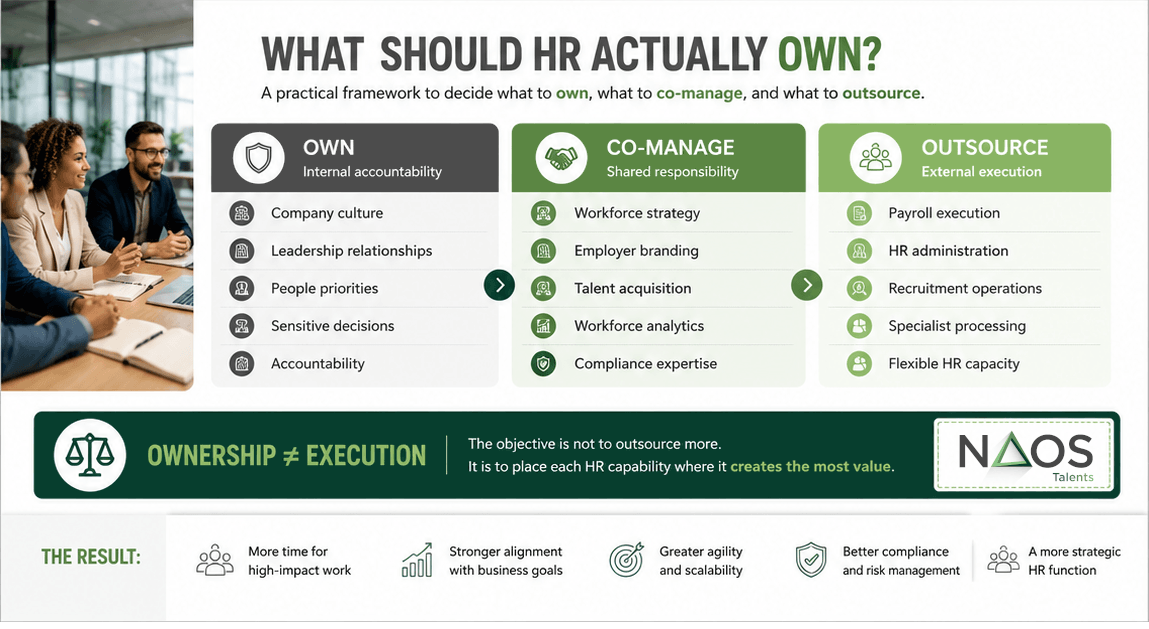
Which capabilities must we own, which should we share and which can someone else execute better?
| HR function | Own | Co-manage | Outsource |
| Company culture | ✓ | ||
| Workforce strategy | ✓ | ✓ | |
| Employer branding | ✓ | ✓ | |
| Talent acquisition | ✓ | ✓ | |
| Recruitment operations | ✓ | ||
| Payroll | ✓ | ||
| HR administration | ✓ | ||
| Workforce analytics | ✓ | ✓ | |
| Compliance expertise | ✓ | ✓ |
This is not a universal template. A multinational with several thousand employees may make very different choices from a rapidly growing Egyptian company opening its third location.
What matters is the principle behind the table. Ownership and execution are not the same thing.
An HR director can remain accountable for recruitment strategy without personally operating every recruitment process.
The company can own its workforce strategy while using external specialists to provide the market data, recruitment capacity, or analytics that support it.
That is where outsourcing begins to look less like delegation and more like an operating model.

WHAT IS YOUR HR TEAM WORTH DOING?
Imagine your HR team has 100 hours available this week.
How would you want those hours spent?
Sixty hours processing administration, twenty-five coordinating recruitment, ten preparing reports, and five discussing workforce strategy?
Or fifteen hours overseeing operations and the remaining time working on talent strategy, employee experience, workforce planning, and supporting managers?
Obviously, real HR departments are more complicated than a 100-hour thought experiment.
But the question matters.
Which version of that HR department creates more value for the business?
The objective is not to make administration disappear. Someone still has to do it.
The strategic decision is whether administrative work deserves the same proportion of your internal team’s capacity that it receives today.
That question is becoming more urgent as expectations increase.
McKinsey’s 2025 HR Monitor found a widening gap between what organizations need from efficient, effective HR functions and what many currently deliver. It also found that technologies such as generative AI had still only been deployed at scale in a relatively small number of HR departments.
Technology will automate some work. External providers will perform other work.
The challenge for HR leaders is deciding where their own people create the most value.

WHEN DO EXTERNAL HR SERVICES MAKE SENSE?
There is no magic headcount at which outsourcing suddenly becomes strategic.
A better starting point is to diagnose the pressure on your HR operating model.
Ask yourself:
- Is HR workload growing faster than our internal capacity? If business growth repeatedly creates HR bottlenecks, the problem may be structural rather than temporary.
- Are specialists spending too much time on standardized work? Expensive expertise should not be trapped in processes that can be handled more efficiently elsewhere.
- Does demand fluctuate significantly? Recruitment peaks and temporary projects often favor flexible capacity over permanent headcount.
- Are we missing specialist expertise? Compliance, talent mapping, analytics or specialist recruitment may require capabilities that are difficult to justify as permanent roles.
- Would another permanent HR hire solve the problem? Sometimes the answer is yes. Sometimes it simply adds another fixed cost while leaving the underlying operating model unchanged.
The goal is not to outsource as much as possible.
It is to determine where each piece of HR work can be performed most effectively.
WHAT HR SHOULD NEVER OUTSOURCE COMPLETELY
If external HR services can now support strategic activities, does that mean everything is outsourceable?
No.
Some responsibilities remain fundamentally tied to the employer.
Culture can be supported by consultants, recruiters, and employee-experience specialists. But an external provider cannot decide what your organization stands for.
People strategy can benefit from outside expertise and market intelligence. Accountability for that strategy still belongs inside the company.
Sensitive workforce decisions may involve external legal, compliance, or HR advice. Management remains responsible for the decisions it makes.
And relationships with employees and leadership cannot simply be handed to a provider.
This is the boundary that matters most:
Strategic outsourcing does not mean outsourcing responsibility.
The strongest HR operating models are therefore unlikely to be those that externalize everything.
They will be those who know exactly what not to externalize.

THE FUTURE OF HR SERVICES IS MODULAR
The traditional debate was simple: In-house or outsourced?
The emerging model is much more fluid.
An internal HR team can own culture, employee relationships and workforce strategy while drawing on recruitment specialists, payroll providers, HR technology, analytics expertise and temporary HR capacity.
Those components can expand or contract as the organization changes.
Deloitte’s 2025 Global Business Services research describes a similar evolution beyond traditional shared-service models, with organizations increasingly focusing not only on lower-cost capacity but also on digital capability, specialized talent, employee experience and transformation.
That suggests the HR department of the future may look less like a traditional department and more like an ecosystem of capabilities.
And for fast-growing companies, that can be a significant advantage.
Instead of trying to permanently own every skill their HR department might someday require, they can decide which capabilities are core and access the others as needed.
That is a very different definition of HR outsourcing. It is also much more strategic.
CONCLUSION: STOP ASKING “WHAT CAN WE OUTSOURCE?”
For years, the outsourcing conversation started with a list of tasks.
Payroll? Yes.
Recruitment? Maybe.
Administration? Probably.
But modern HR services deserve a different starting point.
What should our internal HR team be spending its time on specifically?
Once that question is answered, decisions about outsourcing become much clearer.
Some work belongs internally because it defines the organization. Some require shared ownership. And some can be delivered more effectively through external expertise, technology, or flexible HR capacity.
The HR services revolution is therefore not about outsourcing more.
It is about building an HR function that focuses its energy where it can create the greatest value.
Which HR activities are consuming your team’s time today without truly requiring your team’s expertise?
If you are reviewing how recruitment, payroll, off-payroll, or flexible HR resources fit into your future HR model, contact the NAOS Talents team to discuss where external support could make the biggest difference.
FAQ
What are HR services?
HR services are the activities and expertise used to manage an organization’s workforce, from payroll, contracts and administration to recruitment, workforce planning, analytics and compliance. They may be delivered internally, through shared services, by external specialists, or through a blended model depending on the company’s needs.
Which HR services can be outsourced?
Companies can outsource transactional and specialist HR services such as payroll, employee administration, recruitment, sourcing, screening, onboarding support, compliance advice and selected analytics. Strategic ownership does not have to move with execution: an internal HR team can remain accountable for outcomes while an external provider supplies capacity or specialist expertise.
What are the benefits of outsourcing HR services?
Outsourcing HR services can add specialist expertise, increase capacity during hiring or seasonal peaks, reduce pressure on internal teams and make some HR costs more flexible. The strongest benefit is not simply saving time: it is allowing internal HR professionals to focus more consistently on workforce strategy, employees and business priorities.
When should a company outsource HR services?
Outsourcing becomes worth considering when HR workload grows faster than internal capacity, demand fluctuates, specialist expertise is missing, or experienced HR staff spend too much time on standardized work. The decision should be made function by function, based on business value, risk, required control and the economics of building capability in-house.
What HR services should remain in-house?
Companies should retain clear ownership of culture, people strategy, leadership relationships and sensitive workforce decisions. External specialists can support these areas with data, advice or execution, but accountability remains with the employer. A strong HR operating model distinguishes between what the organization must own and what others can help deliver.