Customer service outsourcing should help you scale support—not force you to choose between operational efficiency and a customer experience you can trust.
This guide gives a practical framework for evaluating the right delivery model. It covers North American customer expectations, multilingual support, quality management, data protection, pricing, and implementation.

By the end, you will know whether outsourcing fits your goals and how to build a scalable customer service operation without losing control of your brand, performance, or customer relationships.
Article at a glance
| Key point | What to know |
|---|---|
| Main challenge | Scaling customer service across channels, languages, and time zones without losing quality, control, or brand consistency. |
| Definition | Customer service outsourcing means assigning defined customer-facing or back-office workflows to an external team that operates under agreed-upon service levels, processes, security controls, and reporting rules. |
| Key benefits | Broader coverage, flexible capacity, access to multilingual talent, reduced recruitment pressure, and more predictable operating costs. |
| Best-fit models | Dedicated teams suit complex or stable operations; shared teams suit lower or variable volumes; and hybrid models combine internal control with outsourced scalability. |
| North American priorities | English, US Spanish, and Canadian French support, multi-time-zone coverage, natural communication, fast resolution, and compliance with applicable US and Canadian privacy requirements. |
| Best practices | Define agent authority, access rights, escalation rules, training standards, quality scorecards, business continuity plans, and regular governance reviews before launch. |
| KPIs to track | Service level, response time, first-contact resolution, backlog, quality score, CSAT, repeat contacts, escalation rate, and contact reasons. |
| NAOS CX approach | Flexible multilingual teams, structured recruitment and training, client-approved technology, documented quality controls, and transparent reporting tailored to each program. |
WHAT IS CUSTOMER SERVICE OUTSOURCING?
Customer service outsourcing means assigning defined customer-facing or back-office activities to an external team that operates under agreed-upon processes, service levels, quality standards, and reporting rules.
The scope may include phone, email, chat, order support, billing inquiries, complaints, technical assistance, retention, and administrative workflows.
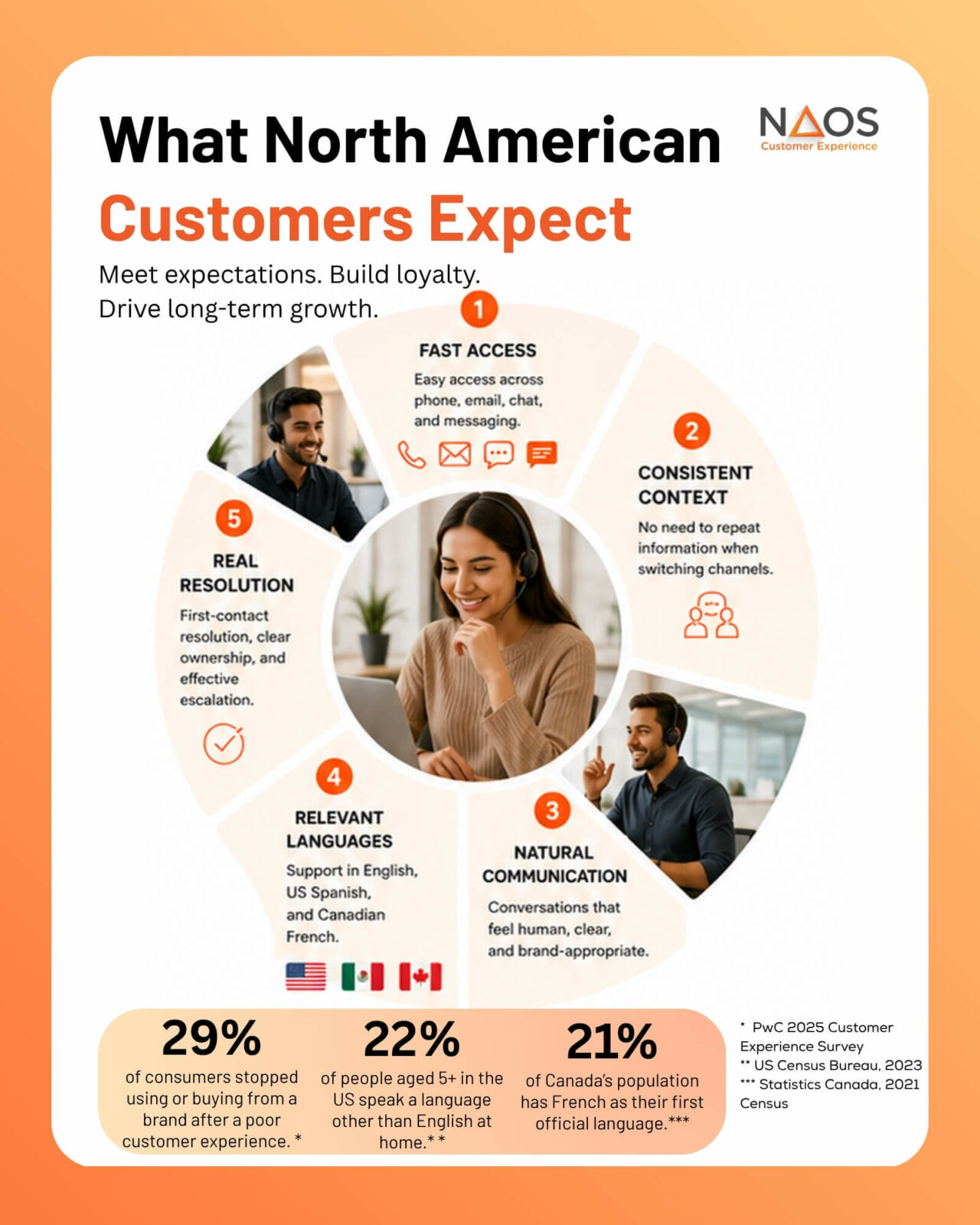
According to PwC’s 2025 Customer Experience Survey, 29% of consumers stopped using or buying from a brand because of poor customer experience. Outsourcing must therefore protect service quality, not simply reduce operating costs.

Customer Service vs Customer Support Outsourcing
Customer service covers the broader customer relationship, including inquiries, complaints, orders, refunds, billing, and retention.
The terms customer service and customer support are often used interchangeably, but there is a useful distinction between them. Customer support generally focuses on helping customers use, configure, or troubleshoot a product, while customer service agents typically have access to a wider range of tools and processes, such as billing systems, order management, refunds, and account administration.
Technical support is a more specialized subset of customer support. It deals with diagnosing and resolving product or system issues that require deeper technical knowledge, structured troubleshooting, or escalation to engineering and product teams.
Many outsourced operations combine customer service, customer support, and selected technical support functions under one governance model.
Organizations evaluating this model can start with a broader overview of the advantages of customer experience outsourcing, which explores the strategic benefits beyond cost reduction.
WHY US AND CANADIAN BRANDS OUTSOURCE CUSTOMER SERVICE
Outsourcing becomes relevant when recruitment, coverage, fluctuating demand, or operational complexity begins to affect the customer experience.
The decision should follow a full assessment of cost, control, risk, and scalability. Our guide to in-house vs outsourced contact center provides a detailed decision framework.
High Recruitment and Employment Costs
The US Bureau of Labor Statistics reported a median hourly wage of $20.59 for customer service representatives in its August 2025 Occupational Outlook update.
Wages are only part of the cost. BLS compensation data published in June 2026 show that benefits accounted for 29.9% of private-industry employers’ compensation costs in December 2025.
Recruitment, training, supervision, technology, facilities, and workforce planning must also be included when comparing operating models.
Staffing and Retaining Experienced Agents
A reliable operation needs enough trained agents to cover turnover, absences, coaching, and unexpected demand without weakening service levels.
An outsourcing partner assumes part of this workforce-planning responsibility. The client should still approve required skills, staffing assumptions, training standards, and performance targets.
Supporting Customers Across Multiple Time Zones
US and Canadian customers may require coverage across Eastern, Central, Mountain, Pacific, Atlantic, and Newfoundland time zones.
An offshore or distributed operation can extend opening hours without requiring every internal manager and specialist to work evenings, weekends, or holidays.
Managing Seasonal and Unexpected Volume Peaks
Black Friday, holiday sales, product launches, delivery incidents, recalls, and subscription renewals can quickly increase contact volumes.
An outsourced model establishes a defined process for forecasting, cross-training, temporary expansion, and controlled ramp-down, rather than relying on emergency recruitment. Brands that experience predictable peaks can also benefit from planning strategies outlined in our guide to customer service for seasonal businesses, which explains how to maintain service quality during high-demand periods.

Expanding Without Rebuilding Customer Operations
Entering Canada, targeting new US customer segments, or adding another language can require new schedules, skills, workflows, and escalation paths.
A scalable operating model allows brands to add capacity while retaining a single knowledge base, a single quality framework, and a single view of performance. Brands that need additional after-hours coverage or peak-period support can also use an overflow support model to maintain service levels without permanently increasing headcount.
WHAT NORTH AMERICAN CUSTOMERS EXPECT FROM CUSTOMER SERVICE
Customers do not distinguish between an internal employee and an outsourced agent. They judge the quality of the interaction and the outcome.
The operating model must therefore feel seamless from the customer’s perspective.
Fast, Convenient Omnichannel Support
Customers expect to use the channel that best fits their situation and to avoid repeating information when moving between chat, email, and phone.
This requires shared customer context, clear case ownership, and routing rules—not simply a longer list of channels.

Natural, Brand-Appropriate Communication
Scripts should ensure accuracy without making conversations sound mechanical.
Training must cover terminology, tone, empathy, cultural references, prohibited wording, and the level of discretion agents have when resolving complaints. Brands that want to maintain a consistent customer experience across internal and outsourced teams should also establish clear voice guidelines and coaching standards.
Our guide on creating a strong customer service provider brand tone of voice explains how to align agent communication with brand expectations while preserving authenticity and customer trust.
English, Spanish and French-Language Support
The US Census Bureau reported in 2025 that 22% of people aged five and older spoke a language other than English at home.
In Canada, Statistics Canada’s language indicators, updated in 2026, show that French is the first official language spoken by 21.4% of the population, while 18% can communicate in both English and French.
For many North American brands, this makes English, US Spanish, and Canadian French the priority languages before broader multilingual expansion.
Resolution, Not Just Fast Responses
A quick answer that does not solve the problem leads to repeat contacts, increased customer effort, and additional operating costs.
Support leaders should balance response time with first-contact resolution, quality, repeat-contact rates, escalations, and customer satisfaction.
WHAT CAN YOU OUTSOURCE TO NAOS CX?
The scope can begin with a single channel or process and expand once quality, access, and escalation controls have been validated.
General Customer Care
General customer care can include product questions, account assistance, complaints, appointments, billing inquiries, policy explanations, and service updates.
Authority levels should specify what agents can resolve directly and what requires client approval.
Authority levels should specify what agents can resolve directly and what requires client approval. Brands evaluating broader customer contact operations can also explore our guide on hiring a call center to elevate customer service, which outlines key considerations for selecting and managing an outsourced customer service team.
Ecommerce and Order Support
Ecommerce workflows may include pre-sale assistance, order status updates, delivery issues, returns, exchanges, refunds, subscription changes, and cart recovery.
Brands with a larger ecommerce operation can learn how a proactive service strategy can reduce chargebacks through customer service by resolving issues before they escalate into disputes.

Technical Customer Support
Technical programs can cover L1 troubleshooting, ticket classification, guided diagnostics, account access, product education, and escalation to internal specialists.
Because these roles often require a combination of customer service skills, technical aptitude, product knowledge, and the ability to follow structured troubleshooting processes, recruitment is typically more specialized and may involve technical assessments, scenario-based evaluations, and longer onboarding periods to ensure agents can effectively support users.
Customer Retention and Revenue Support
Retention activities may include cancellation prevention, subscription saves, renewal support, win-back campaigns, cross-selling, and satisfaction follow-up.
Targets and incentives must protect customer trust rather than reward inappropriate sales pressure.
Back-Office Customer Operations
Back-office support can include CRM updates, order modifications, refund administration, ticket tagging, document verification, review moderation, and case preparation.
Many back-office functions are also considered non-voice operations because they are completed behind the scenes without direct phone interaction with customers. Depending on the workflow, brands may combine back-office processing with email, chat, messaging, or other digital support channels to improve efficiency and customer experience.
Our guide to voice vs. non-voice customer service explains the differences between these models and when each approach is most effective.
CHANNELS AND TECHNOLOGY WE WORK WITH
Technology should support the customer journey and operating model rather than determine them. As customer expectations continue to evolve, brands should also evaluate how emerging technologies, workforce trends, and service models may affect future support requirements.
Our article on how customer service companies are preparing for 2026 explores the operational and technology trends shaping the next generation of customer experience.

Customer Service Channels
Programs may cover voice, email, live chat, social messaging, WhatsApp, and SMS where relevant.
Channel selection should reflect customer behavior, urgency, complexity, consent requirements, and the cost of resolving each interaction.
CRM and Help-Desk Platforms
Teams can work in client-approved environments such as Zendesk, Salesforce, HubSpot, Gorgias, Freshdesk, Intercom, Shopify, and connected order-management platforms.
Access should follow the principle of least privilege, with separate permissions for agents, supervisors, quality analysts, and administrators.
AI-Augmented Agent Workflows
AI can assist with knowledge retrieval, response suggestions, call summaries, ticket classification, translation, and quality analysis.
It should augment rather than remove human accountability. A 2025 Gartner poll found that 95% of service leaders planned to retain human agents to help define AI’s role.
CHOOSE THE RIGHT CUSTOMER SERVICE OUTSOURCING MODEL
The right structure depends on volume, complexity, operating hours, required control, and the value of maintaining dedicated expertise.
Dedicated Customer Service Teams
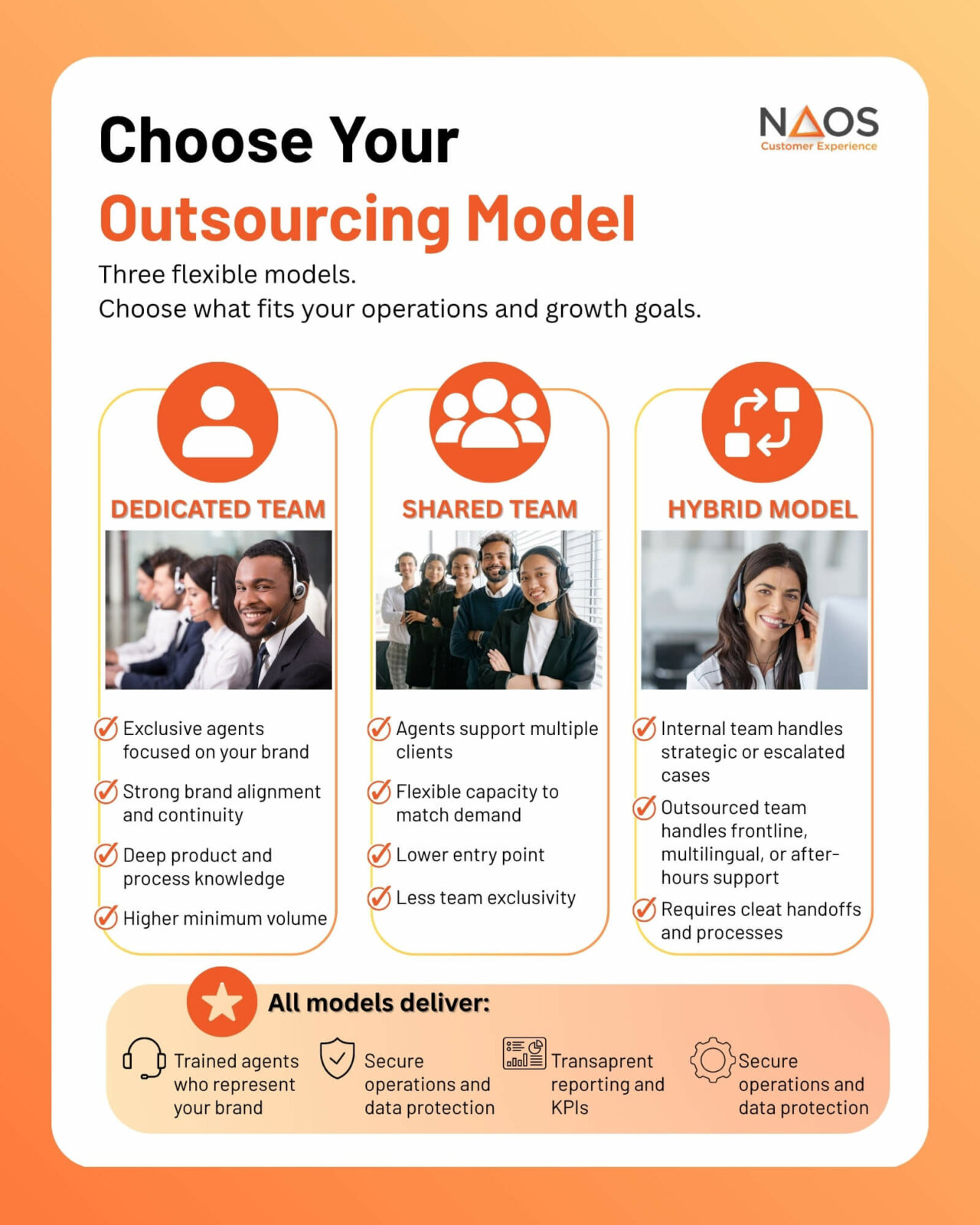
A dedicated team works exclusively for one client.
This model is suited to complex products, consistent volumes, strict brand requirements, or regulated workflows, but usually requires a higher minimum commitment.
Shared Customer Service Teams
A shared team supports several compatible programs.
It can suit lower volumes, straightforward inquiries, overflow, or extended-hours coverage, provided knowledge and scheduling are carefully managed.
Hybrid Customer Service Operations
A hybrid model retains selected activities internally while outsourcing frontline, multilingual, after-hours, or peak-period support.
For organizations that want to reduce risk and maintain operational control during the transition, a phased approach can be particularly effective. Our guide to gradual customer service outsourcing explains how brands can start with limited functions, validate performance, and expand scope over time.
It works best when both teams follow the same knowledge, escalation, reporting, and quality standards.
| Model | Best suited to | Main advantage | Main consideration |
|---|---|---|---|
| Dedicated | Complex or stable operations | Control and continuity | Higher minimum volume |
| Shared | Lower or variable demand | Flexibility | Less team exclusivity |
| Hybrid | Brands retaining an internal CX team | Control and scalability | Requires disciplined handoffs |
HOW NAOS PROTECTS YOUR BRAND, CUSTOMERS AND DATA
Security and privacy controls must reflect the client’s industry, systems, data, and customer locations.
NAOS follows documented data protection and information security practices designed to support client requirements and regulatory obligations. Where relevant, program controls can be aligned with recognized information security frameworks and client-specific security requirements.

Data Privacy and Access Controls
The California Privacy Protection Agency’s 2025 regulations, effective from January 1, 2026, introduced additional requirements concerning risk assessments, cybersecurity audits, and automated decision-making technologies.
For Canadian commercial data, the Office of the Privacy Commissioner’s PIPEDA guidance updated in 2025 emphasizes accountability, consent, safeguards, and breach obligations.
Contracts should define access rights, retention periods, subprocessors, recordings, security incidents, and each party’s responsibilities.
Payment and Sensitive Data Handling
Payment workflows should minimize agent exposure to card details and use client-approved payment environments.
Where payment data is in scope, the program should follow applicable PCI DSS requirements. The PCI Security Standards Council issued additional payment-page security guidance in 2025.
Brand Voice and Knowledge Management
Approved answers, policy changes, exception rules, and escalation paths should have named owners and revision dates.
Regular calibration ensures that internal and outsourced teams interpret customer policies consistently.
Business Continuity
A continuity plan should define backup connectivity, staffing contingencies, priority queues, communication procedures, and decision rights during an incident.
The plan should be tested and reviewed after major operational or technology changes.
HOW NAOS MANAGES QUALITY AND PERFORMANCE
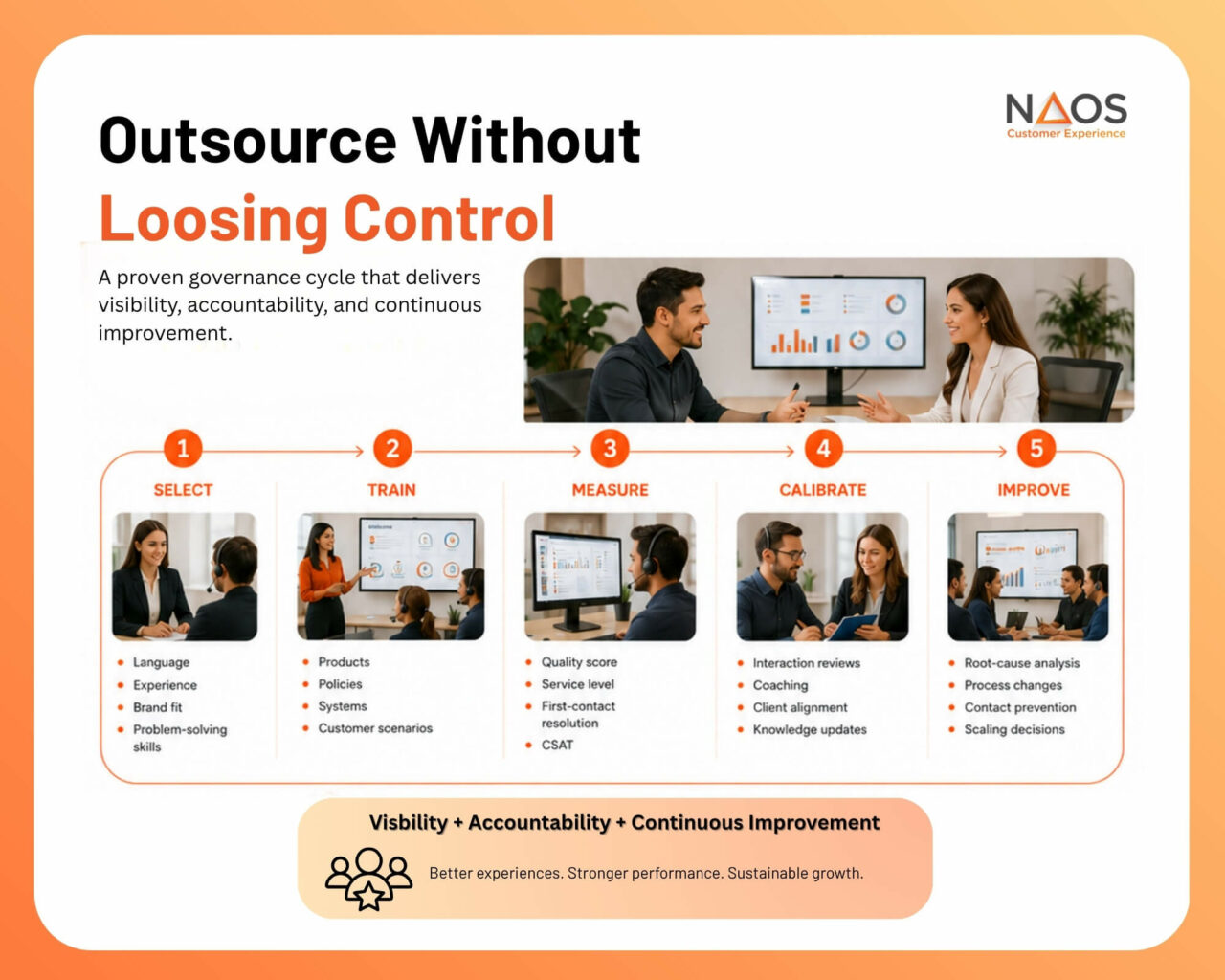
Governance should make the outsourced operation visible, measurable, and correctable.
Recruitment and Agent Selection
Agent profiles should reflect language, written communication, problem-solving, product complexity, channel, schedule, and customer sensitivity.
Selection criteria are agreed before recruitment rather than adapted to whichever candidates are available.
Training and Certification
Training covers the brand, products, policies, systems, customer scenarios, privacy rules, and escalation procedures.
Agents complete knowledge checks and simulated interactions before handling live customers.
Quality Assurance
Quality programs combine interaction reviews, documented scorecards, coaching, and regular calibration with the client.
Evaluation should measure accuracy, resolution, communication, compliance, and customer treatment—not only script adherence.
Reporting and Governance
Reporting can combine service level, response time, backlog, first-contact resolution, quality, CSAT, escalation rate, and contact reasons.
The objective is to support decisions and identify product, process, or policy changes that could prevent avoidable contacts.

Escalations and Continuous Improvement
High-risk complaints, legal threats, vulnerable customers, refund exceptions, and public incidents require predefined escalation routes.
Recurring issues should feed a joint improvement process involving operations and the relevant client departments.
INDUSTRIES WE SERVE ACROSS THE US AND CANADA
Each industry requires different skills, access levels, performance measures, and escalation structures.
Ecommerce and DTC
Common workflows include order tracking, returns, refunds, subscription changes, product advice, seasonal support, cart recovery, and chargeback prevention.
The team needs controlled access to the storefront, CRM, order information, logistics data, and approved refund policies. Brands can explore our ecommerce customer service solutions to see how specialized support teams handle order inquiries, returns, and customer retention.
SaaS and Technology
SaaS programs usually require technical triage, account context, product knowledge, and structured escalation.
The model should clearly distinguish between customer care, L1 support, specialist support, and service incidents. Our SaaS customer support outsourcing guide explains how the technical scope, tools, and escalation processes differ from those in general customer care.
Healthcare and Patient Support
Healthcare workflows may include appointment scheduling, general inquiries, follow-up, billing administration, and non-clinical coordination. Identity verification, recordings, access controls, and health-data obligations must be validated before launch.
Organizations that support patients should also distinguish between general customer service and patient-focused interactions, as the requirements for communication, privacy, and care coordination can differ significantly. For a deeper comparison, see our article that analyses how the CS approach differs between patient support vs customer service.
Financial Services and Fintech
Programs may include onboarding assistance, account inquiries, transaction questions, document follow-up, and controlled escalation.
Authentication, sensitive-data handling, fraud indicators, and prohibited actions require detailed procedures. Financial institutions also face heightened expectations around compliance, security, and customer trust, making structured support processes essential.
For a deeper look at sector-specific requirements and service models, see our guide to customer support in the banking industry.
Retail and Consumer Brands
Retail support often combines product advice, store information, warranties, loyalty programs, delivery inquiries, reviews, and social messages.
For subscription-based retail and DTC brands, customer service also plays a critical role in reducing cancellations, improving retention, and increasing customer lifetime value. Proactive engagement, renewal support, and effective save strategies can help address churn before it affects revenue. Brands looking to strengthen these capabilities can explore our guide to customer service for subscriptions to cut churn.
NAOS CX VS OTHER OUTSOURCING OPTIONS
North American buyers generally compare onshore teams, Latin American nearshore providers, and offshore destinations such as Egypt, the Philippines, and India.
The decision should reflect language requirements, working hours, complexity, risk controls, management structure, and total operating cost—not geography alone.
| Option | Common advantage | Common consideration | Frequent use case |
|---|---|---|---|
| US or Canadian onshore | Market proximity | Higher labor cost | Sensitive domestic programs |
| Latin America | Time-zone overlap and Spanish | French coverage varies | US daytime bilingual support |
| Egypt | English, French, Arabic, and European languages | Requires North American brand training | Multilingual and extended-hours support |
| Philippines | Mature English-language BPO market | Time-zone concentration | Large English-language programs |
| India | Scale and technical talent | Communication fit varies | Technical and back-office support |
For a deeper comparison of leading offshore destinations, explore our guide to call center outsourcing in Egypt, India, and the Philippines, which examines language capabilities, talent availability, time-zone coverage, scalability, and cost considerations.
CUSTOMER SERVICE OUTSOURCING PRICING
Pricing should be assessed against the complete scope and expected outcome rather than a headline hourly rate.
Common Pricing Models
Common structures include per-FTE, per-hour, per-contact, per-resolution, shared-team packages, and hybrid commercial models.
The appropriate structure depends on volume predictability, complexity, flexibility, and which party assumes the demand risk.
What Determines the Cost?
Cost drivers include hours, languages, channels, support tier, agent experience, volume, seasonality, technology, compliance, reporting, and management coverage.
What Is Included in a NAOS Proposal?
A proposal should state whether recruitment, training, supervision, quality assurance, reporting, workstations, telecom, implementation, and software licenses are included.
It should also define minimum volumes, ramp assumptions, overtime, currency, annual adjustments, and exit conditions.
CUSTOMER SUCCESS STORIES
A US nutraceutical brand was losing approximately $35,000 in potential revenue due to abandoned carts each month.
A five-agent cart-recovery team combined automated outreach, segmentation, SMS, email, and calls. After 90 days, it was recovering 1,050 carts and $157,500 in monthly revenue. Read the complete $2 million annual cart-recovery case study.
In another project, a real estate company partnered with NAOS to consolidate and clean two disconnected customer databases, improving data accuracy and creating a more reliable foundation for customer communications and operations. Read the full back-office outsourcing customer success story to see how structured back-office support can improve operational efficiency.
FREQUENTLY ASKED QUESTIONS
What is customer service outsourcing?
It is the transfer of defined customer-facing or support workflows to an external team that operates under agreed-upon processes, service levels, security controls, and reporting.
How much does customer service outsourcing cost?
Cost depends on location, language, hours, channel, complexity, volume, technology, and management requirements.
Per-FTE, hourly, shared-team, and transaction-based models are the most common.
Can an outsourced team support US and Canadian customers?
Yes. The operation must account for time zones, language variants, brand expectations, escalation procedures, and applicable privacy obligations.
Can NAOS provide customer service in English, Spanish, and French?
Programs can be designed around English, Spanish, and French requirements, subject to volume, schedules, skill levels, and required language variants.
Is it safe to give an outsourced team access to customer data?
It can be when access is role-based, systems are client-approved, data handling is documented, activity is monitored, and incident responsibilities are contractually defined.
How long does it take to launch an outsourced customer service team?
The timeline depends on team size, recruitment, systems, process maturity, training, and compliance checks.
A complete plan should include discovery, recruitment, training, testing, and a controlled pilot.
Will I lose control if I outsource customer service?
Not when governance is properly designed.
Shared reporting, quality calibration, escalation rules, documented decision rights, and regular reviews keep the client in control of standards and priorities.
Ready to evaluate whether outsourcing is a good fit for your customer service operation?
Talk to a NAOS CX expert to review your volumes, channels, languages, risks, and target outcomes—and define an operating model that supports your customers without adding unnecessary complexity.