Digital Egypt 2026 is about more than how many Egyptians are online. It’s about understanding where they spend their time, what catches their attention, and how they discover brands. For businesses looking to reach Egyptian consumers, keeping up with these changing habits is essential to making smarter marketing decisions.
Since 2022, our annual Egyptians and Digital series has tracked how people across Egypt use the internet, social media, and digital technologies. In this fifth edition, we draw on the latest DataReportal research and other reliable sources to explore the trends behind the numbers: from TikTok’s growing influence and the dominance of online video to changing shopping habits and the emergence of AI.
Whether you’re planning your next campaign, exploring opportunities in Egypt, or refining your digital strategy, this report will help you understand how Egyptian audiences are evolving—and where to focus your efforts.
About the data: DataReportal’s Digital 2026 report was published in November 2025 and primarily reflects data collected in October 2025. Where relevant, we include additional developments from 2026. Changes in data sources and methodologies mean that some historical figures cannot be directly compared.
Executive Summary: Digital Egypt 2026
Egypt is entering a new phase of digital development. Internet adoption continues to expand, but the most revealing changes concern how people communicate, consume media, discover products, and access information.
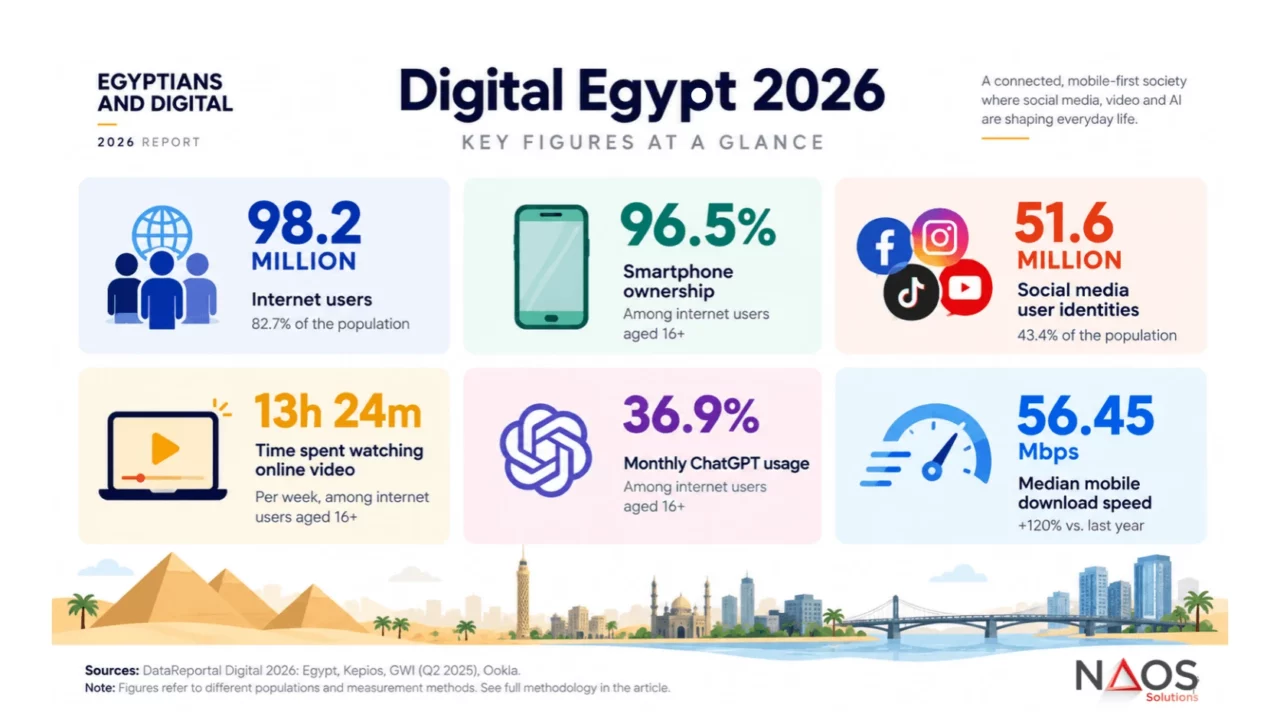
98.2 million internet users | 82.7% internet penetration | 96.5% smartphone ownership among internet users aged 16+ | 51.6 million social media user identities | 13h24 spent watching online video weekly | 36.9% monthly ChatGPT usage among internet users aged 16+.
Beyond these headline figures, five trends stand out:
- Video is transforming media consumption. Egyptians spend considerably more time watching online video than traditional television, with TikTok capturing remarkable attention.
- Social media is becoming more diverse. Facebook remains firmly established, but Egyptians use multiple platforms for different purposes, from private communication to entertainment and professional networking.
- Digital audiences remain unequal. Geography, age, and gender continue to shape access to technology and social media participation.
- Social platforms are influencing purchasing behavior. People increasingly discover products through communities, videos, and content in their social feeds.
- AI is changing how people access information. ChatGPT has become part of many Egyptian internet users’ digital habits.
The key takeaway
Egypt’s digital transformation is no longer just about connectivity. It’s about how technology is reshaping everyday behavior.
1. Internet Users in Egypt: 2026 Statistics
A connected nation, but not an equally connected one
With 98.2 million internet users, Egypt’s internet penetration reached 82.7% in late 2025, according to DataReportal.
Looking back at our earlier editions, Egypt’s digital transformation is remarkable. Internet access has expanded substantially over the past decade, making connectivity part of everyday life for a growing proportion of the population.
Yet approximately 20.6 million Egyptians remain offline.
And the digital divide isn’t simply about how many people have access.
Historical data from the International Telecommunication Union show that internet penetration stood at 84% in urban areas versus 63% in rural areas in 2022.
This 21-percentage-point difference highlights the geographical inequalities that have accompanied Egypt’s digital development. These figures are historical and should not be used to estimate how many rural residents are offline today.
With more than half of Egypt’s population living outside urban centers, extending reliable, affordable connectivity remains a major challenge. Explore the Internet Society’s data on Egypt.
Smartphone Penetration in Egypt: Mobile Comes First
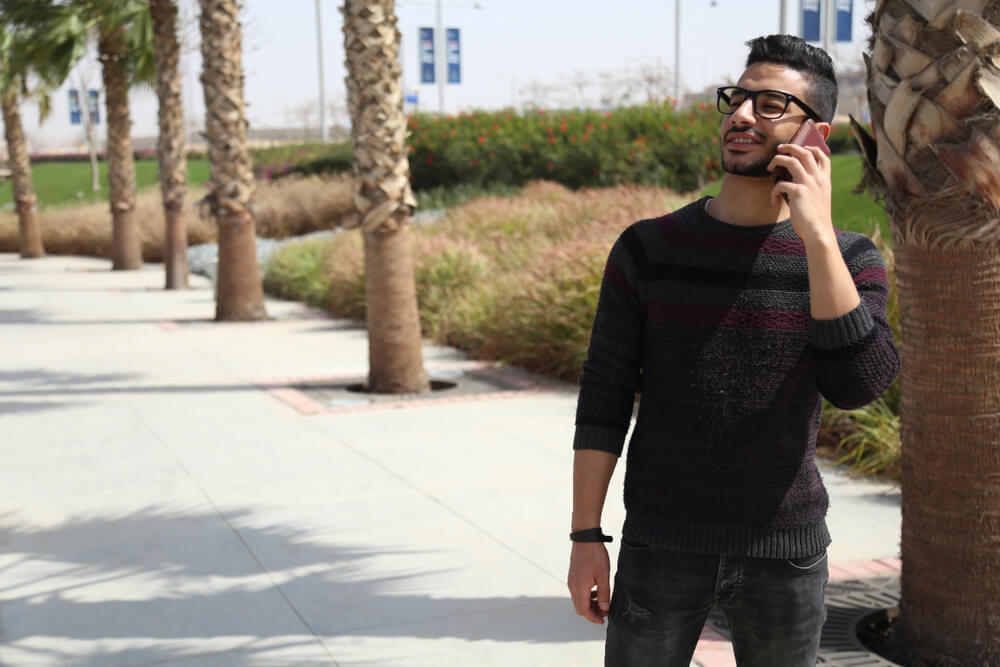
For most connected Egyptians, the smartphone is the primary gateway to the digital world.
According to GWI’s Q2 2025 survey, 96.5% of Egyptian internet users aged 16 and above own a smartphone, compared with 41.7% who own a computer.
Mobile connections are also becoming faster. Ookla reports that median mobile download speeds reached 56.45 Mbps in August 2025, up 120% from the previous year.
Egypt also reached an infrastructure milestone in June 2025 with the commercial launch of 5G services.
These developments point toward an increasingly capable mobile environment, although the speed increase cannot be attributed solely to 5G.
The social consequence is significant: smartphones make digital activities accessible without requiring a computer, from communication and entertainment to learning, shopping, and accessing services.
But mobile connectivity alone cannot eliminate inequalities in affordability, digital skills, or access to reliable networks.
2. How Egyptians Spend Their Time Online
Online video is taking center stage
If there’s one development that captures the evolution of Egyptians’ digital habits, it’s their appetite for video.
According to GWI, Egyptian internet users aged 16 and above spend an average of 13 hours and 24 minutes per week watching online video, compared with 7 hours and 44 minutes watching television.
Short-form videos account for 7h11, while long-form content represents another 6h13.
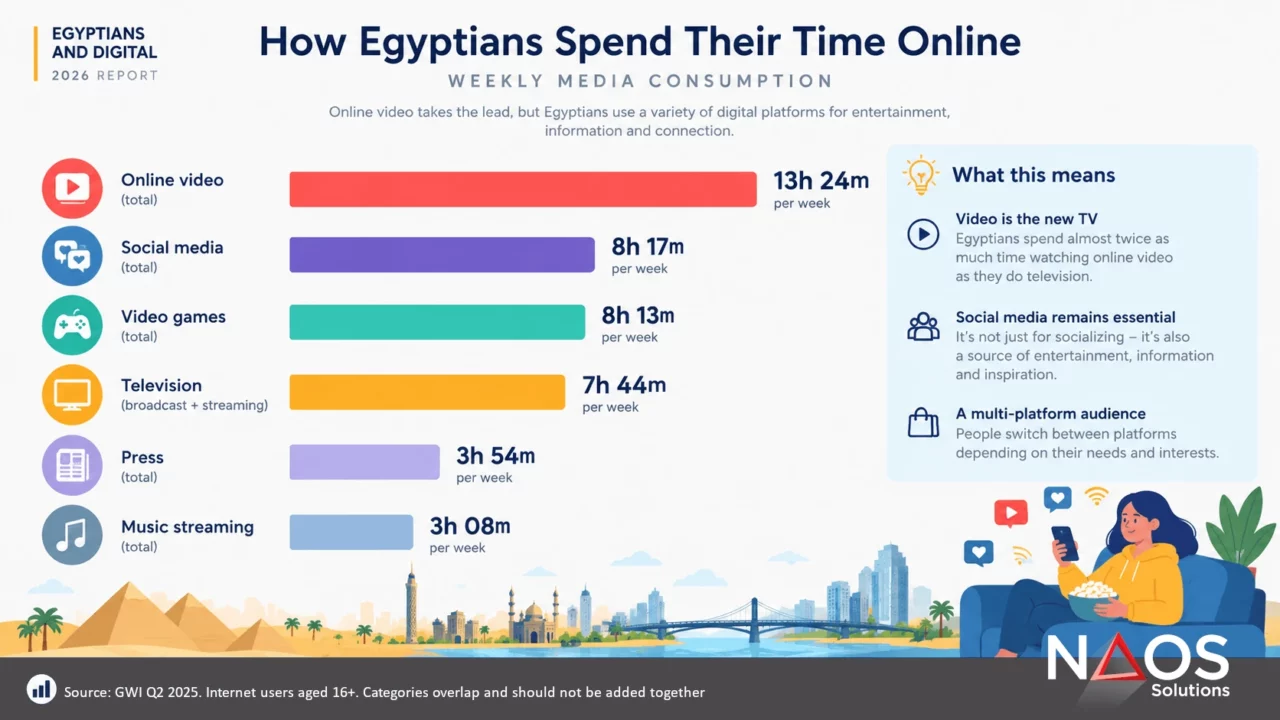
This highlights a key difference in how people consume entertainment.
Traditional television offers scheduled programming. Online video gives audiences greater control over what they watch, when they watch it, and how long they stay.
A five-minute tutorial, a football highlight, a TikTok video, and a full-length documentary can now compete for the same person’s attention.
Our 2023 Egyptians and Digital report already examined the changing relationship between traditional and digital media.
Although GWI’s methodology has changed, preventing direct comparisons of viewing time, the importance of on-demand video is increasingly evident.
The internet is much more than entertainment
Egyptians’ motivations for going online also reveal how integrated digital services have become into daily life.
Staying in touch with friends and family remains the leading reason for using the internet, cited by 50.9% of surveyed users.
Finding information follows at 45.9%, while 45% mention watching videos, television shows, or movies.
Other activities are becoming increasingly important.
About 34.4% research products and brands online, 32.3% use the internet for business networking, and 28.9% use it for business research.
Digital platforms therefore serve several roles simultaneously: maintaining relationships, providing entertainment, supporting professional activities, and helping people make decisions.
This diversity is especially apparent in social media.
3. Social Media in Egypt: Platforms and Audiences
Facebook is still king—but Egyptians aren’t loyal to just one platform
Egypt counted 51.6 million social media user identities in October 2025, making it one of the region’s largest social media markets.
Although its reported penetration rate of 43.4% remains below those of Gulf countries, its audience scale is substantial.
For comparison, DataReportal reports 38.6 million social media identities in Saudi Arabia and 12.5 million in the UAE. These identity estimates are not counts of unique individuals.
But which platforms do Egyptians actually use?
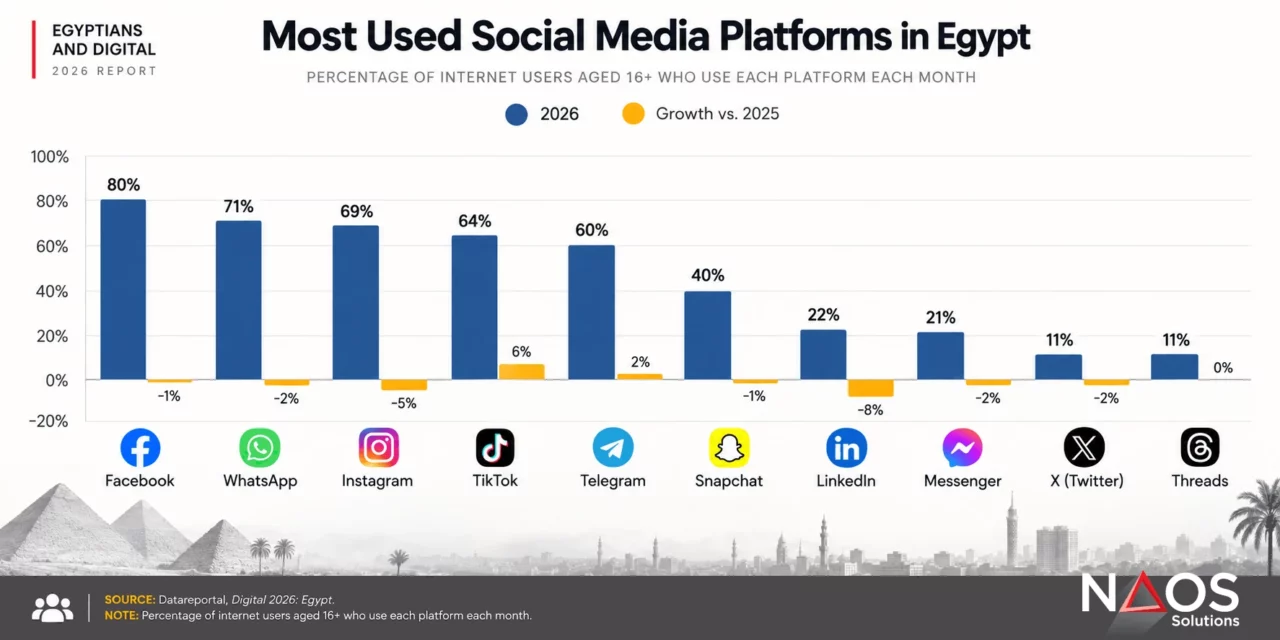
According to GWI’s Q2 2025 survey, Facebook remains the clear leader, with 82.1% of Egyptian internet users aged 16+ reporting monthly usage.
WhatsApp follows at 71.5%, YouTube at 71.1%, and Messenger at 66.9%.
TikTok (65.4%) and Instagram (65.2%) are almost neck and neck, while Telegram reaches 61.7%.
Perhaps the most revealing statistic is that Egyptian social media users engage with an average of 6.9 platforms per month.
This tells us something important about digital behavior.
People don’t necessarily replace one social network with another. They use different platforms to satisfy different needs.
WhatsApp supports direct conversations. Facebook remains important for communities and personal networks. TikTok and YouTube provide entertainment, while LinkedIn serves professional interests.
For businesses, this means you can’t understand audiences through a single platform.
TikTok: From newcomer to attention magnet
Few platforms illustrate this transformation better than TikTok.
When we published our 2023 report, TikTok was already challenging established social networks.
Today, it is firmly positioned as one of Egypt’s major digital destinations.
According to TikTok’s advertising resources, its potential adult advertising reach reached 48.8 million in October 2025, up 25.2% over the preceding year.
But its most striking characteristic is engagement.
Similarweb reports that active TikTok users in Egypt spent an average of 1h52 per day using its Android app in August 2025.
That’s more than Facebook (1h29), YouTube (1h19), or Instagram (54 minutes), among their respective active Android users.
And TikTok isn’t just a teenage phenomenon.
Adults aged 25–34 make up about 46.5% of its reported adult advertising audience, making them its largest age group.
The broader trend is clear: short-form entertainment has become an established part of Egyptian digital culture.
For advertisers, however, attention and purchase intent are different. A platform’s ability to keep users engaged does not automatically make it the most effective sales channel.
LinkedIn reflects another side of Egypt’s digital life
While TikTok illustrates the growth of entertainment-driven platforms, LinkedIn points toward the importance of professional networking.
LinkedIn reported 15 million registered members in Egypt in late 2025, with potential advertising reach increasing by 25% year-on-year.
Registered membership does not equal monthly active usage, but the scale is noteworthy.
Combined with GWI’s finding that almost one-third of Egyptian internet users cite business networking as a reason for going online, it suggests that digital platforms are also important environments for professional relationships and information exchange.
Social media in Egypt is therefore not simply about entertainment. It plays different roles across people’s personal and professional lives.
4. The Social Media Gender Gap in Egypt
A persistent imbalance beneath the national averages
Gender differences have been a recurring theme in our Egyptians and Digital series.
And the latest figures show why the subject remains relevant.
Women make up about 49.5% of Egypt’s population, yet account for only 39% of reported social media user identities.
Men represent the remaining 61%.
Our 2025 report highlighted the same structural imbalance, although earlier estimates suggested some progress.
Changes in DataReportal’s sources and methodologies prevent us from interpreting the latest percentage as proof of a new deterioration.
Nevertheless, the recurring gap raises important questions about differences in digital access and participation.
Factors such as education, affordability, digital literacy, and social expectations may be relevant, but these statistics alone cannot establish their relative influence.
Snapchat tells a very different story
The most interesting finding emerges when we examine individual platforms.
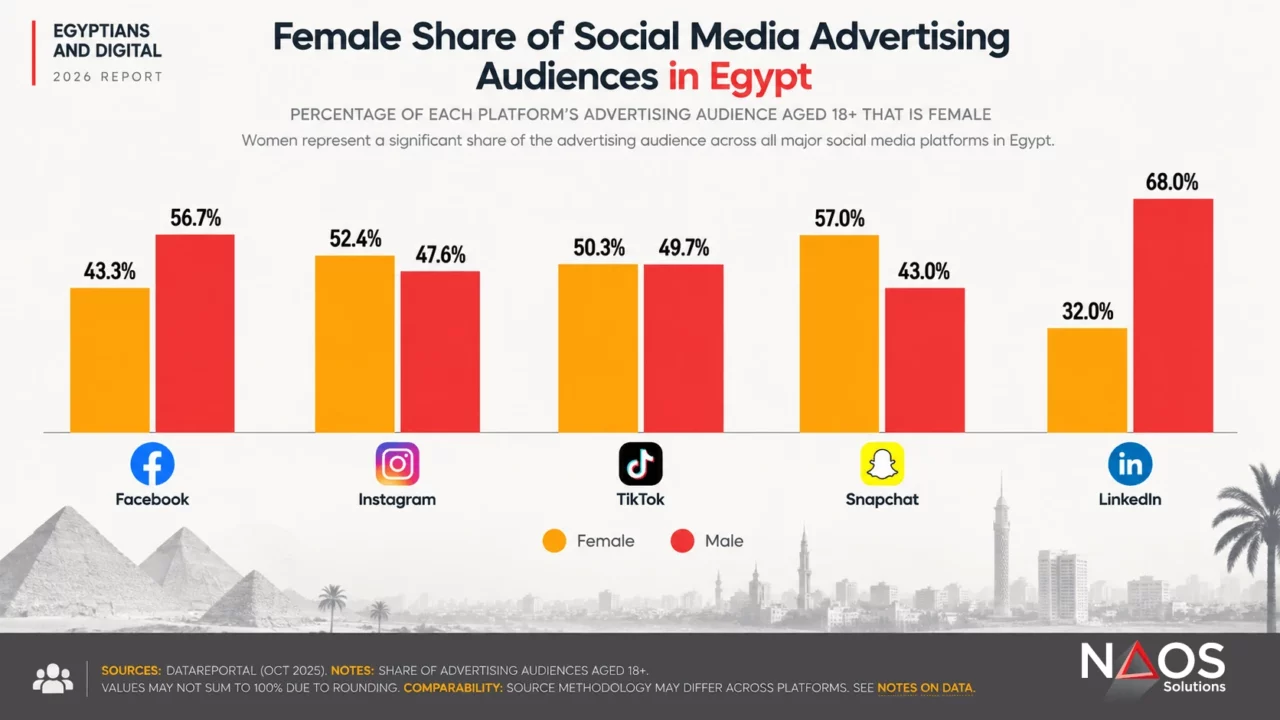
While most major networks report predominantly male advertising audiences in Egypt, Snapchat stands out with a 57% female share.
Instagram is relatively balanced, with women accounting for 46.3% of its reported adult advertising audience.
By comparison, women represent 38.8% of Facebook’s audience, 35.8% of TikTok’s, and 32% of LinkedIn’s.
Age differences are equally revealing.
Snapchat has a particularly young reported advertising audience: about 62% are 13–24. By contrast, TikTok’s largest reported adult age group is 25–34.
These differences illustrate a broader point. There is no single Egyptian social media audience.
Different platforms attract different demographic profiles, and those differences matter when considering where and how to communicate.
However, advertising audience composition does not necessarily explain why people prefer a platform—or mean that all members of a demographic group behave similarly.
For more context, read our article, 16 Facts About Egyptian Audiences.
5. Digital Consumer Behavior and E-commerce in Egypt
Social media is becoming a place to discover brands
Egyptians still use social media primarily for personal reasons.
Keeping in touch with friends and family (39.2%) and filling spare time (39%) remain the leading motivations among surveyed social media users.
But product discovery is becoming an important part of the experience.
According to GWI, 75.8% of Egyptian internet users aged 16+ use at least one type of social media channel to research brands or products.
This broad category includes social networks, blogs, forums, messaging services, and other social channels. Social networks specifically are used for brand research by 49%.
This is an interesting development in the relationship between consumers and businesses.
Product discovery no longer needs to begin with a deliberate search.
A person might come across a product in an entertaining video, see it recommended in a community, or discover it through an influencer.
The research does not measure how often those encounters lead to purchases, but it confirms that social channels play a meaningful role in brand research.
Egyptians follow people before brands
What people choose to follow offers another perspective on Egyptian social media culture.
Friends and family naturally lead the way, but 30% of surveyed social media users follow sports personalities and teams.
Restaurants, chefs, and food personalities attract 27.1%, while influencers and other experts reach 24.6%. These figures highlight the importance of entertainment, shared interests, and recognizable personalities online.
Brands also have their place.
Approximately 21.9% of social media users follow companies they already purchase from, while 21.7% follow brands they are considering buying from.
For businesses, the lesson isn’t necessarily to publish more promotional content. It’s to understand the interests, conversations, and communities that already matter to their audiences.
From discovering products to paying for them
Egypt’s e-commerce market illustrates another shift in digital habits.
According to Statista Market Insights estimates in the DataReportal report, fashion led online consumer goods spending in 2025 at about $5 billion, followed by electronics at $1.54 billion.
Beauty and personal care accounted for around $978 million.
These are modeled estimates, not verified transaction totals, but they illustrate the commercial scale of online retail.
However, discovering products online and completing a digital purchase are two different behaviors.
Access to financial services is an important part of that distinction.
According to the Central Bank of Egypt, financial inclusion reached 79% of Egyptians aged 15+ in June 2026, compared with much lower levels a decade earlier.
Women’s financial inclusion increased from 19.1% in 2016 to 72.5% in June 2026.
This represents substantial progress in access to formal financial services, although having an account doesn’t necessarily mean people shop online.
For businesses, understanding payment preferences remains essential to creating accessible purchasing experiences.
Our guide to online payment gateways in Egypt explores the solutions available to merchants and the factors to consider when selecting a provider.
6. AI and ChatGPT Usage in Egypt
A new way to find information
Artificial intelligence is introducing another dimension to Egyptians’ online behavior.
According to GWI’s Q2 2025 research, 36.9% of Egyptian internet users aged 16+ use ChatGPT at least once per month.
Traditional search engines remain widely used, with 72.3% of respondents reporting monthly usage.
These activities overlap, but they point toward an increasingly varied information environment.
Instead of browsing multiple websites, people can also ask AI assistants to explain a subject, summarize information, or help with a task.
This doesn’t demonstrate that AI is replacing traditional search. It suggests that users have additional ways to obtain information.
ChatGPT dominates AI-generated web referrals
According to Statcounter data included in the Digital 2026 presentation, ChatGPT generated 89.96% of website referrals from a selected group of AI platforms in Egypt in August 2025.
Microsoft Copilot accounted for 3.66%, Perplexity for 3.50%, and Google Gemini for 2.17%.
Claude’s share was just 0.40%.
However, this measurement concerns referrals to external websites, not the proportion of people using each AI assistant.
Claude’s low figure therefore does not show that Egyptians rarely use it, nor does it directly compare with consumer adoption in the United States.
More recent Statcounter figures for Egypt also illustrate how quickly the distribution of measured AI referrals can change.
For now, the most significant finding is that AI has entered Egypt’s digital information ecosystem.
Its implications for search, brand discovery, and consumer behavior will deserve much greater attention in our 2027 edition.
7. What This Means for Businesses in the Egyptian Market
The latest research shows something important: Egypt’s digital audiences are becoming more diverse in their habits, even as connectivity spreads.
For businesses, three implications stand out.
Attention is becoming more fragmented
Egyptians use multiple social platforms, each offering different experiences.
Facebook maintains broad reach, while TikTok captures substantial daily attention among active users.
Snapchat and LinkedIn attract distinctive audiences.
Instead of focusing only on the largest platforms, businesses need to understand where their customers spend time and what they expect from each channel.
Consumers discover brands in different ways
Search engines remain important, but product discovery also happens through social communities, videos, influencers, and increasingly AI-powered tools.
The purchasing journey therefore won’t follow the same path for every consumer.
Brands need consistent, useful information across the channels their audiences consult.
Our guide to creating engaging digital content explores how businesses can align content with audience interests and needs.
National averages can hide important differences
Egypt’s digital market is large, but it is not homogeneous.
Gender, age, geography, and platform preferences all influence how audiences participate online.
A strategy designed for young urban consumers may not be equally relevant to older audiences or people living in less-connected areas.
The challenge is to look beyond national statistics and understand the specific behaviors of the people a business wants to reach.
Conclusion: Digital Egypt Is Entering a New Phase
Over five editions of Egyptians and Digital, we’ve followed the country’s transformation into an increasingly connected society.
The early reports focused on internet access, smartphone adoption, and the expansion of social media.
Today, the most interesting questions have changed.
How do Egyptians divide their attention across platforms? Why are video and online communities so important? How do people discover brands, and what role will AI play in their decisions?
The latest research shows that the answers vary considerably across audiences.
Egypt’s digital future isn’t simply about getting more people online. It’s about the increasingly diverse ways people use technology to communicate, entertain themselves, learn, and make decisions.
For businesses, understanding these differences is the first step to building relevant digital experiences.
At NAOS Digital, we help companies translate audience insights into digital marketing strategies adapted to the Egyptian market.
How is your organization adapting to Egyptian consumers’ changing digital habits?
Explore Previous Editions
Discover how Egypt’s digital landscape has evolved through our annual reports: 2025 | 2024 | 2023 | 2022.
Sources and Methodology
This article is based primarily on DataReportal’s Digital 2026: Egypt report and its accompanying presentation, using data from Kepios, GWI, GSMA Intelligence, Ookla, Similarweb, Statista Market Insights, and major social media advertising platforms.
Additional information comes from the Central Bank of Egypt, the International Telecommunication Union, and official Egyptian telecommunications announcements.
Advertising reach, survey-reported platform usage, registered members, and social media user identities measure different things. Historical comparisons are presented cautiously where methodologies have changed.