

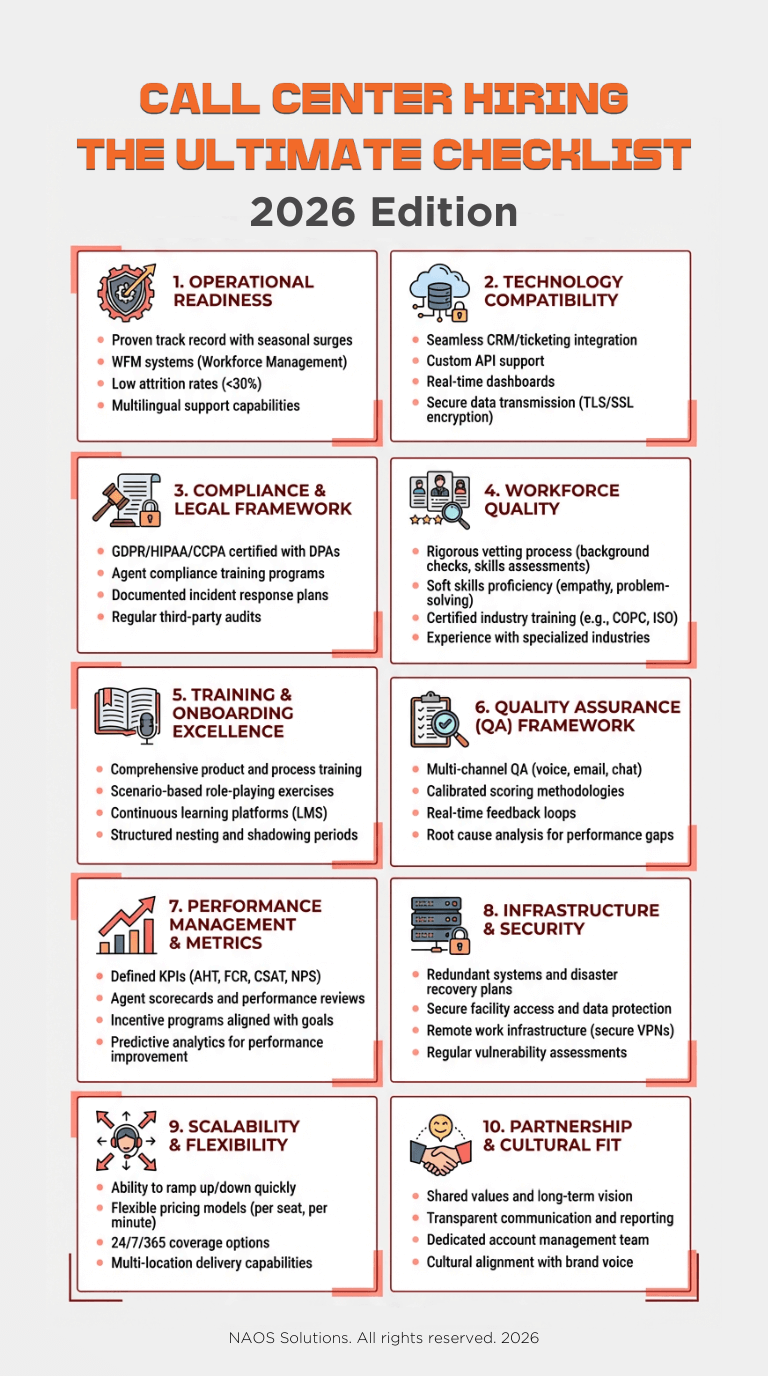
OPERATIONAL READINESS: CAN THEY SCALE WITH YOUR BUSINESS?
Too many partnerships fail because the vendor evaluation process focuses on impressive credentials rather than operational capacity under pressure. You’ve seen it happen: Black Friday hits, call volumes triple, and suddenly your “scalable” partner is drowning in abandoned calls and skyrocketing hold times.
Scalability testing isn’t just about throwing more agents at the problem. It’s about intelligent workforce management, predictive capacity planning, and the infrastructure to absorb unexpected surges without compromising quality.
Why this matters:
A 2025 industry study found that 43% of customer experience outsourcing failures stemmed from inadequate capacity planning during growth phases. When you partner with a contact center that can’t scale, you’re the one who pays—in lost revenue, damaged reputation, and emergency hiring costs.
Performance metrics during peak periods reveal more about operational readiness than any sales presentation ever will.
Checklist Items:
- Do they have a proven track record of handling seasonal surges across multiple client accounts?
- Can they demonstrate workforce management systems (WFM) with real-time capacity planning capabilities?
- What is their agent attrition rate, and how does turnover impact service continuity?
- Do they offer multilingual or multi-regional support with dedicated agent teams?
Dig deeper: Ask for specific examples with quantifiable results. How did they handle a client’s unexpected 200% volume spike? What was their ramp-up timeline? Can they show you their WFM dashboard in action with real data flows?
High attrition rates (above 30% annually) are a red flag in any BPO provider. Constant agent turnover means inconsistent service quality, endless retraining costs, and institutional knowledge walking out the door every quarter.

💡 PRO TIP:
Request a capacity stress test scenario before you hire a call center. Present your peak-volume projections for the next 18 months and ask them to walk you through their staffing model, agent training pipeline, and technology scaling plan, including specific timelines and contingencies.
TECHNOLOGY COMPATIBILITY: SEAMLESS INTEGRATION OR TECH NIGHTMARE?
Your tech stack is the backbone of your CX operation. When you select a call center provider whose systems can’t integrate smoothly, you’ll introduce silos, reporting delays, and customer frustration. Worse, you’ll end up with fragmented data that makes it impossible to track the customer journey or measure true performance metrics.
Why this matters:
Technology integration failures are among the most underestimated risks when companies engage a contact center. When your CRM doesn’t talk to their telephony system, you lose critical context. Agents can’t see customer history. Tickets get duplicated. Resolution times balloon.
According to recent CX benchmarking data, companies with poorly integrated outsourced services experience 35% longer average handle times and 22% lower first-call resolution rates. That’s not just inefficiency—it’s revenue erosion.
Omnichannel support requires seamless data synchronization across voice, email, chat, and social media channels. Without proper technology integration, your customer experience becomes fragmented and frustrating.
Checklist Items:
- Do they integrate with your existing CRM, ticketing systems, and live chat platforms?
- Do they support custom API development for proprietary systems?
- Can they offer real-time dashboards with analytics integration for your leadership team?
- What security protocols and encryption standards are in place for data transmission?
Dig deeper: Don’t accept vague promises of “yes, we integrate with Salesforce.” Request their integration architecture documentation. What’s the data latency between systems? How often do systems sync? What happens if an API call fails—do they have automatic retry mechanisms and error logging?
Request a demo environment to test the integration with sample data. If they hesitate or claim it’s “proprietary,” consider that a warning sign about their technical transparency.

💡 PRO TIP:
Run a comprehensive tech compatibility audit before requesting formal proposals. Create a detailed checklist of your must-have integrations, data flow requirements, and security standards. Share it with potential vendors upfront during vendor evaluation. This saves weeks of back-and-forth discovery and immediately eliminates partners who can’t meet your technical requirements.
COMPLIANCE & LEGAL FRAMEWORK: ARE YOU EXPOSED?
With stricter regulations in 2026—including expanded CCPA enforcement, evolving GDPR requirements, and emerging AI governance frameworks—compliance is non-negotiable when you hire a call center provider. A single data breach or regulatory violation can cost millions in fines and irreparable damage to your brand.
Why this matters:
When you outsource to a call center, you remain legally liable for compliance violations. “We didn’t know our vendor was mishandling data” is not a legal defense. The regulatory landscape has only intensified, with enforcement actions in customer data protection cases increasing 67% year over year.
According to the International Association of Privacy Professionals, global privacy enforcement has reached unprecedented levels, with organizations across sectors facing heightened scrutiny.
Beyond financial penalties, compliance failures erode customer trust, attract media scrutiny, and risk the loss of business licenses in regulated industries such as healthcare and financial services. Your BPO provider’s compliance frameworks directly impact your risk exposure.
Checklist Items:
- Are they certified GDPR-, HIPAA-, and CCPA-compliant with current documentation?
- Can they provide comprehensive data processing agreements (DPAs) with clear liability terms?
- Are their agents trained in compliance protocols with regular refresher courses?
- What’s their documented incident response plan for data breaches, including notification timelines?
Dig deeper: Compliance isn’t a checkbox in customer experience outsourcing—it’s an ongoing commitment. Request their most recent third-party audit reports (SOC 2 Type II, ISO 27001, PCI DSS, if handling payments). Review their DPA line by line with your legal team. Understand exactly where customer data is stored, who has access rights, and how long information is retained.
Inquire about their breach notification procedures and escalation protocols. In 2026, you have 72 hours to report certain data breaches under GDPR. Does their incident response plan account for that timeline with clear communication chains and decision-making authority?
💡 PRO TIP:
Don’t just ask if they’re compliant during vendor evaluation. Request concrete evidence: current certifications, recent audit reports, compliance training curricula, and sample incident response exercises. If potential partners claim compliance but can’t produce verifiable documentation within 48 hours, walk away. The regulatory risk isn’t worth the partnership.

WORKFORCE QUALITY: TRAINED AGENTS OR SCRIPT-READERS?
Every customer interaction reflects your brand identity. Your contact center agents are your frontline ambassadors, and if they’re undertrained, disengaged, or simply reading from scripts without understanding context, your customers will notice immediately and judge your company accordingly.
Why this matters:
Quality assurance issues cascade throughout your entire customer journey. A single bad interaction can undo months of marketing investment and relationship building. In 2026, customers expect personalized, empathetic service—not robotic script recitation. Research shows that 76% of customers will switch brands after multiple poor service experiences.
Forrester’s latest CX research consistently demonstrates that exceptional service quality directly correlates with customer retention, revenue growth, and competitive differentiation.
Agent training quality directly impacts your NPS scores, CSAT ratings, and customer lifetime value. It’s not just about resolving issues transactionally; it’s about building authentic relationships that drive loyalty and advocacy.
Checklist Items:
- What’s their comprehensive agent training cycle and curriculum structure?
- Do they offer client-specific onboarding programs tailored to your products and brand voice?
- How is agent performance tracked, evaluated, and improved over time?
- What’s their quality assurance process: manual call audits, AI-based monitoring, or hybrid approaches?
Dig deeper: Request to observe their agent training program firsthand or review detailed curriculum materials. What’s the onboarding duration for new hires? Do agents receive ongoing coaching and skill-development opportunities, or is training treated as a one-time event that simply checks a box?
Understand their quality assurance framework in detail. What percentage of calls are audited? What performance metrics are tracked beyond basic handle time? Do they measure critical soft skills like empathy, active listening, problem-solving, creativity, and brand alignment in customer interactions?
Ask about their agent career development paths and retention strategies. Call centers that invest meaningfully in agent growth and advancement tend to have significantly lower attrition rates and higher engagement levels, which translates directly to better, more consistent customer experiences.
💡 PRO TIP:
Before you hire a contact center, ask to sit in on live calls or review recorded interactions (with proper customer anonymization and consent). Listen carefully for an authentic tone, comprehensive product knowledge, and creative problem-solving. If agents sound robotic, struggle with basic product questions, or can’t deviate from rigid scripts, that’s a preview of the customer experience you’ll deliver.
CULTURAL ALIGNMENT: CAN THEY SPEAK YOUR BRAND’S LANGUAGE?
Customers shouldn’t feel like they’re being “outsourced” to a generic service provider. They should experience seamless brand consistency, whether they’re interacting with your in-house team or your external partner. Cultural misalignment creates jarring disconnects that erode trust and confuse customers about your brand identity.

Why this matters:
Your brand has a voice, values, and personality. If your call center doesn’t embody that, customers feel the dissonance. A luxury brand partnered with agents who sound transactional? A playful, casual brand with overly formal service? These mismatches damage brand perception.
Cultural fit goes beyond language fluency. It’s about understanding your industry vertical, your customer demographics, and the nuances of your brand promise. As we explored in our guide on how customer service providers must align with your brand’s tone of voice, this alignment is foundational to delivering consistent customer experiences.
Checklist Items:
- Have they successfully worked in your specific vertical (e.g., SaaS, e-commerce, telecom, healthcare)?
- Can they demonstrate the ability to adapt scripts, tone, and communication style to match your detailed brand guidelines?
- Do they offer comprehensive cultural sensitivity training for agents serving diverse international markets?
Dig deeper: Industry-specific experience matters significantly when you select a contact center provider. A call center that has handled thousands of SaaS technical support tickets inherently understands subscription billing complexities, feature request protocols, and technical troubleshooting workflows in ways that a generalist provider cannot replicate.
Ask them to role-play actual customer interactions using your brand guidelines and voice standards. Provide a realistic scenario, your comprehensive style guide, and evaluate how they adapt. Do they authentically capture your brand essence and values, or does the interaction feel generic and disconnected from your identity?
For companies serving international audiences through omnichannel support, cultural sensitivity becomes mission-critical. Are agents specifically trained to navigate different communication styles, cultural holidays, business etiquette expectations, and service preferences across diverse regions and demographics?
💡 PRO TIP
Share a detailed brand style guide early in the vendor evaluation process—ideally during initial discovery conversations. Include specific tone examples, explicit do’s and don’ts, sample interaction scripts, and real customer conversation transcripts. Observe how prospective partners internalize and authentically apply this guidance, rather than merely acknowledging receipt. The best partners don’t just mechanically follow your script—they genuinely become an extension of your brand identity and culture.
TRANSPARENCY IN PERFORMANCE: CAN YOU SEE WHAT THEY SEE?
A transparent provider builds trust through visibility. If you’re flying blind—waiting days or weeks for performance reports—you can’t course-correct in real time. Problems compound, and by the time you spot them, the damage is done.
Why this matters:
Real-time visibility into call center performance is no longer a luxury; it’s a necessity. You need to know what’s happening now, not what happened last week. Without live dashboards and granular KPIs, you’re managing in the dark.
Opacity breeds mistrust. If a vendor is reluctant to share data or only provides sanitized monthly reports, ask yourself: what are they hiding?
Checklist Items:
- Can you access live dashboards and KPIs in real-time?
- Do they offer SLA reporting and agent scorecards?
- Will you have dedicated account management?
- What happens when metrics fall short—do they have an escalation plan?
Dig deeper: Request access to their reporting platform during the evaluation phase. What metrics can you track? How granular is the data? Can you drill down to individual agent performance, or only see aggregated numbers?
Understand their SLA structure. What metrics are tied to SLAs? What are the consequences of missing targets? Vague SLAs like “industry-standard response times” are meaningless. You need specific, measurable commitments.
Ask about accountability. If performance dips, what’s their remediation process? How quickly do they escalate issues? Who owns the resolution?
💡 PRO TIP
Request sample dashboards or anonymized reports from their current clients. This provides a preview of the reporting depth and transparency. If their dashboards are cluttered, incomplete, or difficult to interpret, that’s a usability red flag.
CRISIS & CONTINUITY PLANNING: ARE THEY RESILIENT?
From cyberattacks to natural disasters to sudden infrastructure failures, the question isn’t if disruption will happen, but when. In 2026, resilience isn’t optional—it’s a competitive advantage.
Why this matters:
Business continuity failures are existential threats. If your call center goes dark during a crisis, your customers are stranded, your revenue evaporates, and your brand suffers lasting damage.
We’ve seen it repeatedly: hurricanes knock out facilities, ransomware cripples systems, and pandemics force office closures. The vendors who survive are those with robust BCPs, redundant infrastructure, and tested failover protocols.
Checklist Items:
- Do they have a Business Continuity Plan (BCP)?
- Are there redundant data centers or cloud-based fallback options?
- How do they handle staffing during emergencies?
- What happened the last time their operations were disrupted?
Dig deeper: A BCP document is useless if it’s never been tested. Ask when they last ran a continuity drill. What were the results? What did they learn and improve?
Understand their infrastructure redundancy. If their primary facility goes offline, what’s the failover process? How quickly can they shift operations? Do they have geographic diversity to protect against regional disasters?
To ensure staffing continuity, assess their remote work capabilities. Can agents seamlessly transition to work-from-home during emergencies? What technology and security infrastructure supports that?

💡 PRO TIP
Request real-world examples of crisis execution. The best vendors are proud to share how they navigated past disruptions—because it demonstrates their preparedness and resilience. If they’ve never faced a crisis, ask how they’ve prepared for one.
CONTRACT FLEXIBILITY & COST CLARITY: NO HIDDEN SURPRISES
Cost efficiency is critical—but transparency is just as important. Hidden fees, ambiguous pricing models, and inflexible contracts are recipes for budget overruns and partnership friction.
Why this matters:
Contract disputes are among the top reasons outsourcing relationships sour. When vendors surprise you with “additional fees” for services you assumed were included, trust erodes. When you need to scale down but face punitive penalties, you’re trapped.
In volatile markets, flexibility is essential. Your business needs change. Your call center contract should accommodate that reality, not penalize you for it.
Checklist Items:
- Is pricing per hour, per agent, or per outcome?
- Are setup and transition costs clearly defined?
- Can you scale up/down without penalty?
- Are there penalties for missed SLAs?
Dig deeper: Request a total cost of ownership (TCO) analysis over 12 months. Include setup fees, training costs, technology integration expenses, and any usage-based charges. Compare this across vendors to understand true cost differences.
Scrutinize the fine print. Are there minimums? Ramp-down periods? Early termination fees? Understand what happens if your business needs change six months into the contract.
For SLA penalties, ensure they’re meaningful but not draconian. If they miss targets, you should receive credits or concessions—but the relationship should remain collaborative, not adversarial.
💡 PRO TIP
Negotiate pilot programs or phased rollouts. Start with a limited scope, test performance, then scale. This reduces risk and gives you leverage to renegotiate terms based on actual performance, not promises.
POST-LAUNCH SUPPORT: WHAT HAPPENS AFTER YOU SIGN?
A great onboarding experience doesn’t guarantee ongoing excellence. Some vendors put their A-team on the sale, then disappear once the contract is signed. Without consistent support, calibration, and optimization, performance degrades over time.
Why this matters:
The first 90 days post-launch are critical. This is when you establish workflows, calibrate quality standards, and identify gaps. Without structured support during this period, small issues snowball into major problems.
Long-term success requires continuous improvement. Customer expectations evolve. Your product changes. Market conditions shift. Your call center partner needs to adapt alongside you.
Checklist Items:
- Is there a 30/60/90-day launch success framework?
- How frequently are calibration sessions held?
- Will you have a named success manager?
- How often are agents retrained or refreshed?
Dig deeper: Ask for their launch playbook. What milestones do they track in the first 30, 60, and 90 days? How do they define success at each stage?
Understand the governance structure. Will you have a dedicated customer success manager, or are you routed through a generic support queue? Regular calibration sessions should be scheduled—weekly in the early stages, then monthly—to review performance, address concerns, and align on priorities.
Inquire about agent refresher training. As your products and policies evolve, how quickly can they update agent knowledge? What’s the turnaround time for training on new features or procedures?
💡 PRO TIP
Embed a post-launch support plan directly into your contract. Define review cadences, escalation protocols, and success manager availability. Make ongoing support a contractual obligation, not a goodwill gesture.
BRAND PROTECTION: ARE THEY AN EXTENSION OF YOU OR A LIABILITY?
Your call center is your frontline. Every interaction matters. A single viral complaint, a tone-deaf response, or a mishandled escalation can trigger social media firestorms and lasting reputational damage.
Why this matters:
In 2026, brand protection is more fragile than ever. One screenshot of a poor customer interaction can reach millions within hours. Your call center isn’t just resolving issues—they’re actively shaping public perception of your brand.
Beyond reactive service, the best partners engage in proactive brand stewardship: monitoring sentiment, identifying at-risk customers, and creating opportunities to turn detractors into promoters.
Checklist Items:
- Do they monitor for brand tone and customer sentiment?
- Is there a social media escalation plan?
- How do they handle negative feedback or complaints?
- Can they support proactive outreach, not just reactive service?
Dig deeper: Ask about their sentiment monitoring tools. Do they track customer satisfaction in real-time? How quickly do they escalate negative interactions before they become public crises?
Understand their social media protocols. If a customer complains on Twitter, how fast is the response? Who owns that escalation? What’s the communication chain between the call center and your internal teams?
For proactive outreach, explore their capabilities in customer retention, win-back campaigns, and at-risk customer engagement. The best partners don’t just wait for problems—they help you prevent them.
💡 PRO TIP
Share your voice of customer (VoC) insights with prospective partners early. Show them your detractor themes, pain points, and customer-journey friction points. See how they propose to address those challenges. Their response will reveal whether they’re strategic partners or transactional vendors.
BONUS: 5 RED FLAGS THAT MEAN “WALK AWAY”
- They dodge your compliance questions or won’t provide documentation.
If they can’t prove compliance, they’re not compliant. Period. - They have no visibility tools—you must “wait for reports.”
Real-time data access is standard in 2026. If they’re not offering it, they’re behind the curve. - Their pricing model is vague or variable.
Transparency builds trust. Opacity breeds resentment and budget overruns. - They resist pilot programs or test runs.
Confident vendors welcome the opportunity to prove their capabilities. Resistance signals they know they can’t deliver. - They promise 100% agent availability 24/7, with no staffing breakdown.
Unrealistic promises are red flags. Demand specifics: How many agents? Across how many shifts? What’s the backup plan?
CONCLUSION
In 2026, hiring a call center is less about outsourcing and more about co-owning the customer relationship. With the right checklist in hand, you can confidently move forward knowing you’ve covered more than the basics—you’ve covered what matters.
You’ve assessed operational readiness, technology compatibility, compliance rigor, workforce quality, and cultural alignment.
You’ve demanded transparency, resilience, cost clarity, ongoing support, and brand protection.
This isn’t just due diligence. It’s strategic risk mitigation that protects your customers, your reputation, and your bottom line.
If you’re preparing to hire a call center this quarter, use this checklist to benchmark providers before you sign.
Are you about to hire a call center and want an expert eye on your checklist?
Contact our expert, Mrs. Nermen Mounir, to schedule a strategic alignment session and ensure you’re making a decision that sets your CX operation up for long-term success.