
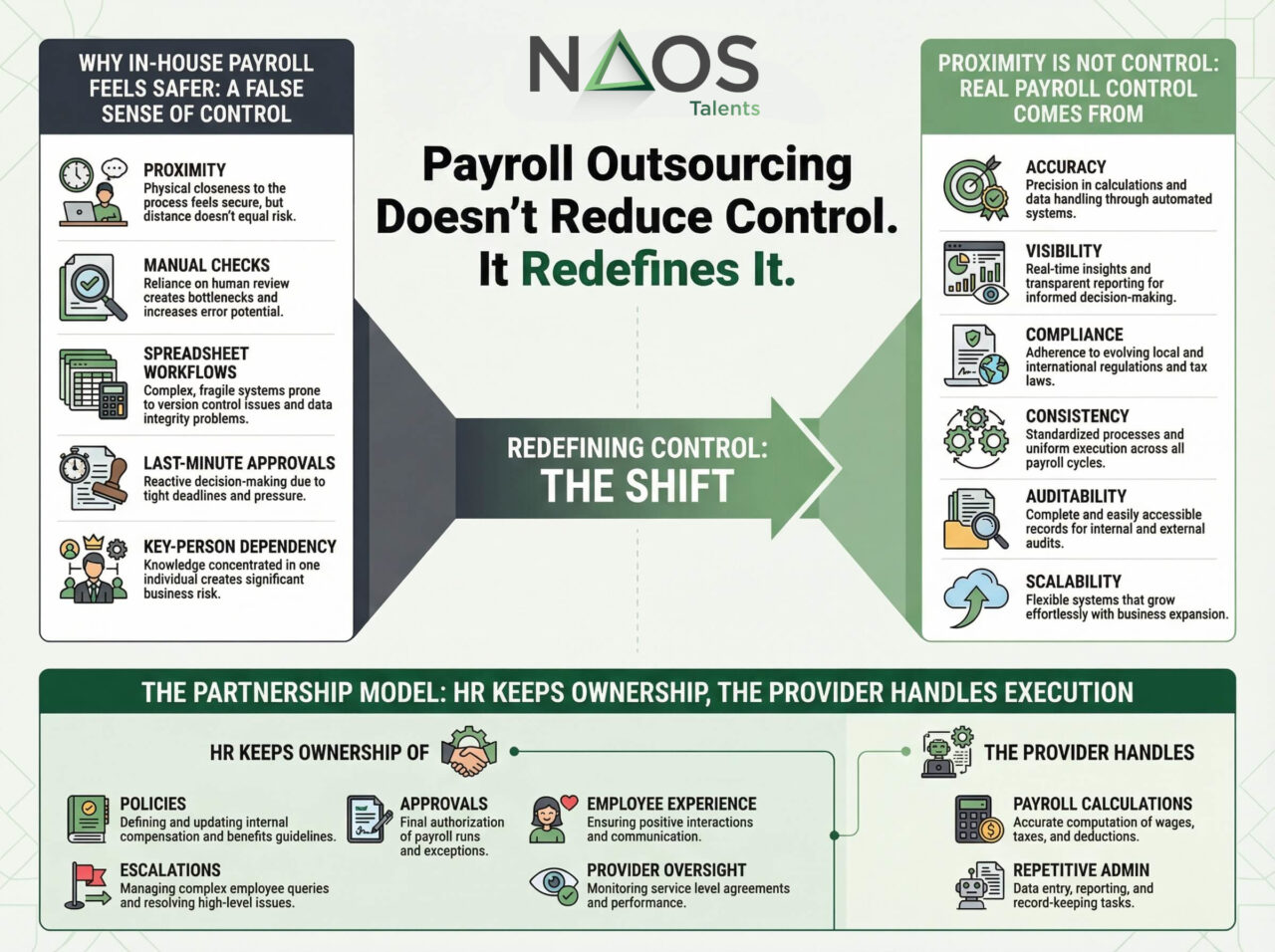
Many HR leaders hesitate to outsource payroll for one simple reason: payroll feels too important to let go. Salaries, deductions, compliance, social insurance, and employee trust all sit inside the same process. When payroll is handled internally, it can seem like HR has tighter control simply because the work stays closer. In reality, proximity is not the same as control. True control comes from accuracy, visibility, consistency, and the ability to manage risk at scale.

That distinction matters more than ever for medium- to large-sized and fast-growing companies. As headcount grows, payroll complexity grows with it. Manual checks, spreadsheet-based workflows, disconnected systems, and last-minute approvals make payroll harder to govern, not easier. This is why payroll outsourcing should be seen less as “handing over control” and more as building a more disciplined operating model.
WHY PAYROLL CAN FEEL UNDER CONTROL IN-HOUSE, EVEN WHEN IT IS NOT
In-house payroll often creates a psychological sense of safety. HR knows the people involved, understands the company rules, and can walk over to finance or operations when something needs clarification. But that comfort can mask structural weaknesses.
If payroll depends on manual entries, outdated software, or one experienced employee who “knows how everything works,” the process is fragile. It may work until the business expands, regulations change, or a key person becomes unavailable.
This is where many organizations confuse activity with oversight. An HR team may be deeply involved in collecting timesheets, checking deductions, correcting files, and following up on errors, yet still lack strong audit trails, clear ownership rules, or reliable reporting. In other words, they are close to the work, but not necessarily in control of the process.
A practical example is a growing retailer with multiple branches and seasonal peaks. During normal months, payroll may be manageable internally. But when Ramadan promotions, new store openings, or peak hiring periods hit, the same payroll process becomes vulnerable to delays, inconsistencies, and approval bottlenecks. What looked controlled in a stable environment starts breaking down under pressure.

WHAT PAYROLL OUTSOURCING REALLY MEANS
Payroll outsourcing does not mean HR gives up ownership of payroll. It means HR changes its role. Instead of manually processing every calculation and chasing every file, HR governs the process, validates the inputs, approves outputs, and monitors provider performance. The provider executes the repetitive, specialized, and compliance-heavy work using dedicated systems and payroll expertise.
That distinction is critical in B2B environments. Payroll outsourcing can be structured in different ways. Some companies outsource only payroll calculations and filings while keeping time-and-attendance administration in-house. Others choose a fuller model that includes reporting support, wage transfer support, and employee data processing. The right model depends on the company’s headcount, internal maturity, and growth plans.
What stays with HR
Even in an outsourced model, HR remains responsible for employee policies, compensation rules, approvals, escalation decisions, and the overall employee experience. HR also continues to own data governance, communication with internal stakeholders, and the relationship with the provider.
This is why outsourcing payroll should be understood as externalized execution, not externalized accountability.
What the provider takes off HR’s plate
The provider typically handles payroll calculations, tax and social insurance updates, repetitive administrative steps, workflow discipline, bank transfer orders, and structured reporting. In stronger models, the provider also brings technology integration, tighter data security controls, and documented service levels. That allows HR to spend less time processing payroll and more time managing the quality of payroll outcomes.
THE ADVANTAGES OF PAYROLL OUTSOURCING FOR HR TEAMS
1. Better compliance control
One of the biggest advantages of payroll outsourcing is stronger compliance management. Payroll is affected by tax rules, social insurance requirements, labor law obligations, minimum wage standards, overtime treatment, and record-keeping obligations. These areas are difficult to manage consistently when payroll is handled through fragmented internal processes. Specialized providers monitor these requirements continuously and reduce the risk of non-compliance.

This matters because payroll mistakes are not only administrative errors. They can trigger penalties, disputes, delayed salary payments, and reputational damage. In the Egyptian context, payroll teams must stay up to date on labor law, tax, social insurance, and documentation requirements. Outsourcing does not remove responsibility from the employer, but it can significantly strengthen the control environment around compliance-sensitive activities.
2. Fewer manual errors and stronger process accuracy
When payroll is processed internally through spreadsheets, email approvals, and disconnected data sources, mistakes become more likely. Manual calculations, duplicate data entry, and inconsistent cut-off rules all increase the chance of errors. A structured outsourcing model reduces that exposure by standardizing workflows and assigning payroll execution to specialists who perform these tasks every cycle.
Accuracy is not a minor benefit. It directly shapes employee confidence. According to a survey cited by HR Daily Advisor, nearly half of employees would begin looking for a new job after just two payroll mistakes. That makes payroll reliability not only a finance or compliance issue, but also an employee retention issue.
For HR teams, that changes the conversation. Reducing payroll errors means fewer employee complaints, fewer emergency corrections, and fewer hours spent on reactive issue handling. Instead of solving preventable problems, HR can invest time in workforce planning, hiring, and retention.
3. More visibility through reporting and audit trails
Many HR teams assume that outsourcing reduces visibility because part of the work is performed externally. In practice, a good provider often gives the business more visibility than an internal process built on scattered files and informal approvals. Modern outsourced models usually include structured reports, approval stages, documented workflows, and audit-friendly records.
This is what “more control” really looks like. HR no longer needs to rely on memory or individual expertise to understand what happened in a pay cycle. The process becomes traceable. Inputs can be reviewed, outputs can be validated, exceptions can be escalated, and responsibilities can be clarified. For growing companies, that level of process visibility is far more valuable than simply keeping payroll physically in-house.
4. More time for strategic HR work
Payroll is essential, but it is also admin-heavy. Time spent checking attendance files, updating salary records, reviewing deductions, and resolving last-minute discrepancies is time not spent on talent strategy, performance, engagement, or workforce capability. Payroll outsourcing helps HR reallocate attention to higher-value activities without compromising payroll quality—part of a broader shift in HR services and strategic growth that moves internal teams away from repetitive execution and toward workforce priorities.
That time impact is measurable. NetSuite reports that about one-third of small businesses spend more than 6 hours per month handling payroll internally, with similar time demands for payroll tax tasks in businesses with 5 or more employees. In larger or more complex organizations, the total internal effort can be significantly higher once approvals, corrections, and reporting are added.
For HR leaders, this is not simply about efficiency. It is about role design. A strong HR function should not be trapped in repetitive payroll administration when that work can be handled more efficiently with expert support and better systems.
5. Easier scaling during growth or seasonality
Payroll processes that seem manageable at 80 employees often become unstable at 300. Expansion across branches, new legal entities, seasonal hiring, shift complexity, and variations in benefits all add pressure. Outsourcing provides businesses with a more scalable operating model because the provider already has the structure, expertise, and technology to handle higher payroll volumes without having to rebuild the process from scratch.
This is especially relevant for companies in retail, logistics, healthcare support, manufacturing, or any sector with fluctuating workforce needs. Instead of hiring additional internal payroll capacity as the business grows, the company can scale service delivery through the provider while maintaining strategic oversight internally. That gives HR flexibility without creating unnecessary fixed overhead.
6. Stronger employee trust
Payroll is one of the most visible proofs that HR operations work. Employees may not notice a smooth payroll process every month, but they notice delays, inaccuracies, or unexplained deductions immediately. Reliable payroll builds confidence in the employer and reinforces the perception that the organization is fair, competent, and professional.
This is why payroll outsourcing should also be viewed through an employee experience lens. A provider that improves payroll accuracy, timing, and consistency helps HR protect trust at scale. That is particularly important in competitive labor markets, where retention depends not only on salary levels but also on the reliability of the employer’s core processes.
7. Less dependency on one internal expert
Many companies face a hidden payroll risk: too much knowledge is concentrated in a single person. It may be a payroll officer, an HR manager, or a finance team member who understands all the exceptions, deadlines, and workaround steps. That creates vulnerability. If that individual leaves, is absent, or becomes overloaded, payroll continuity is threatened.
Outsourcing reduces this key-person dependency by replacing informal knowledge with a documented process. Instead of relying on one employee’s memory, the company works through established service workflows, defined contacts, and measurable service expectations. That is a major governance improvement for any business seeking greater resilience in HR operations.
THE REAL SHIFT: FROM PROCESSING PAYROLL TO GOVERNING PAYROLL
The biggest strategic benefit of payroll outsourcing is that it changes HR’s role. Instead of spending most of its energy on calculations, corrections, and administrative follow-up, HR can focus on governance. That means setting standards, approving inputs, monitoring quality, reviewing reports, and improving employee-facing processes.
This is a more mature model of control. Processing payroll manually may feel hands-on, but governance creates better long-term outcomes. It allows HR to focus on what matters most: policy consistency, confidence in compliance, employee trust, and business readiness for growth.
WHEN PAYROLL OUTSOURCING MAKES THE MOST SENSE
Payroll outsourcing is particularly valuable when the company is growing quickly, payroll errors are becoming too frequent, compliance is harder to track, or HR is spending too much time on repetitive administration. It also makes sense when payroll depends heavily on spreadsheets, when multiple branches or workforce categories are involved, or when leadership wants better reporting without building a larger internal payroll team.
A useful market signal is that outsourcing is already mainstream. Deloitte found that 73% of organizations outsource at least one aspect of payroll. The takeaway is not that every company should outsource in the same way, but that payroll outsourcing is now a standard operating choice, not an unusual exception.
HOW TO OUTSOURCE PAYROLL WITHOUT LOSING CONTROL
The key to successful payroll outsourcing is not to outsource mindlessly. HR should define internal ownership before selecting a provider. Approval workflows, compliance responsibilities, reporting expectations, escalation paths, and data security standards should all be clear from the start. This is what protects control while allowing execution to move outside the business.
Service levels also matter. Deloitte’s findings show that larger organizations are far more likely to use service-level agreements to monitor payroll provider performance. That is a useful lesson for any company, regardless of size. If payroll is business-critical, it should be governed through measurable standards, not goodwill alone.
In practice, HR should ask simple but decisive questions: How will approvals work? What reports will be delivered each cycle? How are legal and regulatory updates managed? What happens when a discrepancy appears? Who owns communication with employees? How is sensitive payroll data protected? These questions do not create friction. They create the structure that enables effective outsourcing.
CONCLUSION
The most important lesson for HR leaders is this: payroll outsourcing does not reduce control when it is designed correctly. It replaces manual effort with process discipline, individual dependency with operational continuity, and reactive problem-solving with clearer governance. For companies that are growing, facing compliance pressure, or trying to free HR from repetitive admin, that is a meaningful advantage.
In other words, the question is no longer whether payroll should stay physically inside the company. The better question is whether the current model provides HR with sufficient visibility, reliability, and resilience to support the business properly. If the answer is no, outsourcing payroll may be the move that gives your HR team more control, not less.
Is your HR team spending too much time processing payroll instead of improving workforce performance? Explore whether a structured payroll outsourcing model could help your business gain the control, compliance confidence, and scalability it needs.