
Outsourced Customer Service for Ecommerce can help growing brands do what matters most: reduce pressure on internal teams, control support costs, and deliver a smoother customer experience that drives repeat business.
If you are reading this article, chances are you are not looking for generic outsourcing promises. You want practical ways to scale support without losing quality, brand consistency, or customer trust. That is exactly the kind of challenge this blog is built to address.

Here, we look at customer experience through a business lens. Not as a soft function, but as a lever for loyalty, efficiency, and growth. In the sections below, you will see how outsourced customer service for ecommerce can help you build a more flexible operation, protect margins, and create the kind of service that keeps customers coming back.
WHY IN-HOUSE ECOMMERCE SUPPORT COSTS MORE THAN MOST BRANDS REALIZE
In-house teams are built for stability, while ecommerce runs on volatility
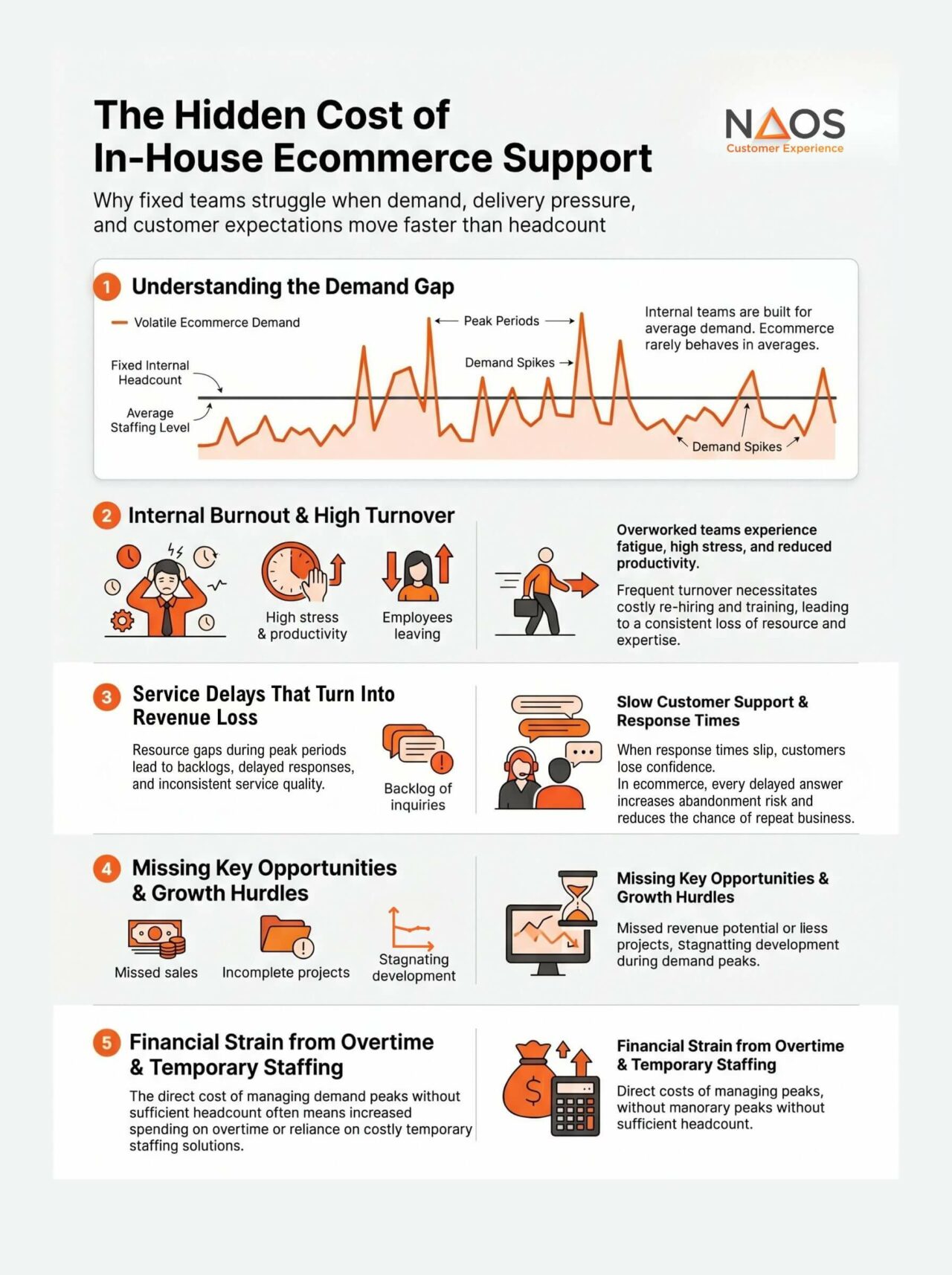
The hidden problem with in-house ecommerce support is not just payroll. It is rigidity.
Most internal teams are designed around average demand. Ecommerce rarely behaves that way. A flash sale, a viral product mention, Black Friday traffic, subscription rebills, delayed deliveries, or a sudden carrier issue can all trigger a spike in support volume. When that happens, brands usually face the same dilemma: overhire for peaks they cannot sustain, or understaff and let service quality slip at the exact moment customers need reassurance most. As NAOS explains on its e-commerce customer service page, high inquiry volumes and seasonal fluctuations quickly turn into CX chaos when support capacity cannot flex with demand.

Skilled agents often spend too much time on low-value contacts
Another cost is less visible, but just as damaging. Too many skilled agents spend their day handling repetitive contacts that do little to improve loyalty or revenue.
The clearest example is the “Where is my order?” ticket. According to Salesforce, each WISMO inquiry can cost between $5 and $15 in time and overhead. Route estimates that a human-handled interaction can cost up to $6. On paper, that may not seem alarming. In practice, when those requests come in by the hundreds or thousands, they consume a significant share of support capacity.
That is where the real cost appears. Agents who could be resolving payment issues, saving subscriptions, calming frustrated customers, or spotting upsell opportunities end up repeating tracking information and apologizing for delivery delays. In other words, some of the most expensive human hours in the business get spent on the least strategic tasks. That is also why articles such as Order Management Outsourcing argue that post-purchase communication is no longer just an operational issue. It is a customer experience issue with direct commercial impact.
Building full coverage internally is more expensive than it looks
The cost of in-house support rises even further when brands try to match how customers actually shop.
Ecommerce does not stop at the end of the workday. Customers browse at night, buy on weekends, ask questions through live chat while commuting, and follow up through social media, email, or phone, depending on urgency. Building real omnichannel support, after-hours availability, and multilingual coverage with only internal resources is rarely as simple or as affordable as it sounds.
This is one of the pressures highlighted by the NAOS e-commerce customer service page, which points to the operational burden created by parcel-status follow-up, refund management, fraud handling, chargeback prevention, and 24/7 service expectations. For many brands, the challenge is not answering tickets. It is answering them consistently, across channels, at the speed customers now expect.
Slow or inconsistent service creates revenue loss, not just service issues
When support teams are overloaded, the cost is not limited to efficiency. It affects future sales.
Route reports that 93% of consumers want proactive shipping and delivery updates, and 81% say those updates play a critical role in whether they buy again. In a separate study, Ipsos found that 85% of online shoppers say a poor delivery experience would stop them from ordering from that retailer again.
That changes the conversation entirely. Delayed replies and weak post-purchase communication are not minor service gaps. They are revenue leaks. If customers do not feel informed, they are less likely to trust the brand with a second purchase.
Poor post-purchase support quietly damages retention
The post-purchase stage is where many brands lose customers without fully realizing why.
As Radial notes, 79% of consumers may not purchase again from a brand after a poor post-purchase experience. That includes order updates, delivery, returns, and customer care. Once you look at support through that lens, the idea that in-house automatically means cheaper starts to fall apart.
If an internal model cannot scale smoothly, respond fast enough, or maintain quality during peak periods, it does not simply increase service pressure. It weakens retention. And in ecommerce, retention is where profitability becomes much harder to protect.

WHAT OUTSOURCED CUSTOMER SERVICE FOR ECOMMERCE REALLY CHANGES
The biggest shift with outsourced customer service for ecommerce is not simply moving tasks outside the business. It is moving away from a rigid support model that struggles to absorb demand fluctuations.
For many ecommerce brands, support costs remain fixed while ticket volume fluctuates. That imbalance becomes obvious during promotions, seasonal spikes, subscription cycles, or delivery disruptions. A more flexible model makes it easier to scale up service when volume rises and scale back when pressure eases. That is one reason the NAOS e-commerce customer service offering highlights adaptable support structures designed for high-growth and high-variability environments.
It gives ecommerce brands access to more specialized support
Not all support teams are built for the realities of ecommerce.
A general customer service team may be able to answer routine questions. But ecommerce support often requires a deeper understanding of order management, returns, chargebacks, fraud-related concerns, subscription issues, and parcel follow-up. That is where outsourcing can create real operational value. On the NAOS e-commerce customer service page, this is reflected in capabilities such as proactive order communication, refund and chargeback prevention, multilingual service, and back-office support for fast-moving online brands.
This matters because customer service in ecommerce is rarely isolated from the rest of the business. It touches logistics, payments, retention, reputation, and revenue simultaneously. That is also why your article on order management outsourcing for ecommerce makes such a strong point: when communication around orders breaks down, what looks like an operational issue quickly becomes a customer experience problem.
It frees internal teams to focus on higher-value work
One of the most practical benefits of outsourcing is not that internal teams disappear. It is that they can finally focus on the work they are best placed to own.
Instead of spending their time answering repetitive tracking questions or handling predictable overflow, in-house teams can focus on escalations, brand-sensitive cases, customer insight, retention strategy, and service improvements that require closer alignment with the business. In that sense, outsourcing works best when it strengthens internal priorities rather than replacing them.
This is also consistent with the phased logic described in the NAOS article on gradual customer service outsourcing, which shows that brands do not need to hand everything over at once. A more controlled rollout often produces better results because it allows teams to test, refine, and expand without risking the entire customer experience.

It helps support and contribute to growth, not just issue resolution
For ecommerce brands, the most interesting change is often commercial.
When the support model is well designed, service no longer exists only to solve problems. It can also protect revenue, recover intent, and create new opportunities during moments of trust. The abandoned-cart case study, How a US Nutraceutical Brand Recovered $2M/Year from Abandoned Carts, is a strong example. It shows how a dedicated outsourced team, supported by automation and targeted outreach, helped transform abandoned-cart leakage into a measurable revenue stream.
The same logic appears in the apparel success story, How a DTC Apparel Brand Turned Inbound Support into a $2.4M Revenue Engine. There, support conversations were not treated as dead-end service interactions. Once the customer issue was resolved, agents were trained to identify relevant buying signals and introduce helpful recommendations naturally. The result was additional revenue without extra headcount or sacrificing customer experience.
It creates a more resilient customer experience across the full journey
At its best, outsourced customer service for ecommerce does more than lower pressure on internal operations. It helps brands build a more resilient customer journey from pre-purchase questions to post-delivery support.
That resilience matters because the modern ecommerce experience is fragile. A delayed order update, a confusing return process, or a slow answer at checkout can all weaken trust. As Route points out, customers expect proactive delivery communication, while Radial underscores how quickly a poor post-purchase experience can damage repeat-purchase intent. In that context, outsourcing is not just an efficiency lever. It is a way to make service more stable, more responsive, and better aligned with how ecommerce actually works.
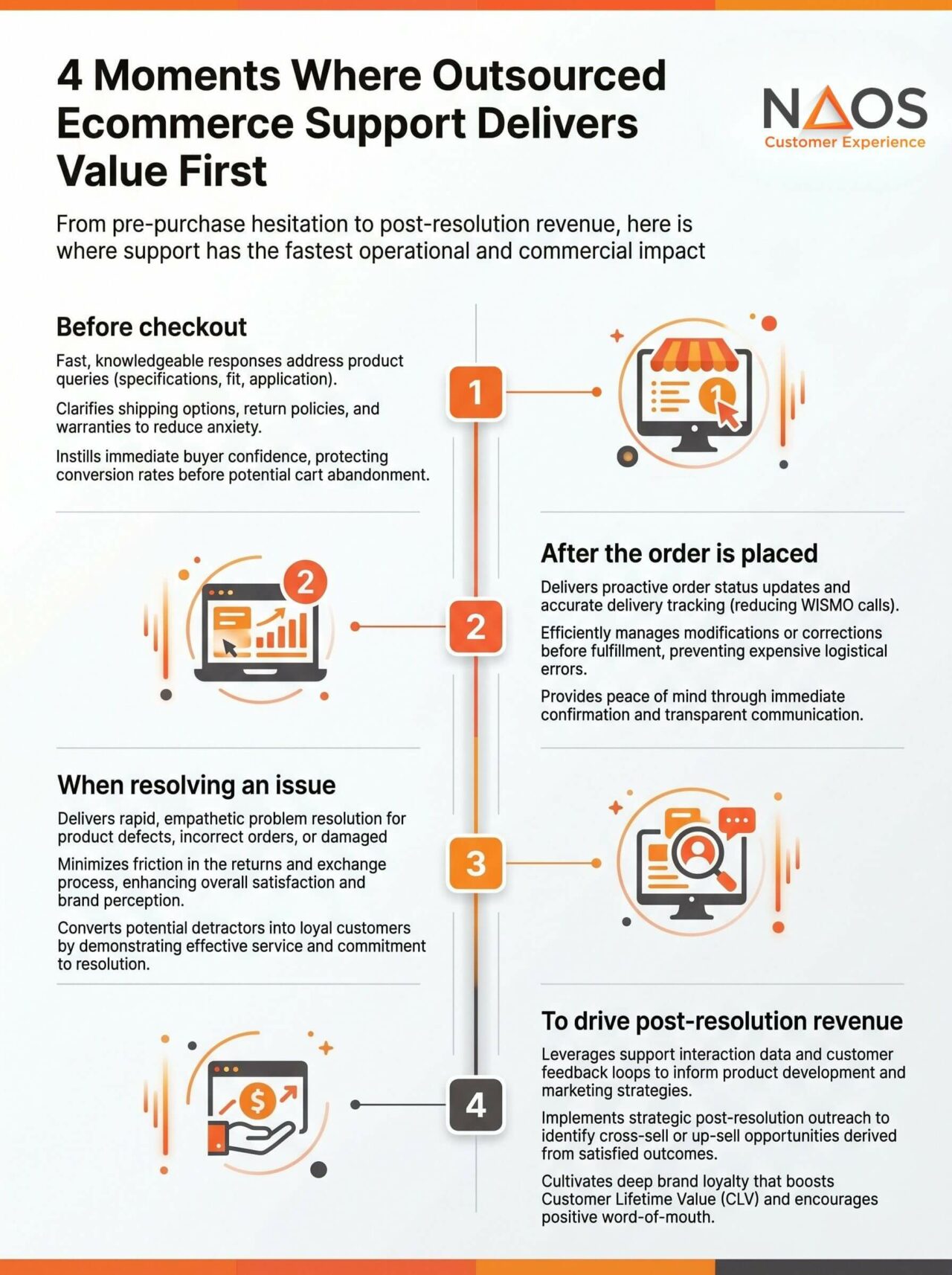
FOUR MOMENTS WHERE OUTSOURCED ECOMMERCE SUPPORT PAYS FOR ITSELF
Before checkout, when buying intent is still fragile
Many ecommerce brands lose revenue before the order is even placed.
Questions about delivery times, payment options, product fit, or subscription terms often arrive when intent is high, but confidence is still low. If answers come too slowly, the customer leaves. That is where outsourced customer service for ecommerce can make an immediate difference, especially by extending coverage across chat, email, or phone at the moments when hesitation is most likely to turn into abandonment. The NAOS e-commerce customer service solution reflects this need by covering both pre-purchase and post-purchase interactions for fast-moving online brands.
That same logic applies to cart recovery. In the NAOS case study on recovering abandoned carts for a nutraceutical brand, a dedicated team combining automation, segmentation, and agent outreach helped recover 1,050 carts per month and generate $157,500 in additional monthly revenue after 90 days. It is a strong reminder that support can recover demand, not just respond to problems.
After checkout, when customers want reassurance
The post-purchase phase is where support volume often starts to climb.
Once payment is complete, customers want confirmation, visibility, and clear communication if anything changes. If that communication is weak, the number of order-status contacts increases quickly. As Salesforce explains in its WISMO guide, brands can reduce this pressure through proactive updates, branded tracking, self-service tools, and clearer delivery expectations. This is also why the NAOS article on order management outsourcing for ecommerce places so much emphasis on communication, not just fulfillment speed.
For brands managing volume peaks, outsourced teams are often better equipped to absorb these repetitive but important contacts without letting response times slip. That matters because post-purchase support is one of the clearest drivers of trust in ecommerce.
When returns, refunds, or disputes threaten margin
This is where customer service stops being purely operational.
A delayed refund, a return request, or a billing dispute can quickly become a chargeback, a complaint, or a lost customer if the response is slow or poorly handled. That is why the NAOS e-commerce customer service page highlights capabilities such as refund management, fraud handling, and chargeback prevention. It also naturally connects with your earlier article on reducing chargebacks through customer service, which already shows how support can protect revenue before an issue escalates.
After the issue is solved, when trust is at its highest
One of the most overlooked moments in ecommerce support comes after resolution.
Once a customer feels heard and helped, the conversation becomes far more valuable than a closed ticket. In the NAOS success story about turning inbound support into a revenue engine for an apparel brand, agents were trained to resolve issues first, then identify relevant buying signals and naturally recommend additional products. The result was projected additional annual revenue of $2.4M, with no extra headcount and no decline in customer experience. That makes one point very clear: outsourced customer service for ecommerce can do more than reduce costs. It can create new value inside conversations brands are already having every day.
WHAT TO OUTSOURCE FIRST WITHOUT LOSING BRAND CONTROL
Start with low-risk, high-volume workflows
The safest approach is rarely a full handover on day one.
For most ecommerce brands, a phased model works better. That can mean starting with after-hours coverage, one channel such as live chat or email, order-status requests, returns support, or overflow during campaigns and peak periods. As NAOS explains in its article on gradual customer service outsourcing, these high-volume, process-driven interactions are easier to document, measure, and quality-control without giving up ownership of more sensitive decisions.
Build the operating model before expanding the scope
A gradual rollout also gives your brand time to put the right structure in place.
According to NAOS CX’s guidance on contact center best practices, strong outsourcing partnerships rely on co-owned SLAs, real-time visibility, clear communication loops, QA calibration, and flexible scaling tied to campaign and seasonality planning. In ecommerce, those habits matter because volume swings are rarely random. They are easier to manage when both sides use the same commercial calendar.
Keep strategic ownership in-house
Not everything should move first.
In most cases, it makes sense to keep brand governance, escalation policy, retention strategy, VIP recovery, and voice-of-customer ownership in-house. Those areas require closer alignment with brand priorities and often involve more judgment than process.
Outsource where relief comes fastest
The best early candidates are usually the most repeatable ones.
That includes repetitive service contacts, multilingual coverage, overnight and weekend operations, proactive delivery communication, returns support, and tightly scripted recovery workflows. On the NAOS e-commerce customer service page, this is exactly where outsourced support is positioned to bring fast operational relief with limited cultural risk.
HOW TO CHOOSE AN ECOMMERCE OUTSOURCING PARTNER WITHOUT REGRETTING IT LATER
Not every outsourcing partner is built for ecommerce.
A strong provider must do more than offer agents at a lower cost. They need proven ecommerce escalation logic, omnichannel capability, CRM and order-system integration, seasonal elasticity, security discipline, and a serious quality assurance culture. Without that foundation, brands simply trade one support problem for another.
Transparency matters too. Hidden fees, vague SLAs, high turnover, weak compliance, and overpromised capabilities are all red flags. NAOS CX’s guidance is especially useful here because it emphasizes the right questions: Can the provider integrate with your systems? Can they flex across languages and channels? Can they train agents to sound like your brand? Can they show proof, not just claims?
For ecommerce brands, one criterion deserves extra attention: brand fit.
Customer service is often the most human part of the buying journey. If outsourced agents feel disconnected from your tone, values, or customer expectations, shoppers will notice immediately. That is why high-performing partnerships treat onboarding, tone-of-voice alignment, QA feedback, and real-time collaboration as ongoing disciplines rather than launch-phase tasks.
THE REAL VALUE OF OUTSOURCED CUSTOMER SERVICE FOR ECOMMERCE
The outdated way to think about outsourcing is to ask, “How much cheaper is it?”
The better question is, “How much waste, delay, leakage, and missed revenue does it remove?”
When ecommerce brands rely solely on in-house support, they often incur fixed staffing costs that do not align with actual demand. They lose time to repetitive post-purchase inquiries. They struggle to maintain service quality during peaks. They under-resource nights, weekends, and multilingual contacts. And they miss the chance to turn support from a cost center into a more resilient, more commercial function.
By contrast, outsourced customer service for ecommerce gives brands room to scale smarter. It helps absorb volatility, improve post-purchase communication, protect retention, support chargeback-sensitive operations, and unlock new value from the conversations they are already having every day. That is not a narrow labor decision. It is a CX and profitability decision.
If your team is spending too much time chasing parcels, calming delivery anxiety, processing preventable refunds, or missing revenue hidden inside support conversations, it may be time to rethink the model. Are you still staffing customer service as a fixed internal function, or are you ready to build it as a flexible engine for growth, retention, and stronger ecommerce margins?