
Subscription ecommerce is booming — but so is the rate at which subscribers leave.
Monthly churn for subscription-based ecommerce brands ranges between 5% and 10%, which means you could be losing the majority of your subscriber base within a year. At those rates, no acquisition strategy can save you. Retention has to become the priority.

Here is what most brands miss: customer service is a top-3 loyalty driver for subscription businesses, accounting for 40% of subscriber retention motivation. Yet it remains one of the most underinvested functions in ecommerce operations.
The good news? Your customer service team — if positioned correctly — is one of the most powerful tools you have to cut churn. These 7 strategies show you exactly how.
WHY SUBSCRIBERS LEAVE (THE SHORT VERSION)
Before diving into solutions, it helps to understand what you are actually fighting.
Subscriber churn falls into two categories. Voluntary churn is when a customer actively decides to cancel because they lost interest, felt underserved, or found a better alternative. Involuntary churn occurs when a subscriber is lost due to a billing failure, with no intention to leave.
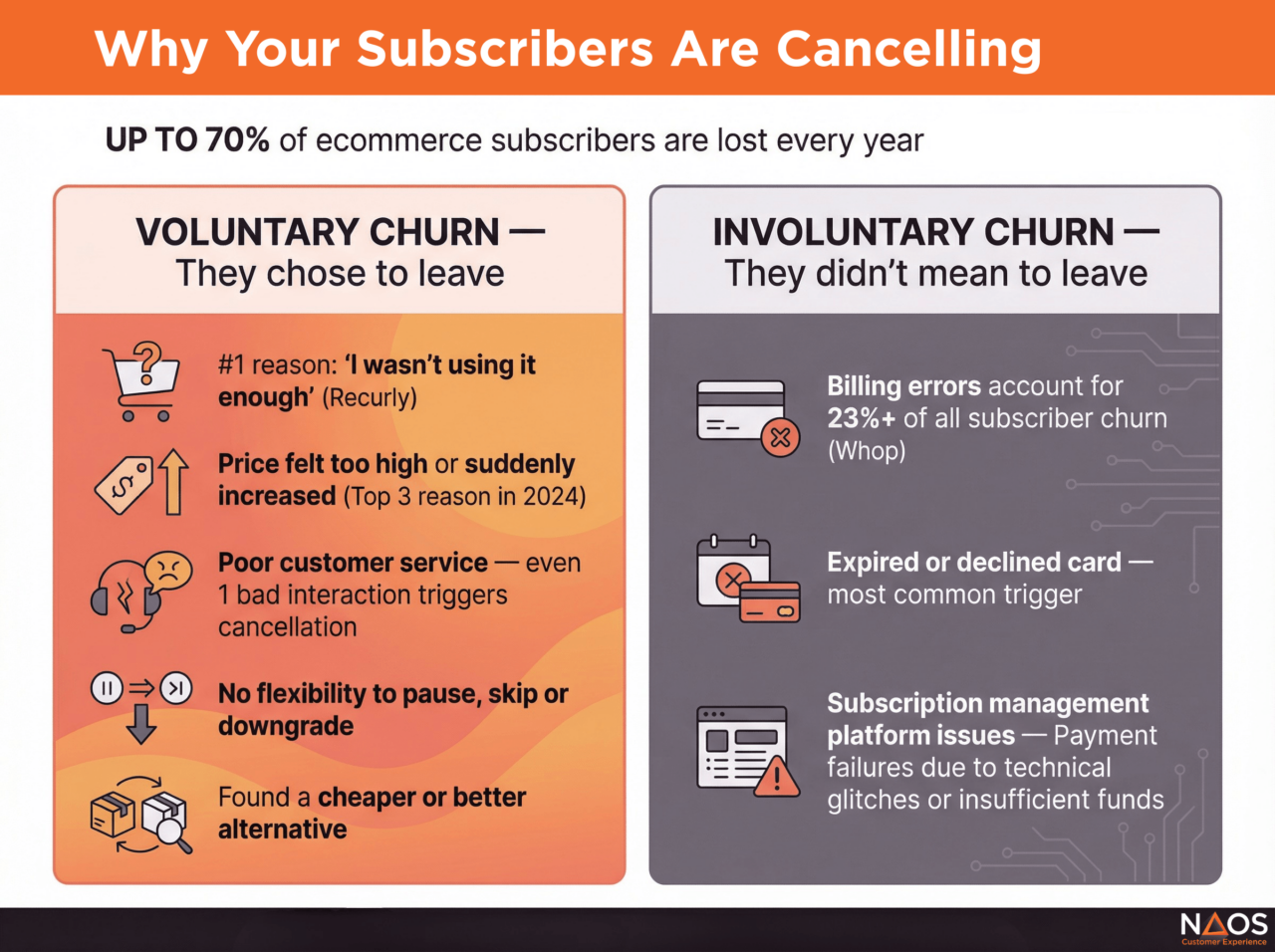
The top 3 reasons subscribers cancelled in 2025 were: wanting to reduce spending, no longer needing the subscription, and dissatisfaction with price increases. Meanwhile, billing errors alone account for more than 23% of all subscriber churn.
Customer service sits at the intersection of both types — and with the right approach, it can prevent the first and recover the second.
TIP #1 – NAIL THE SUBSCRIBER ONBOARDING EXPERIENCE
Make the first 30 days count
“I wasn’t using it enough” is the single most common reason subscribers cancel. That means churn prevention does not start when a customer complains — it starts the moment they sign up.

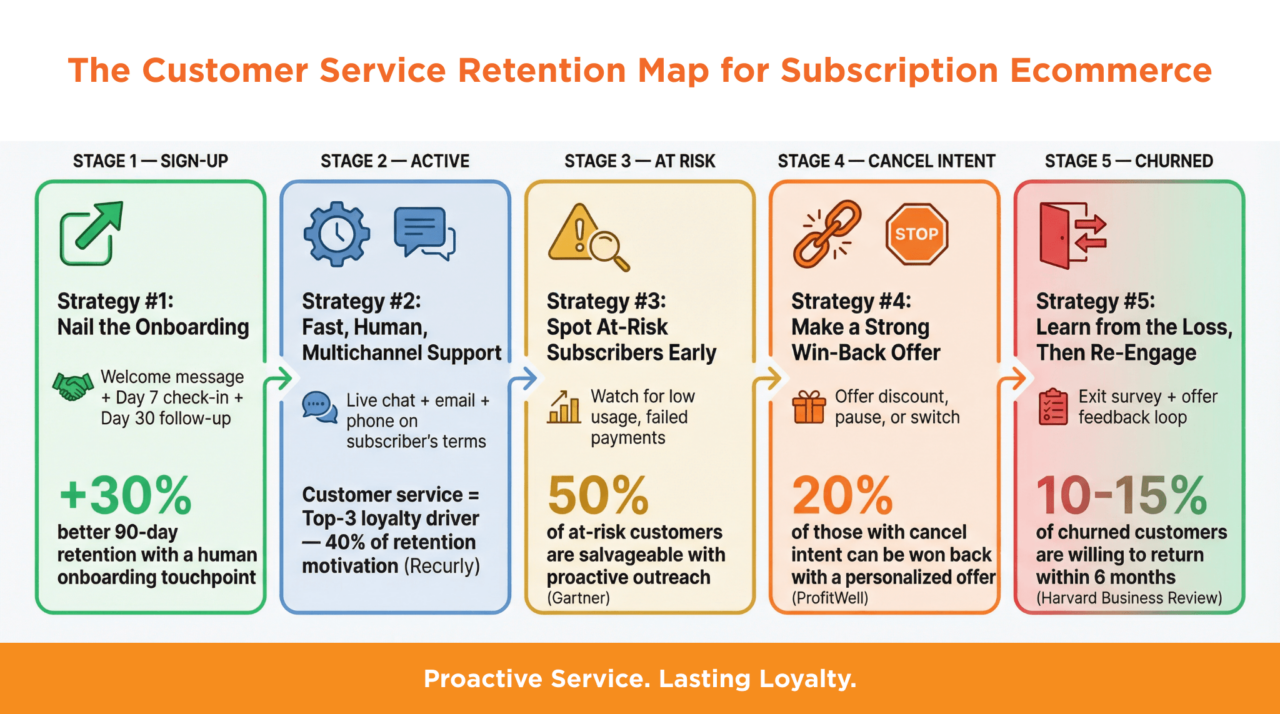
A strong onboarding sequence, led by your customer service team, ensures subscribers understand what they have access to, how to use it, and why it matters to them specifically. Onboarding that includes a human touchpoint — a welcome call, a personalised check-in, or a proactive support message — yields up to 30% higher 90-day retention than fully automated onboarding.
For ecommerce subscription boxes, this means setting clear expectations around delivery cadence, customization options, and how to make changes to an order. For SaaS-adjacent subscription products, it means guiding subscribers to the features that match their stated goals.
The more value a subscriber sees in the first 30 days, the less likely they are to leave in month two.
TIP #2 – OFFER FAST, HUMAN, MULTICHANNEL SUPPORT
Speed and humanity are non-negotiable
Poor customer service is explicitly listed among the top reasons subscribers cancel — and even a single negative interaction can be enough to trigger churn. Thirty-minute hold times and unanswered emails are not just frustrating; they are business-ending for subscription brands.
Today’s subscribers expect to reach you on their terms, whether that is live chat, email, phone, or social media. A multichannel support model is no longer a competitive advantage. It is the baseline.

Automation has its place in support, but it cannot replace human empathy at critical moments. When a subscriber is frustrated or confused, they need to feel heard by a person, not bounced between chatbot flows. Teams that combine smart automation with seamless human escalation retain subscribers at significantly higher rates than those that rely solely on self-service.
If your internal team cannot cover the volume or the hours, outsourced customer service can fill that gap — without the overhead of building a full in-house operation.
TIP #3 – SPOT AT-RISK SUBSCRIBERS BEFORE THEY CANCEL
Don’t wait for the cancel button
By the time a subscriber clicks “cancel,” the decision is often already made. The most effective retention move is to intervene before that moment.
Churn intent appears in your data long before it becomes a cancellation. Watch for: a drop in product usage, visits to the account management or cancellation page, declining email engagement, or a sudden spike in support tickets. These are signals your team can act on.

Proactive support — reaching out to a customer before they escalate an issue — reduces churn by 27% among subscribers who had already experienced a problem. That is a significant recovery rate, simply from getting ahead of the conversation.
A CRM-flagged workflow makes this scalable. When a subscriber meets a set of at-risk criteria, an agent is automatically alerted and reaches out with a personalised touchpoint — acknowledging the inactivity, sharing a relevant tip, or simply checking in. Chargebee documents this approach in action with Powtoon, which uses automated flags to trigger personalised agent outreach before a cancellation ever occurs.
TIP #4 – GIVE SUBSCRIBERS FLEXIBILITY TO STAY
A pause is better than a cancellation
One of the most impactful — and most underused — retention tools in ecommerce subscriptions is flexibility. Many subscribers do not want to cancel permanently. They want to pause, skip a delivery, downgrade, or swap a product. When they cannot do that, they cancel by default.
Subscription brands that offer flexible pause and skip options reduce churn by 11–20%. The numbers are clear: giving subscribers more control over their subscription keeps them in it longer.
Your customer service team plays a critical role here. When a subscriber contacts support expressing hesitation, whether about price, delivery frequency, or relevance, agents need to be trained and empowered to offer alternatives before processing any cancellation. A simple “Would you like to pause for a month instead?” can save a subscriber who would otherwise be gone.
This is especially relevant for ecommerce subscription boxes, where over-accumulation (“I have too much product“) and seasonal changes in need are among the most cited cancellation reasons.

TIP #5 – BUILD A SAVE STRATEGY FOR CANCELLATION MOMENTS
Turn the cancel flow into a retention tool
When a subscriber initiates a cancellation, most ecommerce brands simply process it. That is a missed opportunity every single time.
A properly built save strategy turns the cancellation moment into one last chance to address the subscriber’s concern and offer a resolution. The key is understanding why they are leaving first, then responding to that specific reason rather than presenting a generic discount.
Exit surveys alone are not enough. The difference between a saved and a lost subscriber is whether your team actually offers to resolve the issue. A subscriber cancelling because of price responds to a loyalty discount or a downgrade option. One cancelling because of a product issue responds to a replacement or a personalised recommendation. One cancelling due to low usage responds to re-education about features they have never tried.
For high-value subscribers, the save conversation should be handled by a trained agent, not left to an automated flow. That human moment of acknowledgement and action is what makes the difference.
TIP #6 – RECOVER FAILED PAYMENTS BEFORE THEY BECOME LOST SUBSCRIBERS
Don’t let a billing error cost you a subscriber
Involuntary churn is one of the most overlooked problems in subscription ecommerce and one of the most fixable. Billing errors account for more than 23% of all subscriber churn. These are subscribers who did not choose to leave. They were simply lost to a technical failure.
Early detection and proactive outreach can reduce involuntary churn by 25–40%. That is a significant number of subscriptions — and revenue — recovered through a single operational improvement.
The playbook is straightforward: monitor card expiration dates and alert subscribers before a payment fails, not after. When a payment does fail, the outreach must feel human, not automated. A message that is on-brand, warm, and direct — rather than a cold system notification — significantly improves the response rate.
Personalised SMS reminders for subscription renewals have been shown to reduce involuntary churn by 20–35%. Your CS team should own this touchpoint, ensuring the tone is consistent with the rest of the subscriber experience.
TIP #7 – WIN BACK CHURNED SUBSCRIBERS WITH A CS-LED RE-ENGAGEMENT
Churned is not gone forever
A subscriber who has already cancelled is not necessarily a lost customer. They know your brand. The acquisition cost is already spent. And if the right re-engagement message reaches them at the right moment, many will return.
Re-engagement sequences sent at 30, 60, and 90 days after cancellation recover between 6% and 22% of inactive subscribers, depending on the industry and offer. That is a meaningful recovery rate from a segment most brands have already written off.
The most effective win-back messages do two things: they acknowledge the reason the subscriber left (if known from exit data), and they present something new — a relevant offer, a product update, or a personalised incentive. A generic “We miss you” email underperforms significantly against a message that says “We heard you had too much product. Here is how we have made it easier to manage your subscription.“
Your customer service team is the right function to own this touchpoint. They have the context, the tone, and the human dimension that a purely automated campaign cannot replicate.
CONCLUSION – Taylor Customer Service For Subscription, Your Best Retention Strategy
Churn is not inevitable. In most cases, it is a signal that a subscriber felt unseen, unsupported, or underserved at a critical moment in their journey.
The 7 strategies above all share a common thread: a customer service team that is proactive, empathetic, and empowered to act. From the first onboarding message to the last win-back sequence, CS is the function that holds the subscriber relationship together.
As your subscription base grows, so does the volume and complexity of those moments. Scaling a CS operation that delivers consistently across every touchpoint, in every time zone, and across every channel is not a small ask for most ecommerce brands.
Is your customer service team currently equipped to retain subscribers at every stage of their journey — from onboarding to cancellation to win-back?
If you are looking to build a retention-first support operation without the overhead of scaling in-house, our ecommerce CX specialists are ready to help. Contact the NAOS CX team and let’s talk about what a tailored support model could look like for your subscription business.