Defining the right outsourcing SLA with an external service provider is not easy! Make sure your customers’ time is effectively valued. You will have to define the level of service they expect and lay out the metrics for measuring the outsourced service’s success.
Before talking about SLA departments and metrics, we must first define SLA.
What Are Outsourcing SLAs, And Why Do They Matter?
SLA stands for Service-Level Agreement. It’s an agreement between the customer and the service provider that defines the level of service the customer expects and outlines the metrics, remedies, and penalties.
Any significant contract between two parties may be subject to deliberate or inadvertent misinterpretation. Therefore, an SLA protects the rights of both parties. SLA pulls together all the details of the contracted services in a single document and clearly defines the metrics, responsibilities, and expectations in the event of service issues; neither party can plead negligence to defend itself.
Setting the correct service-level agreement is crucial: it must be demanding enough to satisfy your customers and realistic enough for the service provider to meet.
Main Metrics and KPIs for Customer Service
In customer service, the following metrics are central to the SLA:
- Average response time: How long it takes to start handling a customer contact (calculated for the whole team or every agent in a selected period = Total time taken to respond divided by the number of responses).
- Average resolution time: How long it takes to resolve an issue. Divide the number of tickets solved in the chosen period by the total time taken to resolve tickets during the selected period.
- First contact resolution rate: How much the customer service successfully solves customer queries during the first contact.
These metrics should also be embedded within an outsourced customer service governance framework that covers quality, reporting, escalation, and continuous improvement.
Expected Service Level Agreement (SLA) for each customer interaction type
Each brand and each channel in your customer service has its own specifics. So you will set up the right SLA for outsourcing customer service for calls, emails, live chat, and social media moderation that best suit your customer’s expectations… and the penalties to apply when breaches of SLA occur.
Let’s have a look at the commonly admitted SLA by customer service industry standards:
SLA for Incoming Calls
For incoming calls, you should target at least the following SLA:
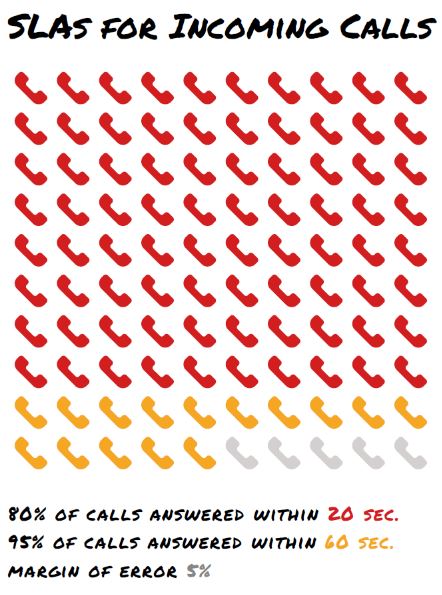
- First Contact Resolution: around 80% of resolved cases, but that KPI will likely vary greatly according to your industry.
- A maximum of 5% of monitored calls with critical errors
- A maximum of 10% of monitored calls with non-critical errors
SLA for Emails
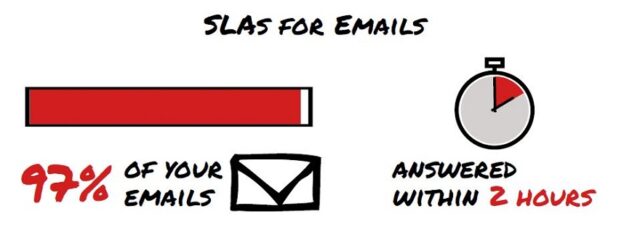
Your Customer Service should answer 97% of your customer’s emails within 2 hours.
For example, a good practice is to send an automatic confirmation email to the customer to let them know the email has been received and will be handled as soon as possible.
SLA for Social Media Moderation
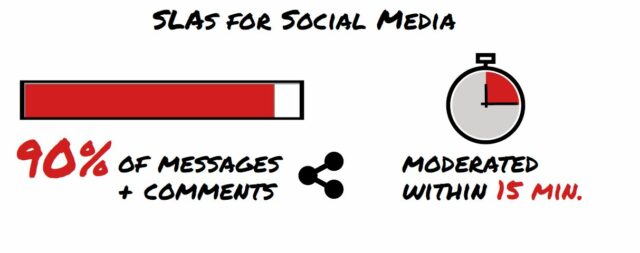
The Customer Service Department should be able to moderate 90% of the comments from your social media profiles within 15 minutes.
Each comment or message will be reviewed, tagged for sentiment analysis, or replied to when needed. The moderator will instantly handle comments like “Love this!” just by reviewing it. But for more complex requests, the moderator informs the customer that he is looking for the answer and will get back to them ASAP.
SLA for Livechat and Instant Messaging
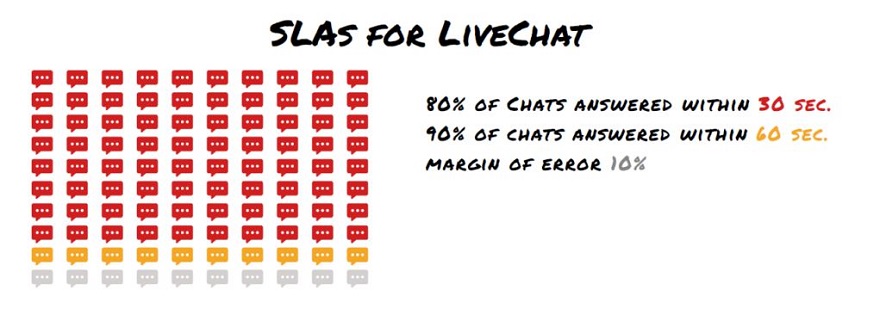
A challenging but achievable SLA for outsourcing would be to answer 80% of newly initiated chat conversations within 30 seconds and 90% within 60 seconds.
The first messages in a chat conversation can be automated, greeting the customer and introducing the support agent by name.
Fortunately, we provide all customer experience services with an SLA. You can contact us.
You can consult the complete guide by following the link: