Insourcing the right HR functions can transform your department from overwhelmed to strategic—but only if you choose the right model for your specific business situation. If you’re an HR leader in Egypt facing the challenge of scaling your team while controlling costs, navigating new labor law requirements, and maintaining operational quality, this decision will define your department’s effectiveness for the next three years.

At NAOS Talents, we’ve spent 15 years helping Egyptian companies—from fast-growing startups to established multinationals—navigate this exact decision. This guide distills that experience into a practical framework designed specifically for Egyptian HR leaders managing growth in a changing regulatory environment.
By the end of this article, you’ll have a straightforward diagnostic process to determine whether insourcing, outsourcing, or a strategic hybrid approach fits your situation—with realistic timelines, clear responsibilities, and transparent cost structures. Your goal is to build an HR strategy that delivers flexibility, compliance, and control. Let’s show you exactly how to achieve it.
UNDERSTANDING YOUR OPTIONS: WHAT INSOURCING AND OUTSOURCING ACTUALLY MEAN
Before you can choose, you need clear definitions that go beyond theory to practical implementation.
Insourcing: Control Meets Flexibility
Insourcing is a tripartite employment model in which a specialized HR provider legally employs staff who work under your direct operational control. These team members can work at your premises or in a dedicated facility, but the key distinction is that you maintain daily management authority.
In this arrangement, you control the operational elements that directly impact business outcomes. Your managers assign daily tasks, set performance expectations, conduct training sessions, and decide who joins or leaves the team. You establish the KPIs that define success, evaluate whether team members meet your standards, and maintain the cultural integration essential to your organization.

Meanwhile, your HR provider manages the employment infrastructure that often overwhelms internal HR departments. They handle employment contracts, process payroll, administer benefits, ensure compliance with Egyptian Labor Law, manage tax filings, and guarantee staff replacement when turnover occurs—all according to service level agreements that protect your operations from disruption.
Think of insourcing as having your own team with all the operational control that entails, while eliminating the administrative complexity and compliance risks that typically accompany employment. You get the best of both worlds: direct management of how work gets done, combined with professional handling of employment legalities.
Outsourcing: Delegation with Distance
Outsourcing means your insourcing provider manages both employment AND operational delivery. Staff work at their facilities under their supervision, delivering defined outcomes in accordance with service-level agreements (SLAs).
You define:
- Service level agreements and deliverables
- Quality benchmarks and reporting requirements
- Expected outcomes and success metrics
Your insourcing provider manages:
- Everything operational: recruitment, training, supervision
- Infrastructure and technology
- Day-to-day problem-solving
- Compliance and legal obligations
In outsourcing, you’re buying outcomes, not managing people.
The Critical Difference
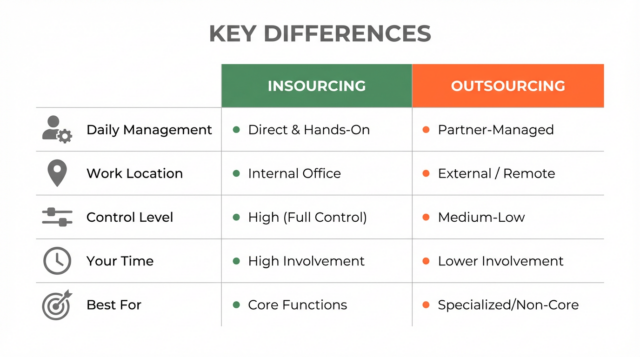
| Aspect | Insourcing | Outsourcing |
| Who manages daily work? | You and your supervisors | NAOS managers |
| Where do staff work? | Your premises (or dedicated facility) | NAOS facilities |
| Control level | High—direct management | Moderate—outcome oversight |
| Your time investment | Moderate (operational management) | Low (SLA monitoring) |
| Best for | Brand-critical, complex roles | Transactional, standardized work |
The fundamental question that separates these models is simple but profound:
Do you need to manage how work gets done, or can you achieve your objectives by defining the outcomes you need?
When customer interactions directly reflect your brand values, when work requires contextual judgment that can’t be codified in procedures, or when roles must integrate deeply with internal teams, the “how” matters as much as the “what.” In these situations, insourcing’s operational control becomes essential.
THE DECISION FRAMEWORK: 5 QUESTIONS TO GUIDE YOUR CHOICE
Work through these questions systematically. Your answers will reveal which model fits your situation.
Question 1: How Much Operational Control Do You Need?
High control need → Insourcing
You need insourcing when:
- Customer interactions directly impact brand reputation
- Work requires judgment and contextual decision-making
- Business conditions change rapidly, requiring daily operational pivots
- Roles must integrate deeply with internal teams
Real example: A luxury hotel chain in Sharm el-Sheik needed multilingual concierge staff who embodied their service philosophy. Outsourcing couldn’t deliver the brand alignment they required. Through insourcing with NAOS, the hotel retained operational control while NAOS handled compliance—providing both quality and cultural fit.
Moderate control needed → Outsourcing
Outsourcing works when:
- Functions follow standardized, repeatable processes
- Success is measurable through objective KPIs
- Work operates independently from core operations
Diagnostic test: Could you document 90% of this role’s requirements in a 10-page SLA?
- If yes → Outsourcing can work
- If no → You need insourcing’s operational control

Question 2: Do You Have Management Infrastructure?
Infrastructure exists → Insourcing becomes viable
You can implement insourcing when you have:
- Supervisors who can provide daily operational direction
- Performance management processes in place
- Appropriate workspace (or budget for dedicated facility)
- Training capability for role-specific skills
Infrastructure lacking → Outsourcing makes sense
Choose outsourcing when:
- Existing managers are fully occupied
- You lack supervision expertise for this function
- Your team must focus on strategic priorities
Critical reality: Insourcing doesn’t mean doing everything yourself—NAOS handles compliance and administration. But you MUST have managers who can lead team operations.
Question 3: How Standardized Is the Work?
Variable work → Insourcing
- Each situation requires different approaches
- Success depends on understanding your specific business
- Quality is qualitative, not just metric-based
Standardized work → Outsourcing
- Processes follow established playbooks
- Quality measured by clear metrics
- Limited variation in daily activities
The “it depends” test: When describing the work, how often do you say “it depends on the situation”? Frequent use signals you need to exercise control through insourcing.
Question 4: What’s Your Timeline?
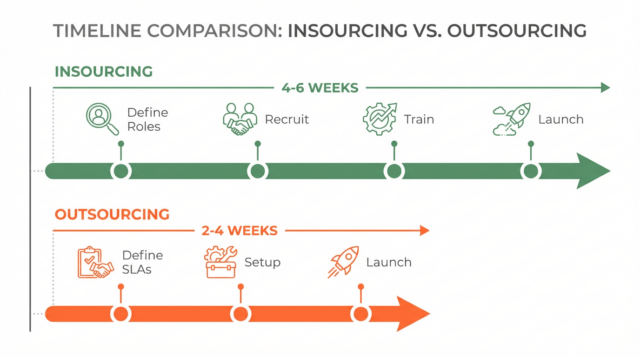
Need rapid launch (2-4 weeks) → Outsourcing
- Outsourcing delivers operational capability immediately
- Provider supplies facility, technology, and trained management
- No setup required on your end
Building for growth (4-6 weeks acceptable) → Insourcing
- Time to establish proper management systems
- Investment in team continuity pays off
- Possible to internalize later if desired
Question 5: What Are Your Cost Priorities?
Transparency and optimization → Insourcing
- Line-item visibility into all costs
- Pay for actual headcount and hours
- Ability to optimize based on data
- Costs adjust immediately with business needs
Predictability and simplicity → Outsourcing
- All-inclusive pricing covering all operations
- Fixed monthly costs for budgeting
- Provider absorbs turnover and infrastructure costs
- One invoice, simplified accounting
McKinsey research on organizational agility shows that companies with flexible workforce models can achieve 20-30% cost reductions through efficiency gains, underscoring the competitive advantage of adaptable HR strategies.
THE EGYPTIAN CONTEXT: WHY THIS DECISION MATTERS MORE HERE
Egypt’s business environment adds specific dimensions that make the wrong choice particularly costly.
Labor Law Uncertainty
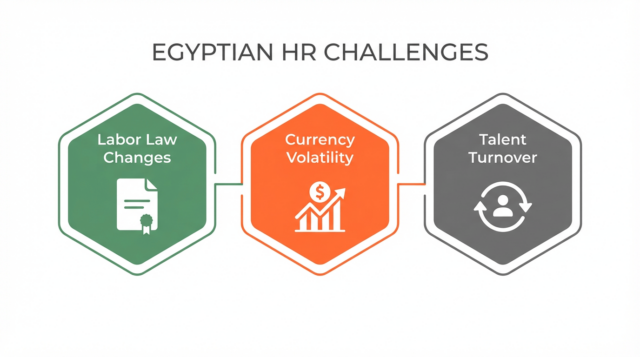
The new Egyptian Labor Law, effective September 2025, introduces changes to termination procedures and contract requirements. While these reforms aim to improve employment protections, they also increase the complexity and cost of managing permanent employees—particularly when business conditions require downsizing.
Both insourcing and outsourcing protect from this uncertainty because your service provider maintains the formal employment relationship, handles compliance complexity, and absorbs regulatory changes.
The advantage: You gain the flexibility to adjust headcount based on business needs without incurring termination costs or compliance violations.
EGP Volatility
Currency volatility creates another layer of complexity. EGP devaluation makes permanent salary commitments unpredictable in hard-currency terms. Both insourcing and outsourcing create variable cost structures that allow you to adjust capacity based on revenue realities, but they differ in cost transparency.
Both models offer variable cost structures, but differently:
- Insourcing provides direct visibility into salary costs and benefits, enabling optimization based on actual spending.
- Outsourcing offers bundled service fees that simplify budgeting but provide less granular cost control.
Your choice depends on whether your CFO prioritizes transparent optimization or predictable planning.
High Turnover in Entry-Level Roles
Egypt’s talent market dynamics present a third consideration. Entry-level customer service, sales, and operational roles often experience annual turnover exceeding thirty to forty percent in some sectors. This creates constant recruitment pressure on HR departments.
Both models address turnover but differently:
- Insourcing typically includes automatic replacement guarantees in service-level agreements—the provider recruits and presents new candidates at no additional cost while you maintain selection control.
- Outsourcing removes turnover management from your responsibility, with the provider handling all recruitment, training, and transitions internally.
THE HYBRID APPROACH: WHY YOU MIGHT NEED BOTH
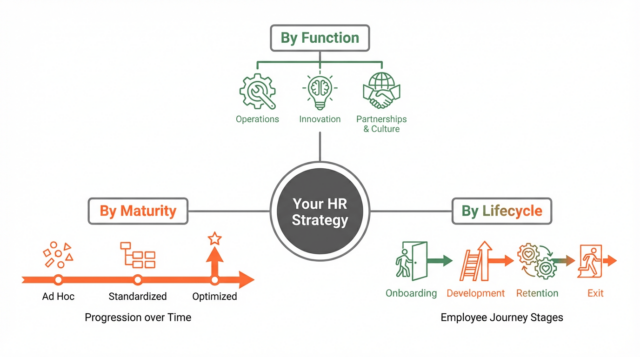
Sophisticated HR strategies often combine both models. Different functions have different requirements.
Segmentation by Function
Real example: A premium healthcare provider in Cairo uses:
- Insourcing: 35 patient care coordinators (brand-critical, requires empathy and medical knowledge)
- Outsourcing: Recruitment for nursing staff (150+ hires annually, transactional process)
- In-house: Physician recruitment (strategic, requires medical director involvement)
Result: Each function operates under the optimal model.

Segmentation by Maturity Stage
Many companies evolve through phases:
Phase 1 (Market Entry): Outsource everything for rapid launch
Phase 2 (Growth): Transition core functions to insourcing for control
Phase 3 (Maturity): Internalize strategic roles, maintain insourcing for flexibility
Real example: A European tech company entering Egypt outsourced their 40-person sales team initially for speed. After six months, they transitioned to insourcing for operational control. At 18 months, they hired top performers permanently while maintaining insourcing to maintain flexible capacity.
The learning: Your optimal model today may not be optimal in 18 months. Build with partners who support evolution.
MAKING YOUR DECISION: PUTTING IT ALL TOGETHER
Let’s return to Rajia. After working through the framework, her path became clear:
Her situation:
- Control need: High—pharmacy consultations require judgment and brand alignment
- Management capacity: Yes—supervisors can lead operations
- Work standardization: Low—each customer interaction is different
- Timeline: 6 weeks acceptable
- Cost priority: Transparency for regional analysis
Her decision: Insourcing for customer-facing roles, outsourcing for seasonal warehouse hiring.
The result: A hybrid strategy matching each function to its optimal model.
THE COST OF CHOOSING WRONG
This framework isn’t academic—it protects you from consequences that affect your business in concrete ways.
Choose outsourcing when you need insourcing, and you’ll lose control over brand-critical customer interactions at the precise moment when service quality determines competitive position. You’ll find yourself trying to influence outcomes through contract negotiations and SLA amendments rather than direct operational management. Quality issues require formal escalation processes instead of immediate coaching conversations. Cultural integration becomes impossible when team members identify with their employer—the service provider—rather than with your organization.
Choose insourcing when you should have outsourced, and you’ll overload managers with supervision responsibilities that prevent them from focusing on strategic priorities. You’ll invest time in recruiting, training, and managing functions that could have been delegated entirely. Your HR team will remain trapped in operational firefighting rather than developing the strategic capabilities that create competitive advantage.
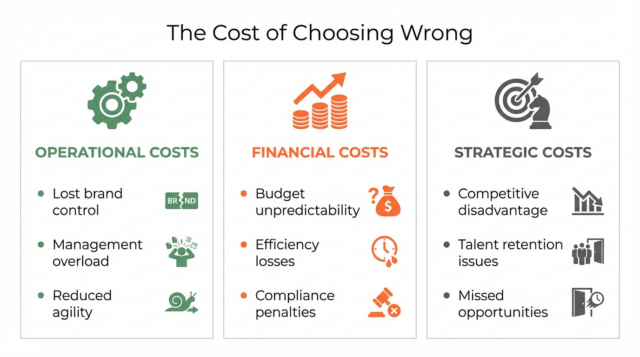
Both mistakes create financial costs through budget unpredictability, efficiency losses from mismatched operational models, and potential compliance penalties from inadequate legal expertise. They incur strategic costs through competitive disadvantage when market response speed matters, talent retention issues from poor integration approaches, and missed opportunities because inflexible workforce models prevent you from adapting to changing conditions.
The good news is that you don’t have to choose permanently. Hybrid approaches and phased transitions let you evolve as business maturity and operational knowledge grow. What matters most is working with HR services providers who understand the complexity of Egyptian labor law, market dynamics, and operational excellence—and who support evolution rather than locking you into static arrangements.
YOUR NEXT STEP
You now have a framework that provides diagnostic clarity:
Choose Insourcing when:
- You need operational control over daily management
- Brand-critical functions require cultural alignment
- Work involves judgment and context
- You have supervisors ready to lead
- Cost transparency matters for optimization
Choose Outsourcing when:
- Functions are transactional and standardized
- Speed to market is critical
- You want complete operational delegation
- Quality is measurable through clear KPIs
- Bundled pricing simplifies budgeting
Consider Hybrid when:
- Different functions have different requirements
- You’re in a transitional growth phase
- You want to optimize across multiple dimensions
CONCLUSION: Ready to Build Your Optimal HR Strategy?
The right HR model doesn’t just solve today’s staffing challenges—it builds the operational foundation for your next phase of growth.
Unsure which model fits your situation?
Our HR strategists at NAOS Talents have guided dozens of companies through this decision. We’ll walk through your specific requirements, management capacity, and growth plans—then recommend the optimal approach with transparent pricing.
No sales pressure. Just strategic clarity.
In a complimentary 30-minute consultation, we’ll help you:
- Diagnose your situation using this decision framework
- Understand implementation timelines
- See transparent cost structures for both models
- Explore hybrid approaches if multiple models make sense
- Map an evolution strategy as your business matures
Are you considering externalizing HR functions or optimizing your current workforce model? Contact our HR Strategy experts at NAOS Talents to explore the right solution—whether insourcing, outsourcing, or a strategic combination.
The right decision builds the foundation for sustainable growth. Let’s make sure you choose wisely.
About NAOS Talents: For over 15 years, NAOS Talents has secured the HR needs of leading Egyptian and multinational companies through insourcing, outsourcing, and recruitment solutions. We deliver fast, reliable talent acquisition, optimize HR departments for core activities, and maintain 100% labor law compliance.

2 comments
Pingback: Staff Insourcing for In-House Contact Center | HRO Blog
Pingback: Insourcing Staff: Optimize Workforce Strategy | HRO Blog
Comments are closed.