Staff insourcing is a solution for businesses looking to streamline their HR departments and tackle recruitment challenges head-on. It allows businesses to keep HR functions agile, maintain control over costs, and ensure quality and compliance.
In this blog, we dive into how staff insourcing can transform your HR operations. We cover everything from cost benefits and flexibility to integration with your current team while keeping you 100% labor law compliant.

This article, designed for HR professionals across the MENA region, offers practical insights and real-world applications to help you make informed decisions about your HR strategy. Read on to discover how staff insourcing can help you meet your recruitment goals, manage seasonal workforce changes, and keep your HR department lean and efficient.
WHAT IS STAFF INSOURCING AND WHEN TO CONSIDER IT?
Staff insourcing is an innovative HR solution for companies seeking flexibility and cost-effectiveness in managing their workforce. This hybrid model between traditional employment and outsourcing gives the Client Company operational control over the staff while the Insourcing Provider manages the administrative and contractual aspects.
Understanding Insourcing
This method involves a tripartite relationship in which the client company engages an insourcing provider to administer employment-related contractual and administrative aspects, while staff work under the client’s operational control and on the provider’s premises.
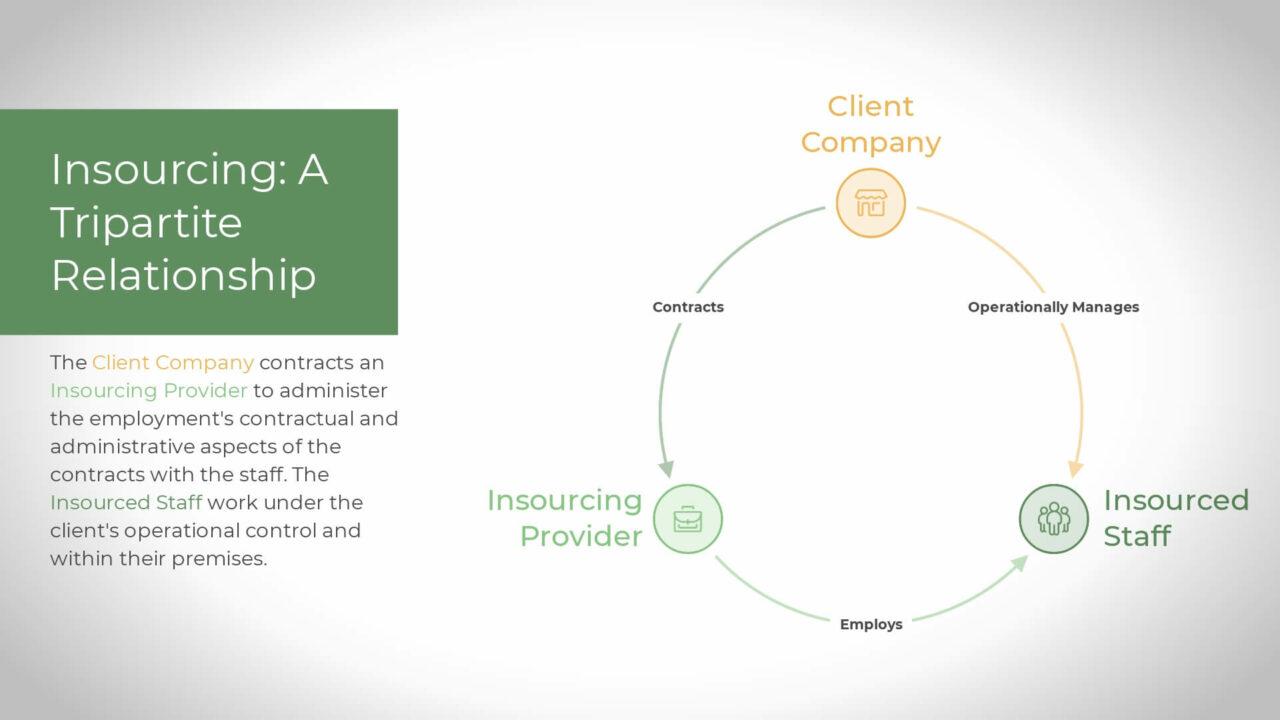
Defining the Parties and Their Roles:
- Client Company: Typically, a company requires customer service. It possesses or invests in the necessary infrastructure, such as offices or a contact center, and retains middle management to supervise the insourced staff’s daily operations.
- The Insourcing Provider: An external partner tasked with the recruitment, employment, and administrative management of the staff, ensuring legal compliance and HR processes.
- The Insourced Staff: Skilled individuals employed by and on the payroll of the insourcing provider. They work on the client’s premises and operate under their guidance. The insourced staff fully integrates into the client’s culture and day-to-day operations.
When a company opts for staff insourcing, it gains a partner to handle employee management, hiring, training, and legal compliance. This partnership relieves the client company’s HR department of a significant administrative burden.
On the other hand, employees receive a structured, compliant employment relationship, with all legal aspects meticulously managed by the provider.
Characteristics of Staff Insourcing
Integration and Control
Staff insourcing gives a company operational control over its team while delegating administrative burdens to the insourcing provider. This symbiotic relationship ensures that, when it comes to workforce adjustments, the provider adeptly navigates the complexities of labor laws governing terminations and contract changes, mitigating legal risks and safeguarding compliance.
The recruitment process is also a collaborative effort. The client company and the insourcing provider agree on the requisite headcount for forthcoming periods. To proactively address attrition, the provider typically proposes a candidate pool that exceeds headcount by about 25%.
From this pool, the client selects the final team, ensuring the quality and fit of each insourced worker.

Compliance and Expertise
Staff insourcing through an expert provider ensures compliance with labor laws, given their expertise and established practices in the Egyptian market. With a 15-year history, NAOS Talents brings a depth of knowledge and a robust system to ensure every employee’s legal and ethical management.
Quality Assurance through Service Level Agreements
The Staff Insourcer enforces Service Level Agreements (SLAs) that clearly outline service delivery expectations.
A pivotal aspect of staff insourcing is ensuring continuity and quality. The insourcing provider pledges to replace any insourced worker who leaves swiftly and at no additional cost. This automatic turnover replacement mechanism is part of the SLAs, which define service delivery standards and emphasize reliability and client satisfaction.

In summary, staff insourcing empowers companies to expand their operational capabilities while ensuring quality standards and local market competitiveness. This strategic approach to insourcing enables businesses to address immediate staffing needs and plan for long-term human resource development.
When to Opt for NAOS Talents’ Insourcing Services?
Opting for an insourcing provider’s services becomes strategically beneficial under certain circumstances:
- Infrastructure Availability: The client company must have or be willing to invest in the necessary infrastructure, including offices or a contact center, to accommodate insourced staff.
- Supervisory Capacity: Competent middle management should be in place to effectively oversee the insourced staff.
- Financial Flexibility: The client should recognize the financial prudence of transitioning from fixed labor to variable costs and appreciate this model’s cost savings and budgetary advantages.
- Seasonal or Project-Based Demands: Insourcing is particularly suited to companies experiencing significant fluctuations in activity or those with project-based scaling needs.
- High Turnover Mitigation: Insourcing will be attractive to companies seeking to reduce the HR department’s recruitment and administrative workload, especially in high-turnover sectors.
The conditions for a successful insourcing strategy include the client’s readiness to integrate new team members into their culture and daily operations, along with an understanding of the administrative relief and expertise the insourcing provider provides.

Determining whether insourcing is the right choice for your organization requires careful evaluation of your operational needs, management capacity, and strategic priorities. For a comprehensive framework to help you decide between insourcing and outsourcing, read our complete guide on choosing the right HR model for your business.
THE STRATEGIC BENEFITS OF STAFF INSOURCING
By partnering with a staff insourcing provider, companies experience a slew of strategic benefits:
- Increased Employee Satisfaction: NAOS Talents’ commitment to timely, accurate salary distribution and adherence to legal standards leads to higher employee satisfaction and retention.
- Optimization of HR Functions: HR departments at client companies are shifting from administrative to strategic roles, with a focus on talent development and operational strategy.
- Quality Service Delivery: NAOS Talents enforces comprehensive SLAs that ensure high service standards, align with client expectations, and maintain consistent customer service quality.
Variable Costs
The variable cost model offered by Staff Insourcing ensures clients pay only for services rendered, with costs fluctuating with workload.
Businesses can achieve remarkable flexibility in scaling their operations up or down without the commitments tied to traditional employment. This agility is critical for responding to market ebbs and flows, especially in sectors with pronounced seasonality or project-based workloads.
Cost-Effectiveness and Flexibility
Insourcing with NAOS Talents provides businesses with flexible staffing solutions that scale with business demand. This model is particularly effective for addressing seasonality, where staff ramp-up and ramp-down are managed smoothly without incurring the fixed costs associated with permanent hires.
Insourcing makes the cost structure variable and predictable, which is invaluable for budgeting and financial planning.
Impact on the HR Departments
For the HR department, insourcing eliminates time-consuming contract management, allowing them to focus on strategic initiatives.
The implementation of staff insourcing has a transformative effect on HR departments. With reduced administrative duties, HR professionals can devote their expertise to strategic initiatives such as talent development, employee engagement, and long-term organizational planning.
Expertise and Compliance
The insourcing provider’s expertise simplifies labor law compliance for its clients, offering a worry-free solution that aligns with Egyptian labor standards and international best practices.
HR Department Transformation
The ripple effect of staff insourcing on the HR department is profound. Integrating customer service agents into the core team transforms HR’s role from administrative work to strategic talent management.
This shift enables the department to focus on fostering employee engagement, tailoring development programs, and directly impacting the overall customer service experience.
In-depth comparison of insourcing versus outsourcing contact center agents
When managing contact center agents, companies often weigh in on insourcing versus outsourcing. Both models have distinct benefits and considerations, and the best choice depends on the company’s specific needs, resources, and strategic goals.

Here’s an in-depth comparison structured into a table to outline the key differences between insourcing and outsourcing contact center agents:
| Criteria | Insourcing | Outsourcing |
| Operational Control | High – The company retains control over day-to-day operations and agents’ management. | Varies – Control can be limited as the outsourcing partner manages agents. |
| Alignment with Company Culture | Seamless – Agents are integrated into the company’s culture and internal processes. | Limited – Agents are less immersed in the company’s culture due to physical and operational separation. |
| Cost Structure | Variable – Costs are based on actual usage and can scale with demand. | Fixed/Variable—Depending on the contract, costs typically combine fixed monthly fees with variable components based on service usage. |
| Compliance and Legalities | Provider’s Responsibility: The insourcing provider is responsible for compliance. | Outsourcer’s Responsibility – The outsourcing partner handles compliance, but specifics can vary by contract. |
| Flexibility in Staffing | High – Allows for quick scaling of staff numbers up or down, limited only by the client’s infrastructure. | Limited – Changes in staffing levels may require contract renegotiations. |
| Recruitment and Selection | Collaborative – The client has input on the final selection of candidates. | Outsourced – The outsourcing partner handles recruitment and selection independently. |
| Employee Training | Customized—The client actively participates in the training, especially on corporate culture, tailoring it to the company’s exact needs. | More Standardized – Training is often standardized to the outsourcing partner’s practices. |
| Turnover & Continuity | Included – Staff replacement is managed by the insourcing provider with no additional charge. | Depends – The outsourcer may experience high turnover rates, affecting service continuity. |
| Data Security and Privacy | Enhanced — Fewer communication channels lead to more secure data under the client company’s protocols. | Dependent — relies on the outsourcing agency’s data security measures. The client must evaluate its adequacy. |
INSOURCING IN ACTION: AN INSOURCING JOURNEY WITH NAOS TALENTS
Embarking on an insourcing journey implies establishing a strategic partnership between a client company and an insourcing provider. This journey transitions from initial negotiations to embedding a new operational culture within the client’s premises.
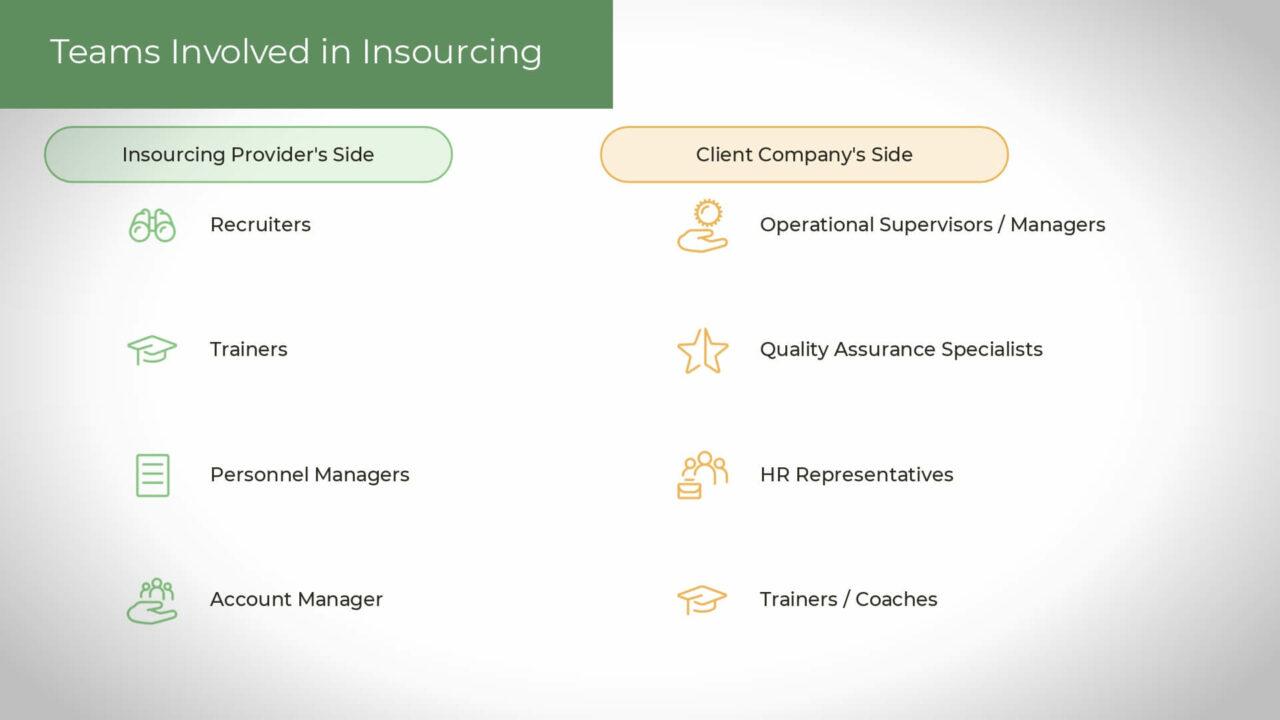
Roles and Teams Involved
From the Insourcing Provider
- Recruiters
These are specialist talent acquisition professionals employed by the provider. They identify and attract candidates who meet the job’s technical requirements and fit culturally with the client company.
- Trainers
The trainers, part of the provider’s team, conduct initial training sessions. They ensure that insourced staff have the necessary skills and a deep understanding of the client’s service standards and operational procedures.

- Personnel Managers
These HR experts oversee employee relations and benefits administration. They ensure employment practices comply with local labor laws. They facilitate smooth operations by managing the administrative aspects of the workforce.
- Account Managers
Account managers are the primary liaison between the insourcing provider and the client company. They ensure that all contractual obligations are met and the relationship is mutually beneficial, fostering clear communication and service satisfaction.
From the Client Company
- Operational Supervisors/Managers
These are the client’s representatives who directly manage the insourced staff’s day-to-day operations. They are crucial for guiding the insourced team and ensuring adherence to the company’s operational protocols and quality standards.
- Quality Assurance Specialists
While the provider offers training and sets quality standards, the client often requires QA specialists to continuously monitor and provide feedback on the insourced staff’s performance to ensure alignment with company standards.
- HR Representatives
While the provider handles most HR management, the client will also involve HR personnel in the selection process, particularly for activities such as culture-fit assessments and potential direct-hire evaluations.
- Trainers (optional)
The client may want to provide a part of the initial training.
Steps of the Insourcing Journey
The following walkthrough highlights each step of this collaborative process:
Kick-off Meeting
Following the signing of the service agreement, the kickoff meeting is crucial for aligning the scope of work, objectives, and processes. It involves comprehensive planning, during which the client company and the insourcing provider agree on the service’s operational details, expectations, and desired outcomes.
In the meeting, the client provides a detailed profile of the candidate’s requirements, such as education, soft and hard skills, and experience. The client specifies which qualifications are mandatory, which are desirable, and which are red flags or detrimental. The more comprehensive the profile, the faster recruiters can find the ideal candidates.
Initial Selection & Recruitment
During the initial selection and recruitment stage, the provider takes the lead in sourcing and interviewing candidates, selecting suitable candidates within 10-15 working days. This phase demonstrates the provider’s recruitment expertise, delivering a carefully curated list of potential hires to the client.
The client typically has the final say in evaluating the candidates and deciding whether to accept them for training.

Training & Onboarding
Once the client validates the staff, a 5-day intensive training and onboarding period ensues. During this time, insourced staff are equipped with the necessary skills and immersed in the client’s culture, ensuring a seamless transition into their roles.
Agents typically complete three days of training, covering the job, processes, tools they will use, and company culture. After the training, they spend one day shadowing a more experienced agent, whenever possible, to better understand the work. Finally, they complete a one-day role-play, which serves as the client’s HR team’s final evaluation.
The client’s operational teams typically provide ongoing training and coaching. If the client identifies insourced agents who demonstrate excellent performance or a strong cultural fit, they may hire them directly into their team.
The client company will comply with the terms of the insourcing agreement, which typically includes financial compensation to the insourcing provider.
Performance of the Service
As newly hired staff begin working at the client’s location, the operations management team monitors their daily performance. For efficient insourcing, it’s crucial to maintain clear communication between the client’s operational teams and the insourcer.
This communication should cover the agents’ Key Performance Indicators (KPIs), faults or errors, attendance records, reasons for sick leaves, and bonuses. Transparency and effective communication are critical to a successful insourcing operation.
Payroll & Taxes
Payroll and taxes are complex undertakings the insourcing provider manages monthly, tailored to attendance and performance indicators. This service significantly relieves the client’s HR department of a burden, allowing them to focus on strategic goals.
Scheduling of the Coming Period
In a forward-looking exercise, the operational team and the provider will review and analyze the workload and required personnel for the upcoming period. This step is critical to ensuring staffing levels align with anticipated business needs.
The insourcing provider guarantees the highest performance and quality standards throughout this journey. Their commitment extends beyond initial implementation; they provide ongoing support and maintain close contact to ensure continued success and adaptability.
Deliverables Offered
- Agent Selection: Sourcing suitable candidates who match the client’s requirements.
- Recruitment: Completing the hiring process efficiently and effectively.
- Initial Training: Providing comprehensive training programs to ensure agents are well-prepared.
- HR Management: Administering all HR-related tasks, fully compliant with Egyptian Labor Law.
Excellence in insourcing services is not merely an aspiration but a deliverable reality, exemplified by the provider’s dedication to aligning with the client’s culture, upholding stringent service-level agreements, and ensuring legal compliance.
This model’s collaborative nature ensures that both parties work together towards shared goals, leveraging each other’s strengths to create a synergy that drives success.

CONCLUSION
In 2024, the business landscape makes agility a strategic imperative for HR departments. Companies that engage in staff insourcing can scale their workforce in line with fluctuating demand, benefit from cost structures that reflect their operational realities, and enjoy enhanced employee satisfaction through systematic HR practices.
The commitment to partnership is a cornerstone of a successful insourcing model. By engaging a provider, companies gain a partner attuned to their staffing needs and committed to their long-term growth and evolution.
As businesses make complex decisions about customer service delivery, they should explore the bespoke solutions offered by NAOS Talents staff insourcing. Whether scaling operations, entering new markets, or seeking a more flexible HR approach, insourcing provides a viable, cost-effective option.
Contact us to learn how insourcing can transform your customer service operations and deliver direct benefits! Explore the possibilities, ask the critical questions, and take the first step towards an agile, efficient, and employee-centric model tailored for the modern business era.
Embrace the change. Explore the potential. Excel with insourcing.

2 comments
Pingback: Insourcing vs. Outsourcing HR | HRO Blog - NAOS Talents
Pingback: Insourcing Staff: Optimize Workforce Strategy | HRO Blog
Comments are closed.