Reclaiming the $260 Billion Bottom-Funnel Leakage

Takeaway 1: “Recoverable” vs. “Lost” — The CRO Mindset Shift
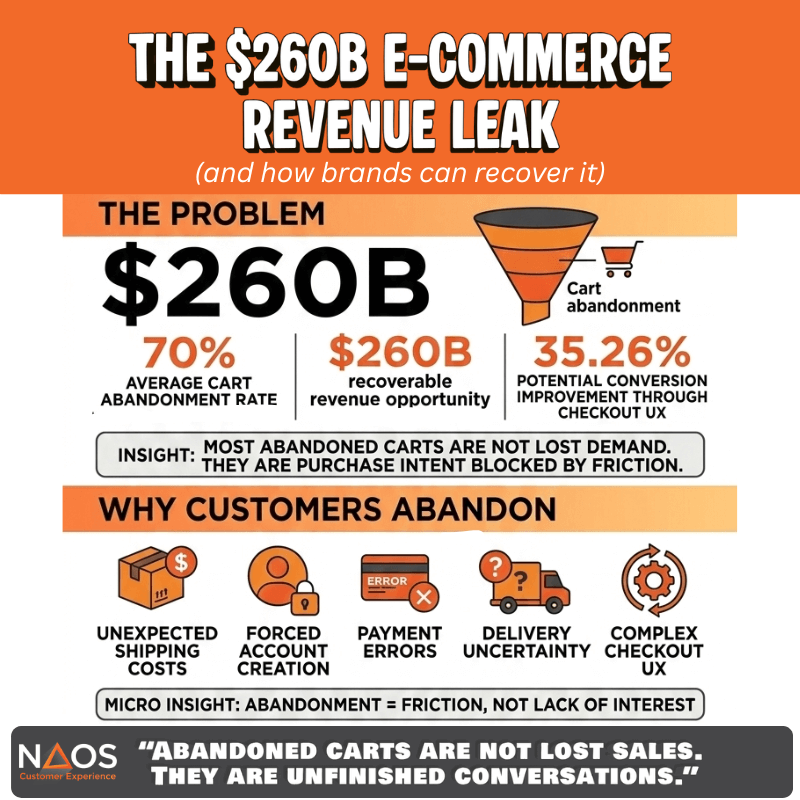
Usability research shows that 35.26% of potential conversions are lost due to checkout design and usability issues alone.
This insight changes the way CRO leaders must interpret abandonment data.
“The average large e-commerce site can gain a 35.26% increase in conversion rate through better checkout design.” — Baymard Institute
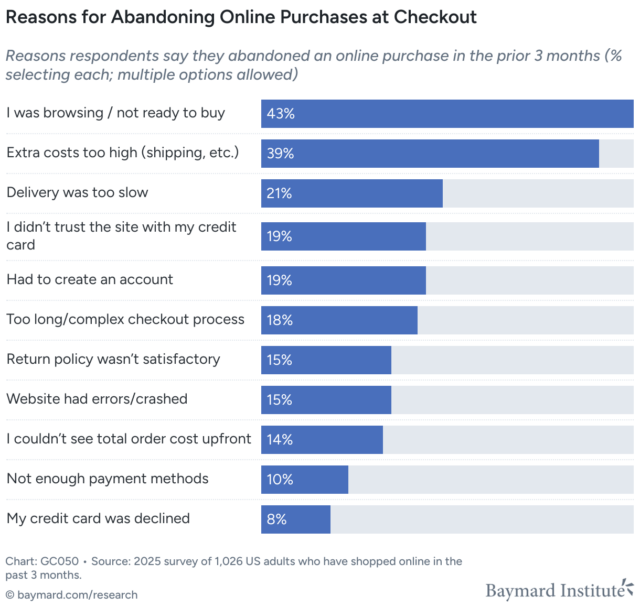
Research on checkout friction highlights that even small UX choices, such as requiring customers to create an account before checkout, can significantly increase abandonment rates.
From a conversion rate optimization (CRO) perspective, abandoned carts represent active buying signals.
The user has:
- Selected a product
- Initiated checkout
- Demonstrated price tolerance
- Invested time in the purchase process
This makes them one of the highest-value prospects in the entire customer journey.
However, the key question is not why they left, but rather how quickly the brand responds to the friction that caused the interruption.
Takeaway 2: The 3x Factor — Why Human Engagement Outperforms Automation
Email and SMS automation remain essential tools for scalable abandoned cart recovery.
Platforms like Shopify recommend a standard recovery cadence:
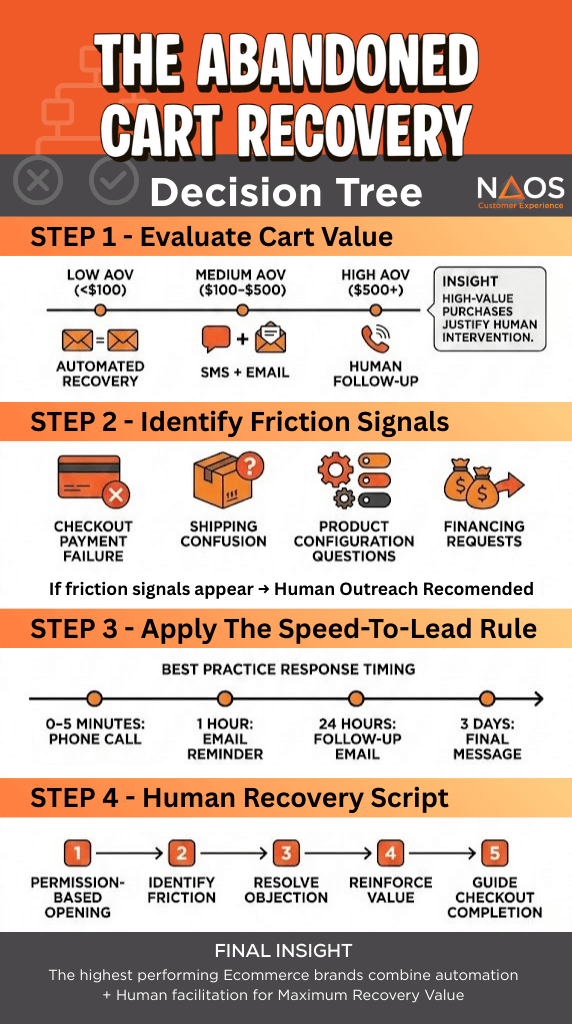
- First email after 1 hour
- Second reminder after 24 hours
- Final message after 3 days
Automated messages cannot diagnose issues such as:
- Payment gateway failures
- Shipping eligibility questions
- Financing options
- Product compatibility concerns
- Delivery timeline uncertainty
In high-value or complex purchase scenarios, human interaction becomes significantly more effective.

Similarly, studies cited by BIA/Kelsey indicate that phone interactions often involve higher-intent customers who are more likely to convert.
A trained recovery specialist can instantly:
- Clarify delivery timelines
- Adjust shipping methods
- Troubleshoot payment failures
- Answer product questions
- Offer alternative checkout solutions
Human engagement also introduces a second operational benefit: fraud detection and order validation.
High-value ecommerce orders frequently trigger automated fraud filters that may block legitimate purchases.
In fact, many ecommerce brands already deploy similar strategies to mitigate payment disputes. A detailed guide on this topic is available here:
https://naos-solutions.com/ecommerce-reduce-chargeback-rates/
Takeaway 3: Recover Abandoned Carts Decision Tree (AOV vs. Speed-to-Lead)
Not every abandoned cart deserves the same level of intervention.
The most efficient ecommerce operations adopt a decision tree based on two key factors:
- Average Order Value (AOV)
- Speed-to-Lead
The logic is simple: save human outreach for high-value, high-intent opportunities.
Priority 1: Human Outreach (“Call First”)
Certain abandoned carts signal strong buying intent and therefore justify immediate human follow-up.
These include:
- High AOV purchases
- Complex products
- Checkout friction signals
Customers who reached the final payment step but encountered an error or confusion are particularly valuable targets for recovery.
The 5-Minute Rule
Research from the MIT Lead Response Management study found that contacting prospects within five minutes of an inquiry dramatically increases the likelihood of conversion.

Priority 2: Automated Sequences (“Email/SMS First”)
Lower-value transactions or routine purchases typically benefit from automated recovery workflows.
Examples include:
- Low AOV products
- Repeat buyers
- Subscription renewals
- Impulse purchases
More details on how operational infrastructure supports ecommerce performance can be found here: https://naos-solutions.com/order-management-outsourcing-for-ecommerce/
Real-World Example: Recovering Lost Ecommerce Revenue
This strategy is already producing measurable results for ecommerce brands.
For example, check how a nutraceutical company partnered with NAOS CX to implement a structured cart recovery program using trained recovery specialists. Instead of relying solely on automated reminders, the team reached out to high-intent customers who abandoned checkout and helped them resolve payment or shipping concerns.
The outcome was a significant boost in checkout completion and recovered revenue from high-value carts.
You can view the full case study here:
Cart Recovery Success Story for a Nutraceutical Ecommerce Brand.
=> When human outreach is used strategically on the right carts, abandoned checkout sessions can quickly convert into completed orders.
Takeaway 4: The 5-Step Human-Centric Facilitator Script

Step 1: Permission-Based Opening
Start by respecting the customer’s time and autonomy.
Example:
“Hello, this is [Name] from [Brand]. I noticed you were exploring one of our products earlier today and wanted to check whether everything went smoothly during checkout.“
This approach positions the conversation as support, not sales.
Step 2: Friction Identification
Useful prompts include:
- “Did you encounter any technical issues during payment?”
- “Were there any questions regarding shipping or delivery options?”
- “Was there anything unclear about the checkout process?”
Step 3: Objection Resolution
Once the friction point is identified, the facilitator can resolve it immediately.
Examples include:
- Explaining shipping timelines
- Offering alternative payment methods
- Providing product clarification
- Assisting with checkout completion
Step 4: Value Reinforcement
At this stage, briefly reinforce the product’s value.
Example:
“Many customers choose this model because it integrates easily with existing systems and includes a two-year warranty.“
Step 5: Direct Path to Completion
Finally, simplify the path to purchase.
Options may include:
- Sending a direct checkout link
- Generating a manual invoice
- Completing the payment over the phone
Takeaway 5: Compliance by Design as a Conversion Tool
In regulated markets, customer outreach must operate within strict legal frameworks.
The European Data Protection Board (EDPB) provides guidelines on how businesses can rely on Legitimate Interest when contacting customers in certain commercial contexts.
Similarly, the UK’s Information Commissioner’s Office (ICO) provides guidance on direct marketing communications and consumer rights.
In the United States, the Telephone Consumer Protection Act (TCPA) outlines rules governing commercial phone outreach and the use of Do Not Call (DNC) lists.
Forward-thinking ecommerce companies implement “Compliance by Design”, ensuring that:
- Customers can easily opt out,
- Consent mechanisms are transparent,
- Contact frequency is limited,
- Data protection standards are respected.
Strategic FAQ To Recover Abandoned Carts
What is the industry standard abandonment rate?
The average ecommerce cart abandonment rate across industries is approximately 70%, according to Baymard Institute research.
Is the $260 billion figure realistic?
Yes. This estimate represents revenue lost specifically due to checkout usability problems rather than lack of purchase intent.
What follow-up cadence works best?
A widely used ecommerce recovery sequence is:
1 hour → reminder
24 hours → follow-up
3 days → final message
High-value carts may justify immediate phone outreach.
Is it legal to call customers about abandoned carts?
Yes, provided that brands respect regulations such as:
- Do Not Call lists
- Clear opt-out options
- Legitimate Interest principles under GDPR frameworks.
How should teams respond to “I didn’t have time”?
Treat this as a signal of friction rather than rejection.
A helpful response could be:
“I understand—would it help if I quickly walked you through the checkout so it only takes a minute?“
Which carts should be prioritized?
Focus on carts with:
- High AOV
- Checkout payment failures
- Complex products
- Shipping uncertainties
Conclusion: The Future of High-Converting Ecommerce
However, only humans can interpret nuance, rebuild trust, and resolve complex purchase barriers as they happen.
Final Thought