For most senior CX, Support, and Operations leaders, hesitation about customer support outsourcing rarely stems from cost. It comes from control. What happens to the brand voice? Who owns the data? How fast will we know when something breaks?

These are legitimate questions, not objections. And the honest answer is that customer support outsourcing, done well, gives leaders more control than an overloaded in-house team, not less. The shift starts with seeing outsourcing as a controlled operating model — not a hand-off. This article unpacks exactly how that model works.
What Customer Support Outsourcing Really Means Today
From cost play to controlled operating model
A decade ago, customer support outsourcing was framed as a cost-arbitrage decision. Today, that framing is outdated. Deloitte’s latest survey of more than 500 global executives confirms that outsourcing is shifting from a tactical cost lever to a strategic capability — driven by access to talent, AI integration, and operational agility (Deloitte Global Outsourcing Survey 2024).
The implication is significant. Customer support outsourcing is no longer about handing off a problem to the lowest bidder. It is about building a controlled operating model in which execution is delegated while strategy stays at home.
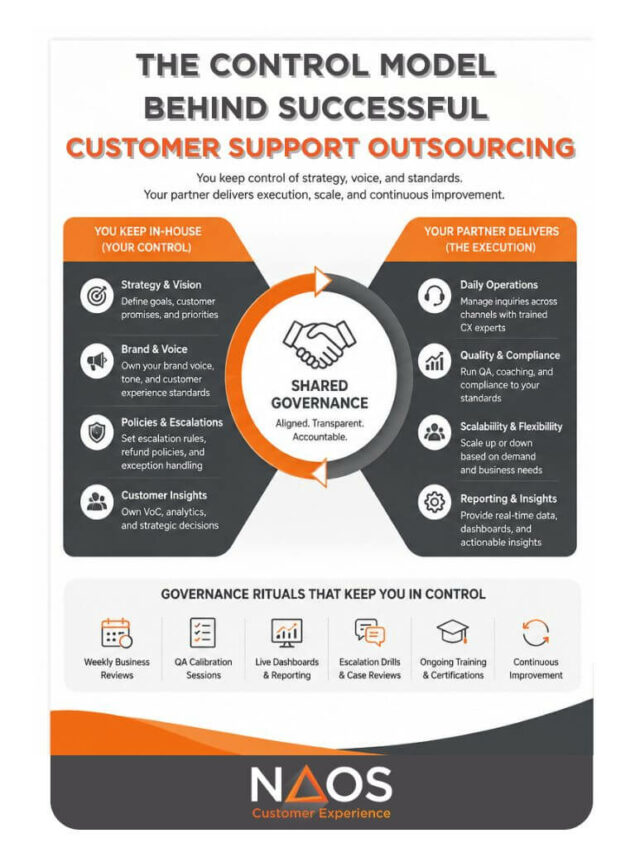
In the new model, the client company remains the owner of the customer relationship, the brand voice, and the performance bar. The outsourcing partner becomes the operator — running recruitment, training, scheduling, quality monitoring, and continuous improvement against that bar. For a deeper look at the strategic side, see the 5-step roadmap to outsourcing customer service.

What clients now keep vs. delegate
Senior CX leaders who succeed with outsourcing typically hold on to four things: the brand promise, the customer experience strategy, the escalation policy, and the analytics layer that turns voice of the customer into product decisions. Everything else — sourcing, training, workforce management, QA, reporting — is delegated to the partner under documented standards.
This split is what makes the model defensible to a board, a CFO, or a Chief Customer Officer. It is not “less control.” It is structured control.
Why Companies Fear Losing Control When Outsourcing
The three control gaps: brand, data, performance
When CX leaders push back on outsourcing, their concerns usually cluster into three control gaps.
- Brand control: will agents speak like us?
- Data control: where does customer information sit, and is it compliant?
- Performance control: will I find out about a backlog before a CEO does?
These fears are valid, and they are exactly what a governance framework is designed to neutralize. They are also what separates a mature partner from a vendor selling seat-hours. The strategic advantages of customer experience outsourcing become real only when these three gaps are closed by design.

Signals that an in-house team is actually less controlled
There is a paradox in this debate. Many in-house support teams are far less controlled than leaders assume. Knowledge bases drift. New hires are onboarded inconsistently. Quality calibration is informal. Reporting is monthly at best. Holiday seasons expose every weakness at once.
Gartner research found that only 14% of customer service issues are fully resolved through self-service, meaning the vast majority still require well-trained, well-managed human agents at scale (Gartner, August 2024).
A well-governed outsourcing partner enforces the rituals an internal team rarely has time to enforce: weekly calibration, monthly QA recertification, daily dashboards, and a documented escalation tree. In other words, the partner often imports discipline rather than dilutes it.
The Control Model Behind Successful Outsourcing
Strategy & brand: stays in-house
The first principle of the control model is simple. Anything that defines who you are as a brand stays inside your company. That includes the customer promise, the tone of voice, the escalation thresholds, the refund authority, and the rules for handling sensitive moments such as bereavement or complaints.
These elements are written down, documented — not assumed. A short, well-edited brand-voice playbook (10 to 20 pages) is worth more than any contract clause when it comes to keeping agents on-brand. Practical guidance on this discipline is collected in our piece on protecting your brand’s tone of voice with a customer service provider.

Execution, QA & scalability: handled by the partner
What the partner owns is the operating engine: sourcing the right profiles, certifying them on your knowledge base, scheduling them across time zones, monitoring their interactions in real time, and reporting performance back to you on agreed cadences. This is where economies of scale, BPO expertise, and labor-law compliance become real value.
Scalability becomes a feature, not a risk. When a product launch triples your volume in 48 hours, the partner adds trained capacity without you having to post a single job ad. When volume drops, you pay only for what you consume.
Governance rituals that keep both sides aligned
The glue between strategy and execution is governance. Three rituals matter most.
- Weekly QA calibration: client and partner reviewers score the same handful of interactions and reconcile differences, so quality standards stay aligned over time.
- Monthly business review: trends, root-cause analysis, attrition, training gaps, and roadmap items are reviewed against a shared scorecard.
- Quarterly strategy review: SLAs, KPIs, and scope are renegotiated against business reality, not contract inertia.
The cornerstone of all three is the SLA itself. A well-designed agreement defines not only response and resolution targets, but also the consequences when they are missed and the mechanisms to fix root causes. For a complete walkthrough, read our guide on defining the right outsourcing SLA.
What to Outsource First — and What to Keep In-House
Outsource-ready workflows (tier 1, overflow, back office)
Not every workflow should leave the building on day one. The safest starting points share three traits: they are high-volume, well-documented, and emotionally low-stakes. Typical candidates include:
- Tier-1 inquiries (account, billing, order status, password resets)
- After-hours and weekend overflow
- Live-chat coverage on FAQ-driven topics
- Back-office tasks (data entry, returns processing, claims triage)
- Outbound follow-ups on satisfaction surveys and renewals
These workflows let your partner prove its operating discipline on contained perimeters before scope expands. Many leaders choose a phased approach rather than a full transition — explored in full or gradual customer service outsourcing.
Keep in-house: VIPs, escalations, strategy, voice of customer
Some interactions should remain with internal staff, at least until the partnership is mature. VIP and enterprise accounts, sensitive churn or legal escalations, voice-of-customer analysis, and product-feedback synthesis all sit closer to strategy than to execution. Treat them as the in-house “control tower” of your CX operating model.
Over time, mature partners earn the right to handle more complex tiers. But the principle holds: the scope of outsourcing should expand on evidence, not on hope.

Customer Support Outsourcing KPIs That Actually Matter
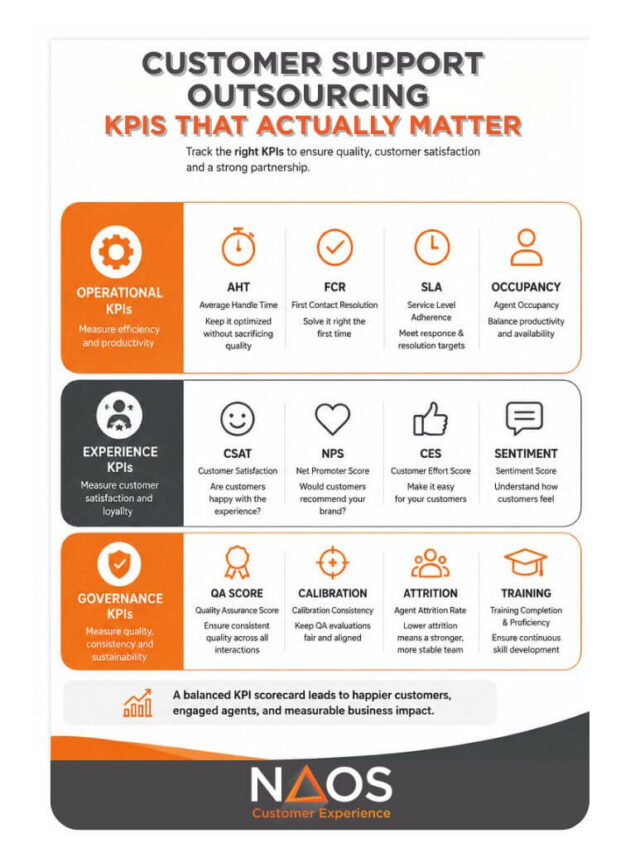
Operational KPIs: AHT, FCR, SLA, occupancy
Operational KPIs answer the question, Is the engine running? They include Average Handle Time (AHT), First Contact Resolution (FCR), SLA adherence on response and resolution times, and agent occupancy. Healthy targets vary by industry, but a well-run partnership typically delivers FCR above 75% and SLA adherence above 95% within agreed response windows.
A common mistake is to optimize AHT in isolation. Shorter calls are not better calls if customers come back twice. Always read AHT alongside FCR and CSAT, never on its own.
Experience KPIs: CSAT, NPS, CES, sentiment
Experience KPIs answer a different question: Is the engine delivering the brand promise? CSAT (Customer Satisfaction), NPS (Net Promoter Score), and CES (Customer Effort Score) are the foundation. CSAT should be at 90% or higher for tier-1 support in most industries.
Zendesk’s annual research confirms that CX quality remains a competitive differentiator, with the majority of consumers expressing satisfaction with brands that invest in human-centric service (Zendesk CX Trends 2024). Outsourced teams should be held to the same — or higher — experience targets as internal ones.
Governance KPIs: QA score, calibration, attrition
The third KPI family is the one most often missing from outsourcing scorecards, and the one that matters most for control. Track the internal QA score (target ≥ 85 %), the calibration alignment between client and partner reviewers, agent attrition (a runaway figure here is the earliest warning sign of trouble), and the percentage of escalations resolved at level one.
Governance KPIs are leading indicators. Operational and experience KPIs are lagging indicators. A controlled operating model watches all three every month.
How to Choose a Partner Without Losing Your Brand Voice
Brand-voice onboarding & training rituals
Brand voice is not transferred in a kickoff meeting. It is transferred through rituals: a brand-voice workshop, recorded examples of “good” and “bad” interactions, role-play certifications, and shadow-listening sessions in the first 90 days. A partner that resists this depth of onboarding is not the right partner.
The single best predictor of brand-aligned service after go-live is the time the partner invested in your knowledge base, your decision trees, and your tone-of-voice library before the first ticket was handled.
Red flags that signal future loss of control
A few warning signs surface early in the sales process. Watch for vendors who quote only per-minute or per-FTE pricing without discussing KPIs. Watch for opaque QA processes, a refusal to name the operations manager for your account, vague answers about labor-law compliance, and resistance to shared dashboards. Each is a leading indicator of future loss of control.
A structured way to assess vendors is laid out in our 2026 vendor scorecard and red flags, used by CX leaders evaluating new providers.
Article at a glance
| – | What CX leaders need to know |
| Challenge | Fear of losing control over brand voice, quality, and customer data when outsourcing support. |
| Definition | Customer support outsourcing is a controlled operating model — the client owns strategy, the partner owns execution. |
| Key benefits | 24/7 scalability, predictable cost-per-contact, faster ramp-ups, stronger QA discipline, no recruitment burden. |
| Best practices | Document brand voice, co-design SLAs, weekly QA calibration, shared dashboards, dual escalation paths. |
| KPIs to track | CSAT, FCR, SLA adherence, QA score, attrition, AHT, NPS, % escalations resolved at L1. |
| Common mistakes | Outsourcing without a governance charter, paying only per-minute, no calibration sessions, no brand-voice training. |
| NAOS CX angle | A transparent, labor-law-compliant partner that operates as an extension of your team — not a black box. |
Conclusion
Customer support outsourcing should never feel like letting go. Done well, it is a deliberate redistribution of work — strategy stays with you, execution scales with a partner, and governance keeps both sides honest.
Are you considering outsourcing customer support in the coming quarters but worried about keeping your hands firmly on the wheel? Talk to the NAOS CX experts about building a controlled operating model that protects your brand, your data, and your customers from day one — contact our team here.
Frequently Asked Questions
Does customer support outsourcing mean losing control of my brand?
No. With the right operating model, you keep full ownership of brand voice, escalation policies, and performance standards. The outsourcing partner runs daily execution under your governance framework, with shared KPIs, QA calibration, and live dashboards giving you more visibility than most in-house teams.
What is the difference between customer support outsourcing and BPO?
BPO is the broader category covering any business process delegated to a third party. Customer support outsourcing is a specialized BPO segment focused on inbound and outbound customer interactions — live chat, phone, email, and social — with dedicated CX KPIs such as CSAT, FCR, and SLA adherence.
Which customer support functions should I outsource first?
Start with high-volume, well-documented workflows: tier-1 inquiries, after-hours overflow, FAQ-driven live chat, and back-office tasks like order processing. Keep VIP accounts, complex escalations, and voice-of-customer analysis in-house until the partner has proven its quality and your governance rituals are stable.
What KPIs prove that outsourced customer support is working?
Track a balanced scorecard: CSAT and NPS for experience, FCR and SLA adherence for operations, QA score and calibration consistency for quality, and agent attrition for sustainability. A healthy partnership shows CSAT ≥ 90%, QA ≥ 85%, and attrition below the industry average.
How long does it take to onboard a customer support outsourcing partner?
A typical onboarding runs 6 to 12 weeks: discovery and brand-voice workshops, knowledge-base build, agent training and certification, a pilot phase with daily calibration, then a steady state with weekly business reviews. Rushing under six weeks usually leads to quality gaps and the very loss of control leaders fear.