
Handling customer complaints is an inevitable part of any business, regardless of its nature or size. The grievances possess immense power to dismantle an entire organization in no time, making them an undeniable force to be reckoned with.

Even though handling complaints can be challenging, it is also a great opportunity for businesses to grow, develop, and build stronger bonds with their clients. Adopting a mindset that treats client complaints as opportunities to enhance products/services and strengthen relationships is crucial. The secret is to properly evaluate and address customer concerns to prevent them from recurring.
So, dear reader, are you ready to embrace complaints, understand their power, and transform them into a stepping-stone toward delivering first-class customer service? Then let’s dive in and explore how to handle customer complaints in a way that will make your customers love you, even when they’re mad!
Complaints Have The Power!
Despite the best efforts put into customer service strategies, unexpected complications may arise. Regrettably, this may lead to customer grievances. But here’s an interesting fact—these grievances, these potent seeds of discontent, have the remarkable potential to blossom into exceptional opportunities.
Common customer complaints include poor experiences with products or services, unavailability or out-of-stock items, long waits on hold, and products breaking down or not performing as they should.
Risks Of Not Properly Handling Customer Complaints
Poor customer service may negatively affect the overall health of your business. Sales may suffer in the short term, and your company may experience various long-term effects. Don’t let bad customer service break your business; it can ruin your reputation or brand.
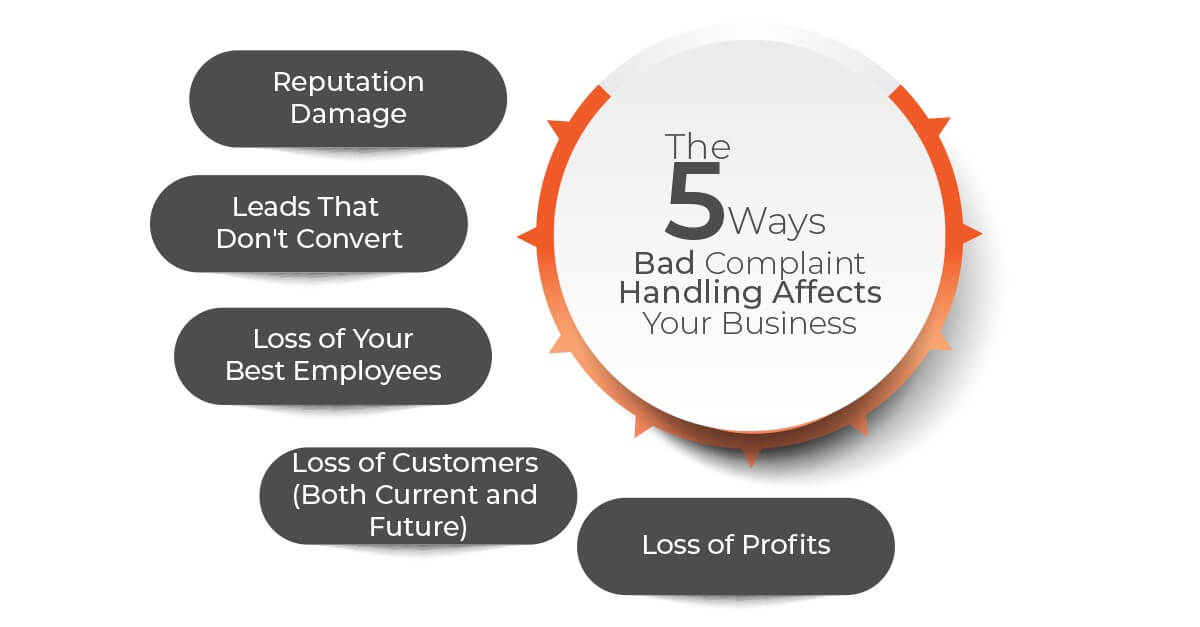
Reputation Damage
A poor customer service experience can seriously harm your reputation if your organization is online. Whether it’s through a poor comment, a furious tweet, a post on Facebook, or something else entirely, dissatisfied consumers frequently take to their keyboards to express their anger online.
Customers are more likely to leave a review after a negative experience than a positive one.
Leads That Don’t Convert
Imagine this: You’re a customer inquiring about a product or service and never receive a response. How annoyed would you be? Would you be likely to return to that business in the future?
The answer is most likely no. If you wouldn’t do it, why would your customers?
Loss of Your Best Employees
When some employees aren’t willing to take on their share of responsibility, other employees will be forced to take on their roles.
As you know, this can lead to resentment and anger from employees who are left doing jobs and taking on responsibilities that aren’t theirs. Thus, they may become fed up and decide to leave their positions.
Loss of Current and Future Customers
Word of mouth spreads quickly. When it’s negative, sadly, it spreads like wildfire.
One angry tweet or negative online review about poor service might cost you many clients. Therefore, address those irate reviewers and resolve problems as soon as you can.
Why not consider investing in your call analytics if you don’t want to lose any more customers? You’ll be able to listen in on your calls to see how your staff members respond to angry clients and make improvements.
Reduction of Profits
When you lose customers, you lose sales. And lost sales equal a loss of profits.
Depending on the severity of your customer loss, the resulting loss of profits could have a lasting impact on your business’s financial health.
When A Client Leaves Negative Feedback, He Still Leaves You A Chance!
Looking On The Bright Side: The Benefits of Handling Customer Complaints
Do not fear disgruntled customers. Do not avoid their ire. These expressions of dissatisfaction shed light on flaws that may be hidden within your operations, waiting to be addressed. And more importantly, when a customer complains, they are extending a second chance to your organization, an opportunity to make things right and regain their loyalty. According to Help Scout’s Customer Service Statistics, only 1 in 26 customers actually tell a business about a negative experience. The majority just decide to leave without providing any feedback.
When customer complaints roll in, it’s crucial to listen to customer complaints as they present valuable opportunities, such as:
- they highlight key areas where your products or services need improvement,
- and provide valuable insights into how trained your front-line support is and how to improve them,
- and accordingly, you can boost customer communication,
- which will lead to enhanced customer satisfaction,
- and have a positive impact on brand image.
Efficiently Handling Complaints: Recognizing the Type of Complainers
There are three types of complainers when clients aren’t happy with your service: Aggressive, Expressive, or Constructive.
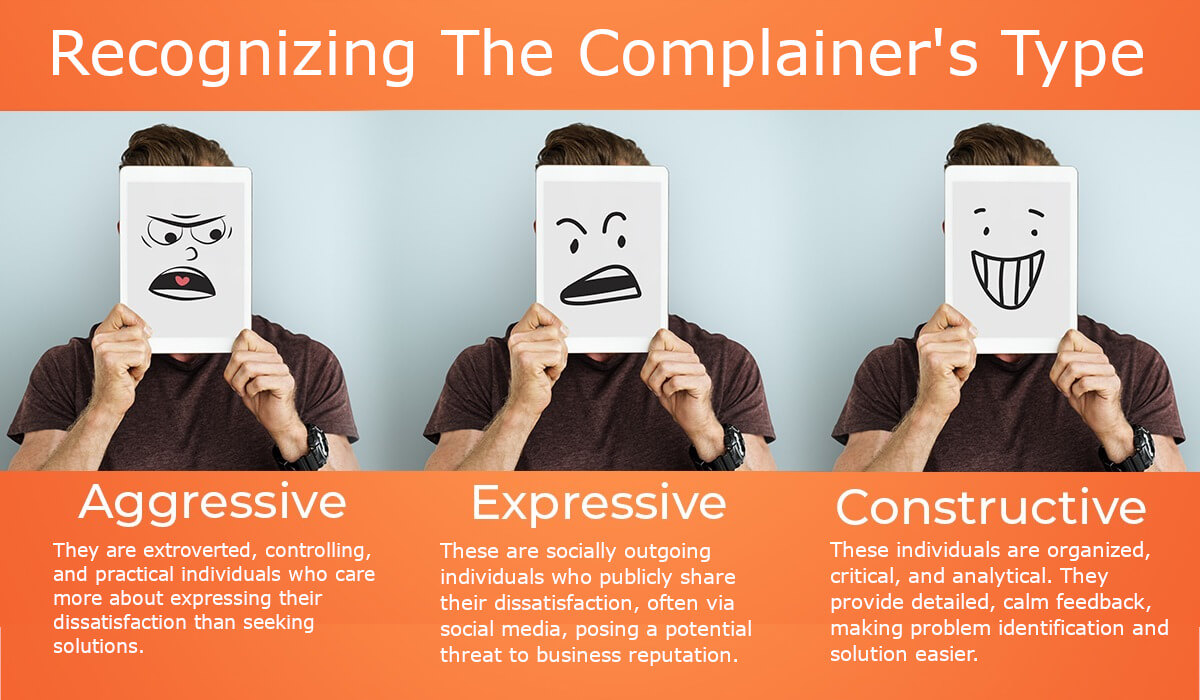
Aggressive Complainers
They are extroverts who are controlling, practical, and determined. Get right to the point and skip the small talk if you want to connect with them. Provide them with choices so they feel in charge. They are the hardest to satisfy because they frequently care more about showing off their feelings than finding a solution.
Here is a short dialogue with an Aggressive Complainer inspired by real-life examples in the contact center:
- Aggressive Complainer: “I’ve been on hold for an hour, and now you’re telling me you can’t process my return? This is ridiculous!“
- Customer Service Representative (CSR): “I understand how frustrating this is for you, and I apologize for the inconvenience. We have two possible solutions here. We can start the return process now, or I can schedule a callback at your convenience to address this. Which would you prefer?“
=> We try to acknowledge their feelings and offer them choices, helping them feel in control of the situation.
Expressive Complainers
Because of their social nature, outspoken clients are more likely to voice their complaints to others—possibly without coming to you. They can be lethal to a business’s success, as they may express their dissatisfaction on social media, making their complaint public. This leaves no opportunity to address the dissatisfaction, so you should provide a rapid, public, and favorable reply.
Here is a short dialogue to illustrate this type of complainer:
- Expressive Complainer: “I’ve told all my friends about the terrible service here. I can’t believe how slow and unresponsive your team is!“
- CSR: “I’m really sorry to hear about your experience. It’s crucial for us to keep our customers satisfied. Let’s see how we can make this right. I’ll escalate your issue immediately to ensure it gets resolved promptly.“
This shows how quickly and publicly responding to expressive complainers can turn a potentially harmful situation into a constructive one.
Constructive Complainers
They are organized, critical, and perfectionist, and can suffer from analysis paralysis. Give them plenty of detail and proof to win them over. Constructive complainers are most beneficial to a business since they are analytical and address their problems calmly, rationally, and in detail. You can identify the exact cause of the problem, making it easier to handle and helping you avoid future problems.
Here is a short dialogue to illustrate this Constructive Complainer type:
- Constructive Complainer: “I’ve noticed that every time I use your website, it’s slow, and my orders take longer to process than on other sites. I think there might be an issue with your server speed.“
- CSR: “Thank you for your detailed feedback. We appreciate customers like you who help us identify potential issues. I’ll immediately share this with our tech team so they can look into it. In the meantime, can I assist you with placing your order through another method?“
In this example, the CSR validates the constructive complainer’s feedback and uses the information to improve the company’s service.
In conclusion, recognizing the three types of complainers – the Aggressive, the Expressive, and the Constructive – is paramount to handling customer complaints effectively. By understanding their unique characteristics, you can tailor your response to meet their specific needs, mitigate potential damage, and even transform a complaint into an opportunity for improvement. Identifying and responding appropriately to complaints is a critical skill that every customer service agent must possess to enhance customer satisfaction and contribute to business success.
Not Just Symptoms: Facing the Root Cause of Customer Complaints
Problems happen! They don’t happen accidentally but can come from anywhere, inevitably leading to a customer complaint. Hence, when you know the root cause of the complaint, you can determine where the problem lies and why it happened, and then solve it more easily.

One of the best practices to improve your complaint management process is to conduct a Root Cause Analysis (RCA) for each complaint. It is a systematic method for identifying and addressing the underlying factors that caused the problem, rather than just fixing the symptoms.
Every time a customer complains, they provide enough data to help identify the root cause of the problem. Engagement analytics helps you to analyze every interaction automatically. They can help identify customers’ routes to complain and the words and phrases associated with complaints. The analysis can show you whether you make a bad situation worse by having an ineffective call routing system or insufficiently trained agents who lack empathy when handling complaints.
The Pivotal Role of Customer Service Agents in Handling Complaints
The role of a customer service agent in complaint handling is of utmost importance, as their responses can make or break the customer relationship. They play a pivotal role in complaint handling, serving as a business’s first line of defense in addressing client issues. Hence, they often bear the brunt of a customer’s dissatisfaction, even when they weren’t directly responsible for the issue. They must do everything possible to guarantee the client’s total satisfaction.

Some aspects show the significance and the deep impact of the customer service agent role on the business as follows:
- Customer Retention
Customers expect a swift and satisfactory resolution when they have complaints or issues. A customer service agent plays a crucial role in addressing these concerns effectively. Providing prompt assistance, empathy, and appropriate solutions can help retain dissatisfied customers, preventing them from switching to competitors and maintaining long-term loyalty.
- Customer Satisfaction
Resolving complaints satisfactorily enhances customer satisfaction. A skilled customer service agent can listen actively to customers, empathize with their concerns, and demonstrate a genuine willingness to help. Taking ownership of the situation and offering effective solutions can turn a negative experience into a positive one, leaving the customer satisfied and potentially even more loyal.
- Reputation Management
Complaints can spread quickly through various channels, such as social media, online reviews, and word of mouth. By handling complaints professionally and resolving them to the customer’s satisfaction, customer service agents contribute to positive reputation management. Satisfied customers are likelier to share their positive experiences, which can help build a strong brand reputation and attract new customers.
- Brand Loyalty and Advocacy
Exceptional complaint handling can turn dissatisfied customers into brand advocates. Customers may become more loyal to the brand when they feel their complaints have been adequately addressed. Moreover, satisfied customers who receive excellent service during complaint resolution are more likely to recommend the company to others, positively impacting the brand’s image and acquiring new customers through positive word-of-mouth.
- Feedback for Improvement
Customer complaints often highlight areas where a company can improve its products, services, or processes. Customer service agents act as a crucial bridge between customers and the company, relaying feedback and insights gathered during complaint handling. Companies can make necessary changes, rectify shortcomings, and enhance their offerings by identifying recurring issues and patterns.
- Relationship Building
The customer service agent’s role extends beyond complaint resolution. It involves building relationships with customers, establishing trust, and ensuring open lines of communication. Agents can strengthen the customer-company relationship by actively engaging with customers, providing personalized assistance, and demonstrating genuine care. This can lead to increased customer loyalty and repeated business in the future.
Key Training Areas for Effective Customer Complaint Management
Successful complaint resolution depends on well-trained customer service agents. Their skills in empathy, active listening, problem-solving, effective communication, and knowledge of policies and products are vital to managing complaints. These skills ensure a quick, effective resolution while maintaining a customer-focused, responsive approach.

- Empathy and Understanding
These are critical to customer satisfaction. When customers feel valued and heard, their loyalty increases, boosting the business’s reputation. To foster this, agents need training in active listening to effectively address different types of complaints.
- Active Listening
Essential for complaint management, it involves focusing on the customer’s words, avoiding distractions, and confirming understanding. Techniques include paraphrasing, asking clarifying questions, and summarizing.
- Problem-Solving Skills
Identifying underlying issues that trigger complaints allows agents to prevent their recurrence and offer the best solutions. Creative resolutions, such as discounts, free upgrades, or alternative plans, demonstrate the company’s commitment to resolving complaints.
- Effective Communication
Clear, polite, and concise communication can reduce the impact of complaints. By improving how agents communicate, businesses can save costs and reduce disruptions from complaints.
- Knowledge of Policies and Products
Comprehensive knowledge of the company’s offerings can enhance customer satisfaction, improve brand perception, and make agents more confident. Providing accurate information to customers can boost trust and sales. Misinformation, on the other hand, can erode brand reliability.
Ongoing Training and Evaluation: The Backbone of Exceptional Customer Service
“The only thing worse than training your employees and having them leave is not training them and having them stay.” — Henry Ford
Ongoing training and regular evaluation are crucial for customer service agents to maintain and improve their skills, provide excellent customer experiences, and contribute to a company’s success.
Here are several reasons why these practices are important, and by investing in these practices, companies can build a strong customer service team and cultivate long-term customer relationships.
- Skill Development: enhance the team’s knowledge, learn new techniques, and stay current with industry trends.
- Adaptability: adapt to changing needs and circumstances, learn how to handle new products or services, use updated software and systems, and adjust their communication style to cater to different customer demographics.
- Customer Satisfaction: provide prompt, accurate solutions to customer queries and address concerns more effectively, reducing customer frustration and increasing satisfaction.
- Consistency: maintain consistent performance standards by monitoring their interactions, evaluating their responses, and identifying areas for improvement.
- Efficiency and Productivity: optimize their workflows, adopt efficient practices, and learn time management techniques, multitasking skills, and effective use of tools and resources.
Importantly, the key ingredients of effective complaint management are sincerity, humility, and conciliation. If there’s a slip-up, agents must learn to resist the temptation to shift the blame onto external factors or sheer misfortune. Instead, they have to step up, take responsibility, and offer a heartfelt apology to customers. They not only deserve it, but they are also likely to appreciate your honesty and offer swift forgiveness.
Laying the Groundwork: Tips for a Successful Customer Service Training Program
Consistency in performance and continuous improvement are key to successful customer service, and this can be achieved by creating a continuous training program that empowers your customer service agents, enhances their skills, and contributes to the overall success of your customer service team.
Ten Practical Tips to Establish an Effective Training Program
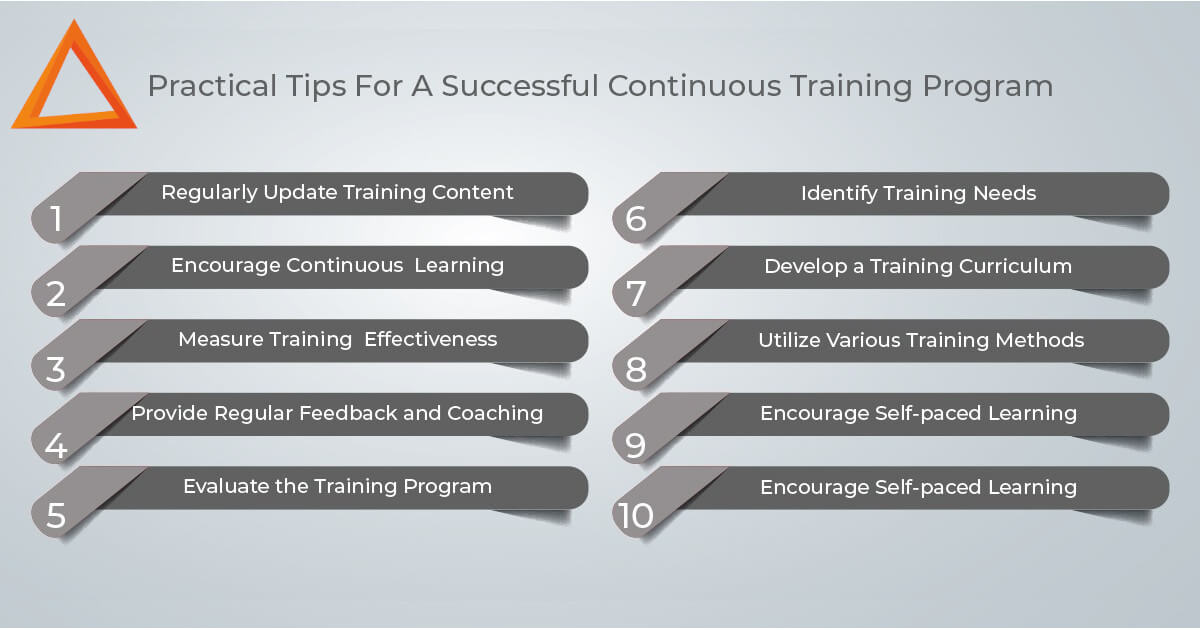
1- Identify Training Needs
Begin by assessing your customer service agents’ current skill levels and knowledge gaps. Conduct surveys, analyze customer feedback, and gather insights from team leaders to identify areas that require improvement. This assessment will help you tailor the training program to address specific needs.
2- Develop a Training Curriculum
Based on the identified training needs, design a comprehensive curriculum that covers essential topics such as product knowledge, communication skills, problem-solving techniques, and customer empathy. Break down the curriculum into modules or courses that can be delivered in a structured manner.
3- Utilize Various Training Methods
Incorporate a mix of training methods to cater to different learning styles and preferences. Combine classroom-style training sessions, interactive workshops, e-learning modules, role-playing exercises, and real-life simulations. Use multimedia tools such as videos, quizzes, and case studies to make the training engaging and interactive.
4- Encourage Self-paced Learning
Offer self-paced learning opportunities so customer service agents can learn at their convenience. Provide access to an online Learning Management System (LMS) for training materials, modules, and resources. This flexibility enables agents to manage their training alongside their daily responsibilities.
5- Provide Practical On-the-job Training
In addition to theoretical training, ensure that agents receive practical on-the-job training. Pair them with experienced agents or mentors who can provide guidance, shadowing opportunities, and real-time feedback. Hands-on experience is crucial for agents to apply their knowledge and skills in real customer interactions.
6- Regularly Update Training Content
Customer service practices and technologies evolve. It’s important to keep the training content up to date to reflect current industry trends, new products or services, and changes in customer expectations. Regularly review and update the training curriculum to ensure its relevance.
7- Encourage Continuous Learning
Foster a culture of continuous learning among customer service agents. Encourage them to seek additional resources, attend relevant webinars or industry conferences, and participate in online forums or communities.
8- Measure Training Effectiveness
Establish metrics to evaluate the effectiveness of your training program. Monitor key performance indicators (KPIs) such as customer satisfaction scores, first-call resolution rates, average handling time, and agent feedback. Analyze the data to assess the training’s impact and identify areas for improvement.
9- Provide Regular Feedback and Coaching
Continuous evaluation and feedback are essential for agents’ growth. Schedule regular one-on-one coaching sessions with team leaders or supervisors to discuss performance, provide constructive feedback, and set improvement goals. Recognize and reward agents who demonstrate exceptional skills and consistently deliver outstanding service.
10- Evaluate the Training Program
Periodically review the effectiveness of your training program. Collect feedback from agents, team leaders, and customers to gauge the program’s impact. Use this feedback to refine and enhance the training curriculum, delivery methods, and overall program structure.
How Superior Complaint Handling Can Make All the Difference.
Superior complaint handling has a significant impact on the overall customer experience. Effectively addressing customer complaints can turn a negative situation into a positive one, build customer loyalty, and enhance a company’s reputation.

Promptly and satisfactorily resolving customer complaints demonstrates a commitment to customer satisfaction. When customers feel heard, understood, and their issues are resolved satisfactorily, it leaves a positive impression. It shows that the company values its customers and their concerns, leading to increased customer satisfaction.
Customers who resolve their complaints effectively are likelier to remain loyal to a brand. Going the extra mile to address a customer’s complaint can profoundly impact their loyalty to a company. Customers are more likely to recommend a company that effectively resolves complaints, thereby contributing to a positive brand reputation. This can lead to increased customer referrals and new business opportunities.
In a competitive marketplace, superior complaint handling can differentiate a company from its competitors. By consistently delivering exceptional complaint resolution experiences, a company can stand out and gain a competitive edge.
Conclusion
The risks of mishandling complaints are very harmful to any business, including reputational damage and loss of customers and profits. Every business needs to pay closer attention to the role of customer service agents in complaint handling and prioritize effective complaint management to ensure customer satisfaction, loyalty, and business success.
The role of customer service agents in complaint handling is critical, and they have a wide impact on customer retention, satisfaction, reputation management, brand loyalty, trust, opportunities for improvement, and the creation of customer advocates. Therefore, having a well-trained team of contact center agents will lead to superior complaint handling and a better customer experience, driving business success.
Here at NAOS CX, we provide expert agents who can level up your customer service process in every way to deliver outstanding customer results. Contact us now for more details and to see our success stories with a range of clients.

2 comments
Pingback: Order Management: E-commerce Profitability in 2026 | CX Blog
Pingback: Pro Tips to Manage Business Reviews | NAOS Solutions
Comments are closed.